|
Getting your Trinity Audio player ready...
|
Circle has put numbers on a debate that has been building among stablecoin issuers: who earns what when a dollar token grows. In a blog post published October 16, Circle’s chief commercial officer, Kash Razzaghi, laid out first-half 2026 figures and argued that USDC’s partners capture most of its economics. The post responds to unnamed new entrants that, in Circle’s telling, claim issuers keep too much and charge too much to redeem.
Where the money goes
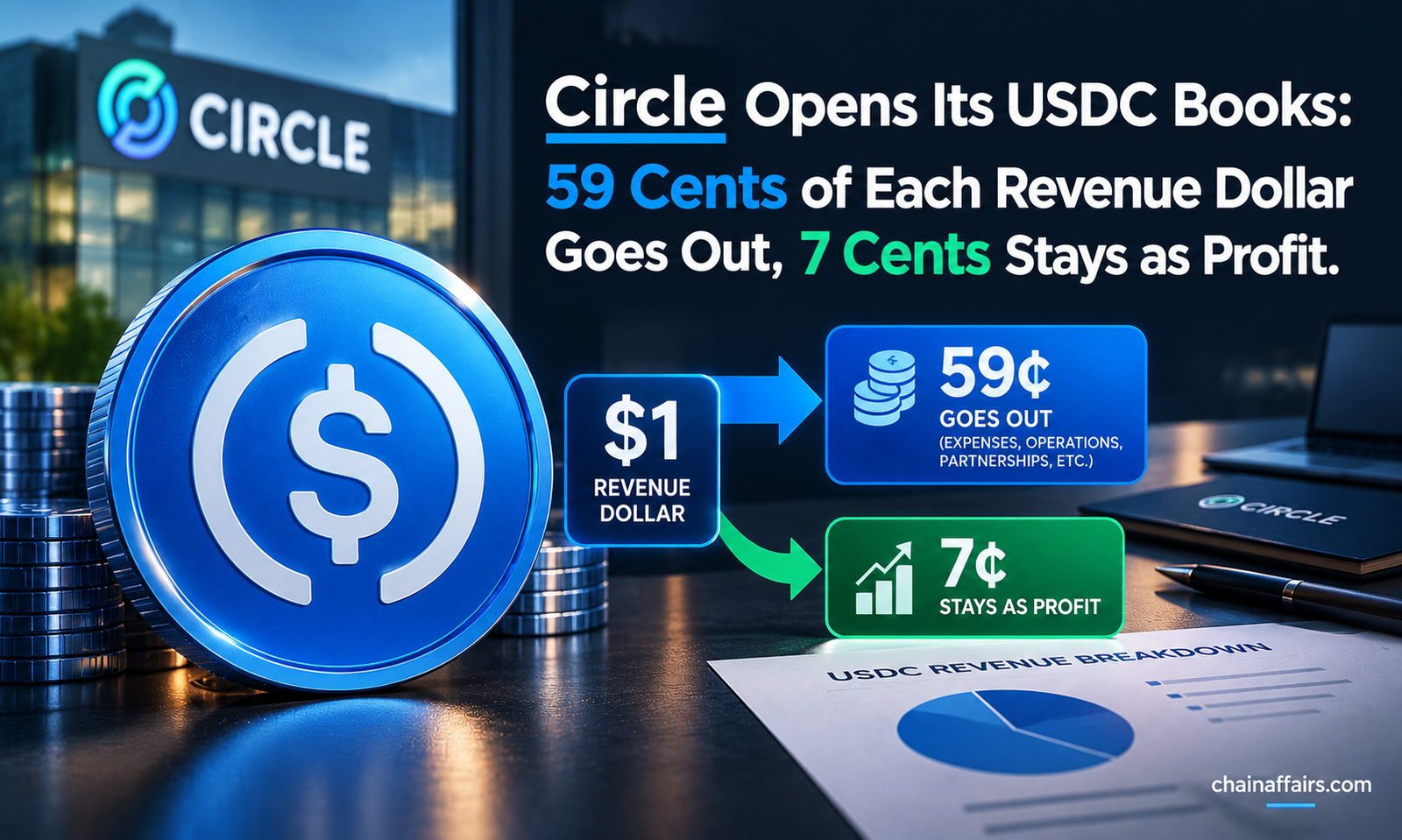
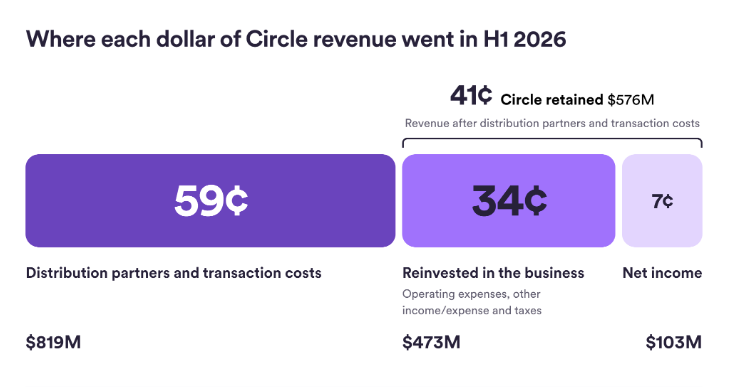
Circle reports about $1.4 billion in revenue for the first half of 2026. Roughly $819 million of that went to distribution partners and transaction costs, which Circle puts at about 59 cents of each revenue dollar. Another $473 million, about 34 cents, went back into licenses, banking relationships, settlement liquidity, compliance, new products and blockchain integrations. That leaves around 7 cents of net profit per dollar.
One detail deserves attention. The 59% figure combines partner payouts with transaction costs, and the post doesn’t separate them. Readers can’t tell from the page how much reaches partners alone.
Scale and share
The post says USDC settled more than $36 trillion in onchain transaction volume in the first half. Circle minted and redeemed over $315 billion, about $1.7 billion a day, and says USDC carried roughly 77% of global stablecoin transaction volume in June, up from 60% a year earlier. That’s a share of transaction volume, not of supply or market capitalization, and the post gives no supply figure.
Coinbase, described as the largest and longest-standing partner, reported average USDC held in its products reached a record $20 billion in the second quarter, up 44% year over year. Circle also says Binance signed a five-year commercial agreement and invested $100 million in September, and that more than 150 other partners have an economic stake in USDC’s growth.
How partners earn, and the redemption claim
Partners earn in two ways, according to Circle. Distribution partners that hold and grow USDC balances share in the reserve income those balances generate, with larger balances earning a bigger share. Customers who build on the Circle Platform, including the Circle Payments Network, Arc, Circle Mint and Circle Wallets, can redeem for free in near real time.
Circle says every customer has always been able to redeem for free through standard banking rails, with settlement in up to two business days. It reports redeeming $71.8 billion in the first quarter, roughly 90% of the supply then outstanding, and combined mint and redemption volume of $170 billion in the second quarter, up 105% year over year. Near-real-time settlement, the post explains, depends on cash held at bank partners and kept liquid, which earns less than Treasuries. Circle says it doesn’t charge for that cost when customers participate in the network.
The case for the infrastructure bill
The central argument is that a stablecoin’s usefulness costs money, and Circle’s reinvestment line is the proof. It lists more than 55 licenses and registrations, including a U.S. national trust bank charter and MiCA compliance, relationships with over 25 partner banks, compliance programs covering 185 countries, deployments on more than 35 blockchains, and reserves held in a government money market fund managed by BlackRock and custodied at BNY, with monthly attestations.
Also Read: IOTA Q3 2026 Update: Faster Finality, Verifiable Nodes and a Real-World Trade Push
What to read carefully
The post is a defense of Circle’s model, aimed at rivals it doesn’t name, so the claims about competitors can’t be checked here. The financials are company-reported for a half-year, and the 7% net margin is a single-period figure. Independent confirmation should come from Circle’s investor filings and public reserve attestations.
What the post does make clear is where the competition now sits. Stablecoin issuers are bidding for distribution, and the fight is over how much of the reserve income they hand to the businesses that bring them users.
Disclaimer: The information in this article is for general purposes only and does not constitute financial advice. The author’s views are personal and may not reflect the views of Chain Affairs. Before making any investment decisions, you should always conduct your own research. Chain Affairs is not responsible for any financial losses.

I’m your translator between the financial Old World and the new frontier of crypto. After a career demystifying economics and markets, I enjoy elucidating crypto – from investment risks to earth-shaking potential. Let’s explore!