
|
Getting your Trinity Audio player ready...
|
Michael Saylor, executive chairman of Strategy Inc. (Nasdaq: MSTR), says bitcoin investors do not all want the same outcome. In comments shared Oct. 4, he framed BTC as the choice for ownership, MSTR for amplified exposure, and STRC for dollar dividends.
Volatility Data Shows an 85-Point Gap
Saylor backed the pitch with a chart dated Oct. 2 that shows historical volatility of 94% for MSTR, 39% for BTC, and 9% for STRC. Subtracting STRC from MSTR yields an 85-percentage-point spread. MSTR’s reading was roughly 2.4 times BTC’s and more than 10 times STRC’s.
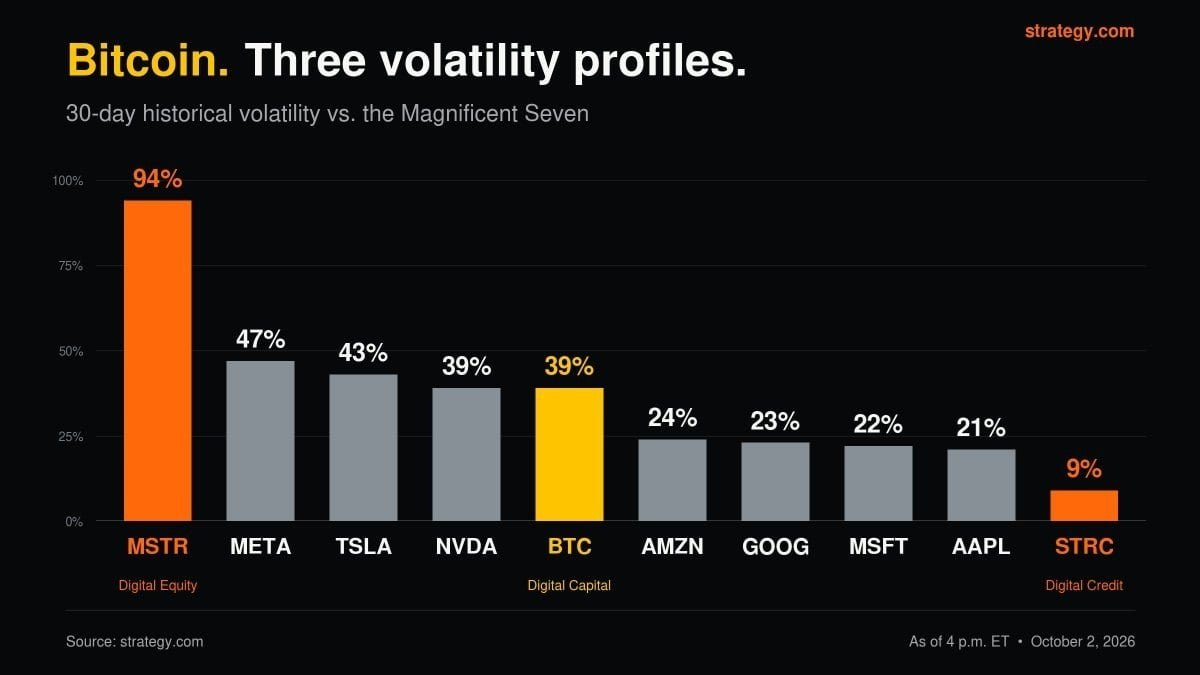
Strategy annualizes daily price fluctuations over the last 30 trading days and uses BlackRock’s IBIT as its bitcoin proxy. The figures describe past price behavior, not returns or future outcomes.
Saylor also said STRC offers income with less 30-day volatility than every Magnificent Seven stock. Those stocks range from Apple’s 21% to Meta’s 47%, all above STRC’s 9%.
Three Securities, Three Different Claims
Each product gives investors a different financial right. Buying BTC means owning the asset itself on a decentralized network. MSTR holders own part of Strategy, not its coins directly, and the shares carry potentially larger gains and losses.
STRC holders own preferred stock, which ranks ahead of common shares for dividends and liquidation proceeds. Debt holders still rank ahead of STRC. According to the offering terms, dividends are cumulative, so unpaid amounts accumulate. Payments still require legally available funds and board declarations.
Saylor calls BTC “digital capital,” the foundation for what he terms digital equity and digital credit. In that framework, MSTR represents ownership in the business and STRC a claim on dividend payments.
Also Read: Michael Saylor Reveals Why Strategy Sold Bitcoin — The Reason May Surprise Investors
How STRC Generates Income
STRC uses a variable dividend that is adjusted monthly to encourage trading near its $100 stated amount. The annualized rate is 12% for October, paid in cash twice a month. That equals $12 per share per year if the rate holds, though the actual yield depends on the purchase price.
The income comes from Strategy’s funding, not the Bitcoin network, since holding bitcoin generates no interest or dividends. The preferred shares are not collateralized by the company’s coins, and lower historical volatility does not guarantee principal repayment.
What Investors Should Weigh
Saylor’s broader argument is that investors can take part in a bitcoin-focused business without all holding the same instrument. His longer-term view envisions bitcoin as global digital capital with financial products built around it by 2036.
For readers, the key takeaway is that lower volatility is not the same as lower risk. STRC’s smoother price path depends on Strategy’s ability to keep funding dividends, while MSTR and BTC carry swings that reflect their very different exposures.
Disclaimer: The information in this article is for general purposes only and does not constitute financial advice. The author’s views are personal and may not reflect the views of Chain Affairs. Before making any investment decisions, you should always conduct your own research. Chain Affairs is not responsible for any financial losses.

I’m the cryptocurrency guy who loves breaking down blockchain complexity into bite-sized nuggets anyone can digest. After spending 5+ years analyzing this space, I’ve got a knack for disentangling crypto conundrums and financial markets.