
|
Getting your Trinity Audio player ready...
|
- Audit Trails anchors hashes, metadata, and event order onchain — not the sensitive documents themselves — so outside parties can confirm a record’s authenticity without organizations giving up data privacy.
- Governance is built into the ledger, not bolted on: Role-based permissions and time- or address-bound capability objects let organizations control exactly who can add, tag, or delete records, turning a simple log into an auditable chain of custody.
- With ready-made examples for supply chains, customs clearance, and clinical trials, Audit Trails targets workflows where multiple outside parties — regulators, partners, auditors — need to verify the same history independently.
IOTA rolled out Audit Trails last month, an open-source tool that lets organizations anchor the history of a business process — not just a single record — on a public ledger. The alpha release, part of the IOTA Notarization toolkit, shipped with a Move package, a Rust SDK, and WebAssembly bindings for JavaScript and TypeScript developers, and has since been available for teams to test against real workflows.
The Problem: Records That Can’t Be Trusted Across Organizations
Most companies track their operations through a patchwork of databases, spreadsheets, and internal logs. That works fine inside a single organization, but it breaks down the moment a regulator, partner, insurer, or customer needs to confirm that a record is genuine. Internal systems can be edited, backfilled, or disputed, and outside parties are typically left trusting an exported report rather than verifying the underlying data themselves.
Audit Trails is designed to close that gap. Rather than storing sensitive documents onchain, the tool anchors the events, hashes, and metadata tied to a workflow, giving outside parties a way to independently confirm who did what, when, and under what authority — without exposing confidential source material. Original documents and personal data stay off-chain by design; only proofs of their existence and order go on the ledger.
Also Read: IOTA Is Building the Green Case for Web3 And the Numbers Back It Up
Governance Built In, Not Bolted On
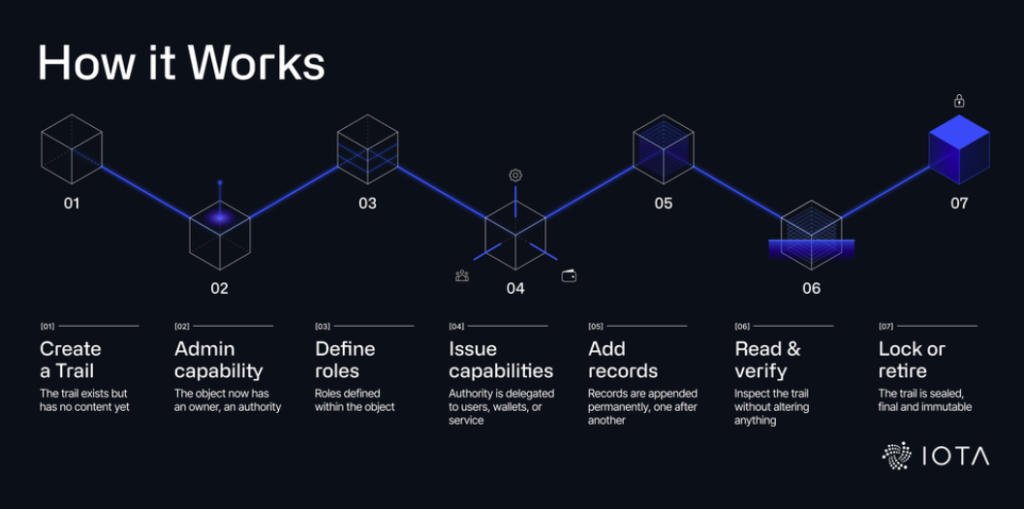
What sets Audit Trails apart from a simple onchain log is its governance layer. Each trail supports role-based access control, meaning organizations can define exactly who is allowed to add records, delete them, manage tags, or lock the trail entirely. Permissions are granted through capability objects — onchain credentials that can be tied to a specific wallet address or limited to a set time window.
A typical deployment starts with an administrator creating the trail and receiving an admin capability. From there, the administrator defines roles such as RecordAdmin or TagAdmin and issues capabilities to the people, services, or automated systems responsible for adding data. Every record is appended in sequence, optionally tagged and time-bound, and can be inspected by any authorized verifier through read-only tools — no write access required.
Where It’s Meant to Be Used
IOTA is pitching the tool at industries where records routinely cross organizational lines and carry regulatory weight. In supply chains and digital product passports, manufacturers could log inspections and lifecycle events that follow a product from production to end of life. Legal and compliance teams could build tamper-evident histories of approvals and filings. Customs authorities could coordinate multi-party clearance steps, and IoT systems could record machine and sensor events with clear provenance.
The Notarization repository already includes working examples for customs clearance, clinical trials, and digital product passports, giving developers a template rather than a blank slate.
Availability
A month in, Audit Trails remains available for testing on the IOTA Testnet, with Mainnet deployment open to teams ready to move past experimentation. IOTA says the broader goal is straightforward: replace reconciled, after-the-fact logs with a single shared history that every participant in a workflow can verify independently.
Disclaimer: The information in this article is for general purposes only and does not constitute financial advice. The author’s views are personal and may not reflect the views of Chain Affairs. Before making any investment decisions, you should always conduct your own research. Chain Affairs is not responsible for any financial losses.

I’m your translator between the financial Old World and the new frontier of crypto. After a career demystifying economics and markets, I enjoy elucidating crypto – from investment risks to earth-shaking potential. Let’s explore!