
|
Getting your Trinity Audio player ready...
|
- Salus tokenizes warehouse receipts and bills of lading as NFTs on IOTA, making shipment ownership verifiable by any authorized participant across jurisdictions in real time.
- Smart contracts automate payment triggers — inspection clearance, geolocation confirmation, insurance — removing the manual steps that slow trade finance cycles.
- The platform targets alternative capital sources (DeFi funds, stablecoin pools) that could finance commodity trade but currently lack the verification layer to do it safely.
A startup called Salus is using IOTA’s blockchain infrastructure to digitize trade finance for critical minerals — copper, lithium, rare earths — where slow payments, paper documents, and shrinking bank appetite have created a financing bottleneck at exactly the moment global demand is accelerating.
The Problem Salus Is Solving
Banks are pulling back from commodity trade finance. The gap between what businesses need to move goods across borders and what lenders actually provide now exceeds $2.5 trillion globally. Smaller funders — DeFi pools, stablecoin investors — could fill part of that gap, but won’t without reliable verification of what they’re financing.
Critical minerals make the problem acute. A lithium shipment crossing three jurisdictions involves inspectors, freight forwarders, customs officials, insurers, and buyers — each working from different documents, none of which are easily verified by the others. Fraud risk is high. Financing is expensive and slow.
How Salus Uses IOTA and TWIN
Salus runs on IOTA’s Trade Worldwide Information Network (TWIN), a shared data infrastructure built for cross-border coordination. The integration covers four functional layers:
Identity. Every participant in a Salus transaction — suppliers, buyers, inspectors, even individual containers — gets a decentralized identifier (DID) anchored on the IOTA ledger. No central authority manages these; they’re verifiable by anyone with access to the network, and they satisfy KYC and AML requirements across jurisdictions.
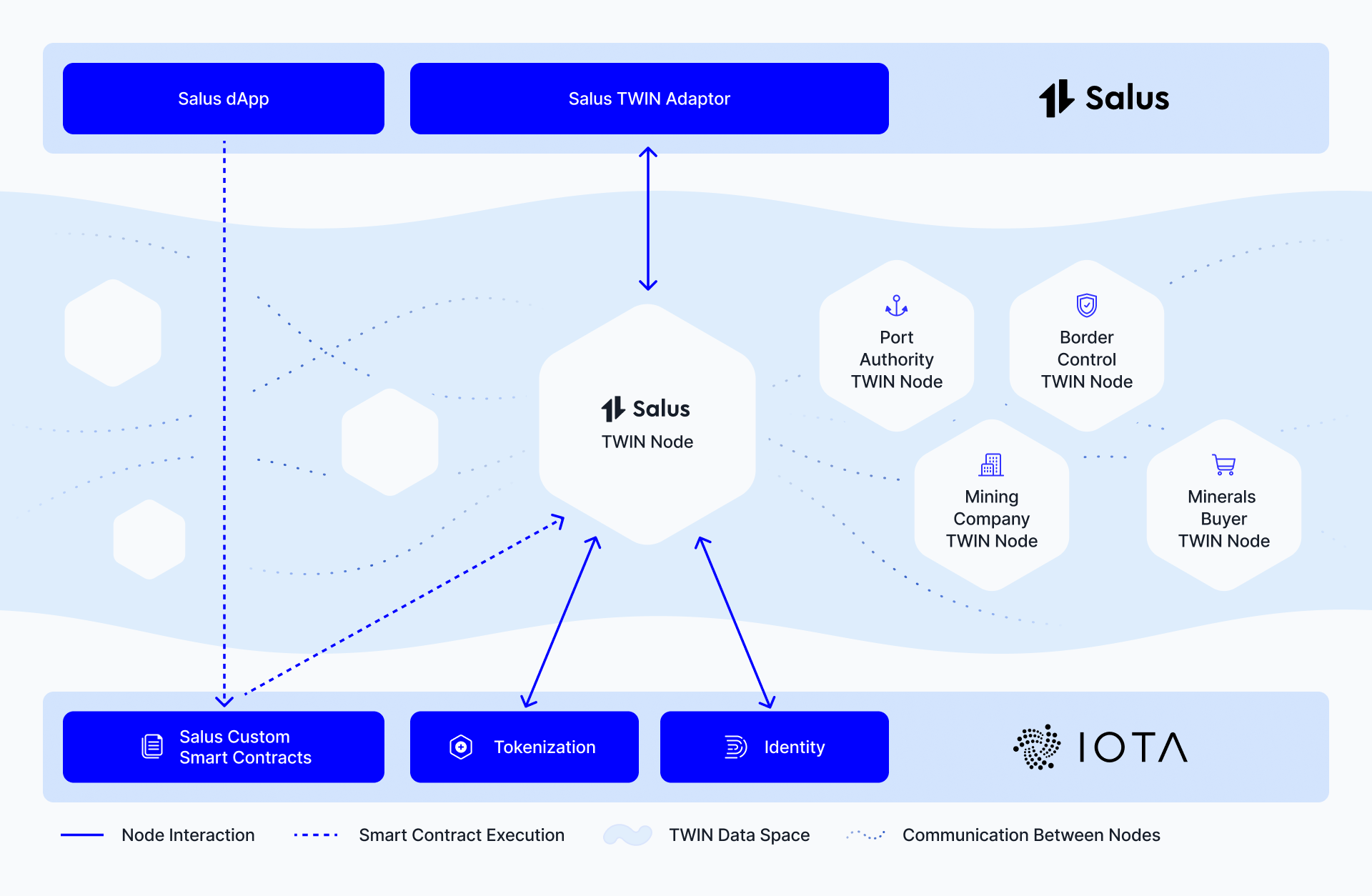
Tokenized documents. Warehouse receipts and bills of lading — the documents that legally represent ownership of a mineral shipment — are issued as NFTs on IOTA and shared across a permissioned network of TWIN nodes. A customs official, insurer, and mine operator can all access the same verified document at any point in the supply chain. This aligns with MLETR, the international legal standard for electronic transferable records.
Automated payments. Smart contracts replace manual payment triggers. When a shipment clears inspection, a contract can automatically release a partial payment to the supplier. Insurance confirmation or geolocation verification can trigger the next financing step. No intermediary, no delay waiting for a bank to confirm.
Audit trails. Every inspection, movement, and document update is recorded on IOTA’s mainnet, creating a tamper-proof log that links each mineral shipment to its full chain of custody. For funders making lending decisions, that audit trail is the trust layer.
To smooth onboarding for participants unfamiliar with blockchain, Salus uses IOTA’s Gas Station — a mechanism that lets Salus cover transaction fees on behalf of users, so investors and suppliers don’t need to hold or manage IOTA tokens to participate.
Who This Is For and What’s Still Unproven
The immediate target is alternative capital — DeFi funds and stablecoin pools that could finance commodity trade but currently lack the verification infrastructure to do so safely. By making shipment data auditable and document ownership transferable on-chain, Salus is building the trust layer those funders need.
Also Read: IOTA Pushes Blockchain Into the $35 Trillion Trade Economy — and Governments Are Listening
The broader ambition is inclusion. Smaller mining operations and traders that can’t access traditional bank financing are the long-term beneficiaries if the system scales.
What remains unproven is adoption. Salus is a new platform entering a conservative industry. The technical infrastructure exists; the harder work is convincing customs agencies, insurers, and established trade finance players to route their operations through it. IOTA’s ecosystem includes parallel efforts — TLIP for East African cross-border logistics, Realize for tokenized Treasury Bills — that reflect the same strategy but face the same adoption challenge.
The $2.5 trillion trade finance gap is real. Whether tokenized infrastructure closes a meaningful portion of it depends on uptake, not architecture.
Disclaimer: The information in this article is for general purposes only and does not constitute financial advice. The author’s views are personal and may not reflect the views of Chain Affairs. Before making any investment decisions, you should always conduct your own research. Chain Affairs is not responsible for any financial losses.

I’m your translator between the financial Old World and the new frontier of crypto. After a career demystifying economics and markets, I enjoy elucidating crypto – from investment risks to earth-shaking potential. Let’s explore!