|
Getting your Trinity Audio player ready...
|
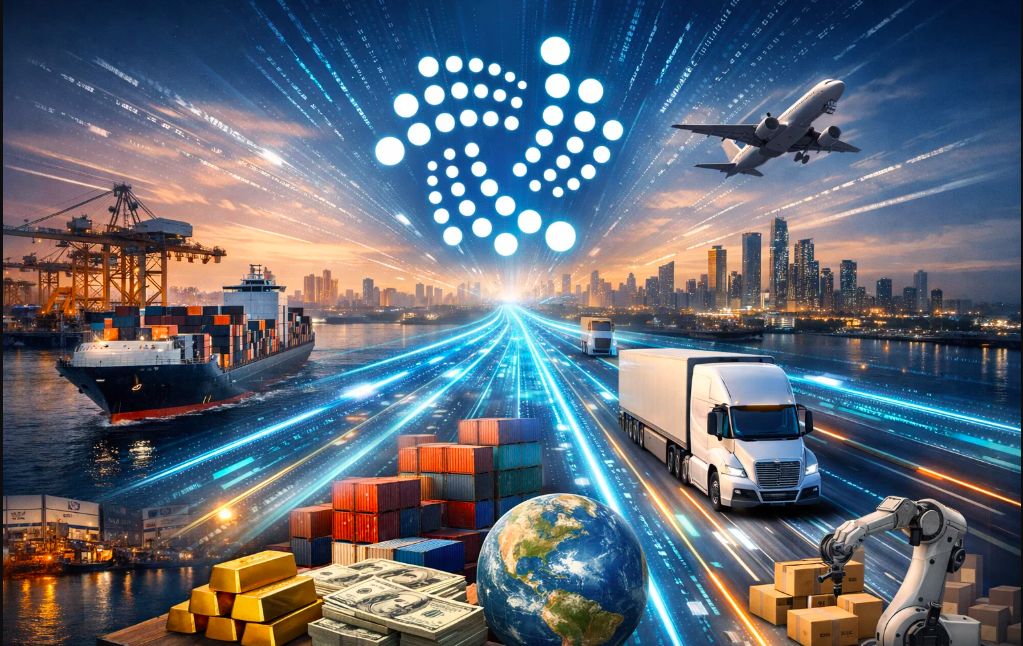
Global trade moves trillions of dollars worth of goods every year — and much of it still runs on paper. IOTA wants to change that, and in 2026, the project is staking its future on making that shift happen at scale.
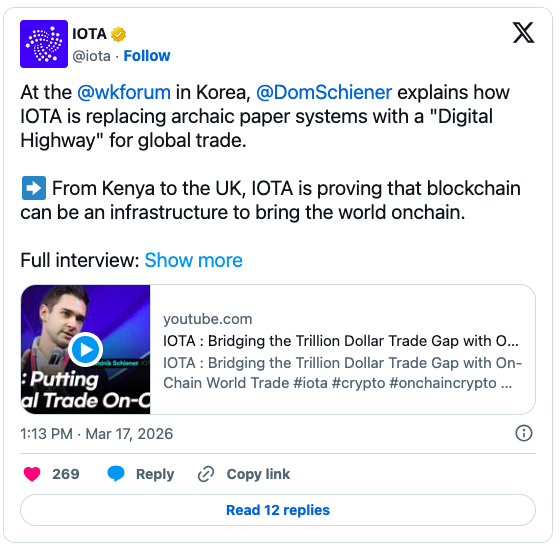
Co-founder Dominik Schiener unveiled the project’s core infrastructure vision at the World Crypto Forum in South Korea, presenting what IOTA calls the “Digital Highway” — a neutral public network designed to replace the paper-heavy documentation that customs agencies, ports, and banks currently rely on to verify cross-border transactions. The presentation generated enough attention that Schiener was subsequently featured in a leading Korean business newspaper discussing blockchain-based trade modernization — a sign that the institutional audience IOTA is courting is paying attention.
A $35 Trillion Market Still Running on Paperwork
The inefficiency IOTA is targeting is staggering in scale. International trade is projected to surpass $35 trillion in 2025, yet the systems underpinning it remain largely manual. Up to 4 billion trade documents circulate on any given day, and delays caused by repeated checks and disconnected national systems push costs higher across the entire supply chain.
Chief Marketing Officer Karen O’Brien has been direct about what this means for IOTA’s positioning. The project is deliberately shifting its message away from speculation toward real-world infrastructure. For 2026, she said the priorities are global trade and supply chains, verifiable data, government adoption, institutional use, and live deployments — in that order.
The Digital Highway addresses this by acting as a connectivity layer between existing national trade systems, instantly verifying shared data without relying on intermediaries. Origin and content of documents can be confirmed directly between trading partners, reducing administrative friction at every checkpoint.
TWIN Goes Live — From Kenya to the UK
The Trade Worldwide Information Network, TWIN, is IOTA’s primary deployment vehicle. In Kenya, it is already integrated into the national trade system and has expanded beyond its original focus on flower exports to cover a broader range of commodities. In Rwanda, mining firms are using digital records of stored materials to access financing, reducing dependence on high-interest borrowing and improving cash flow. The model is straightforward: physical commodities are represented as digital assets, which can then be used to unlock funding without lengthy approval processes.
In the United Kingdom, a freight pilot covering poultry consignments moving from Poland cut customs processing times from days to hours across roughly 4,000 shipments. TWIN supported the entire documentation trail — shipment tracking, document exchange, and verifiable credentials — with a full audit trail on the public network.
Over the next 12 months, pilots are expected to expand across Africa, Europe, Southeast Asia, and North America. To support the credibility and execution of these deployments, IOTA has also launched a dedicated expert advisory board, bringing in figures including Mark Johnson and Anna Jerzewska, who carry direct experience in customs, logistics, and regulatory systems.

Schiener has drawn a deliberate comparison to Amazon Web Services: IOTA provides the infrastructure layer. Trade and finance are simply applications built on top of it.
Also Read: IOTA and FedEx Could Be Circling Each Other — Here’s Why It Matters
ADAPT and the African Continental Free Trade Play
One of the most ambitious components of the roadmap is the ADAPT initiative, led by the AfCFTA Secretariat in partnership with IOTA, the Tony Blair Institute for Global Change, and the World Economic Forum. The program aims to connect trade platforms across all 55 African nations — modernizing border clearance, cutting cross-border payment costs, and linking identity, data, and finance through shared digital infrastructure.
Enterprise Tools Built for Institutional Depth
Beyond trade data and logistics, IOTA’s 2026 product suite targets the full spectrum of enterprise needs. The manifesto explicitly lists five products built for institutional use: Tokenization, Identity, Hierarchies, Notarization, and Gas Station. Together, these tools are designed to support customs workflows, supplier verification, digital product passports, trade receivables, and asset-backed finance — covering the administrative, financial, and compliance layers that large-scale trade requires.
The project estimates that digitizing just 1% of the roughly 2.5 billion annual cross-border consignments would generate approximately 650 million mainnet transactions per year. That figure underscores how much runway remains — and how significant the network effects could become if institutional adoption accelerates through 2026 and beyond.
Disclaimer: The information in this article is for general purposes only and does not constitute financial advice. The author’s views are personal and may not reflect the views of Chain Affairs. Before making any investment decisions, you should always conduct your own research. Chain Affairs is not responsible for any financial losses.

I’m your translator between the financial Old World and the new frontier of crypto. After a career demystifying economics and markets, I enjoy elucidating crypto – from investment risks to earth-shaking potential. Let’s explore!