
|
Getting your Trinity Audio player ready...
|
- Polygon holders are asking how Polygon Labs’ future profits will benefit the POL token.
- Despite growing stablecoin volume, Polygon’s market share has declined as rivals gain ground.
- Transparency around governance and treasury management has become a key community concern.
Polygon’s strategic shift toward becoming a blockchain payments company is raising fresh questions across its community. While Polygon Labs aims to build a profitable business centered on digital payments, many POL holders are asking a fundamental question: How will that success benefit the token they own?
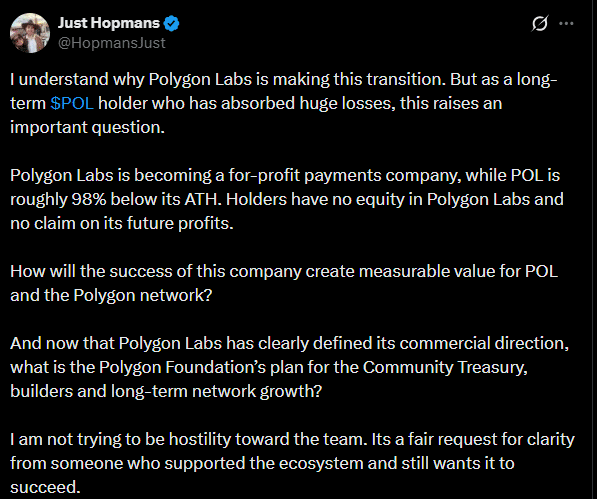
The debate has intensified after community member Just Hopmans publicly questioned whether Polygon Labs’ future profits would create measurable value for POL holders. His concerns highlight a growing conversation about transparency, governance, and the relationship between Polygon Labs, the Polygon Foundation, and the broader ecosystem.
POL Holders Seek Greater Transparency
POL, formerly known as MATIC before its rebranding in late 2024, has experienced a difficult market cycle. After briefly reaching around $1 following the transition, the token has fallen roughly 93% to about $0.06 in 2026, leaving many long-term investors deep underwater.
Despite the steep decline, interest in the ecosystem remains strong. The number of POL holders has climbed approximately 78% over the past month, surpassing 245,000 wallets. That growth suggests new participants continue to enter the network even as token performance remains weak.
Hopmans argued that token holders have no ownership stake in Polygon Labs and no direct claim to any future profits generated by its payments business. He also called for greater clarity regarding how the Polygon Foundation manages its community treasury, pointing to reports that more than 50 million POL tokens were moved during the first half of 2026 without detailed public communication.
As of publication, Polygon Labs has not publicly responded to these concerns.
Polygon Bets Big on Blockchain Payments
Polygon Labs CEO Marc Boiron has stated that the company’s transition toward payments is intended to put the business on a path to profitability by 2027.
The strategy builds on Polygon’s established role as a blockchain for stablecoin transactions. The network processed a record $106 billion in annual stablecoin transfer volume during 2025. In 2026, that figure has already reached roughly $70 billion, reinforcing Polygon’s position as a major settlement layer alongside Ethereum, Tron, and Arbitrum.
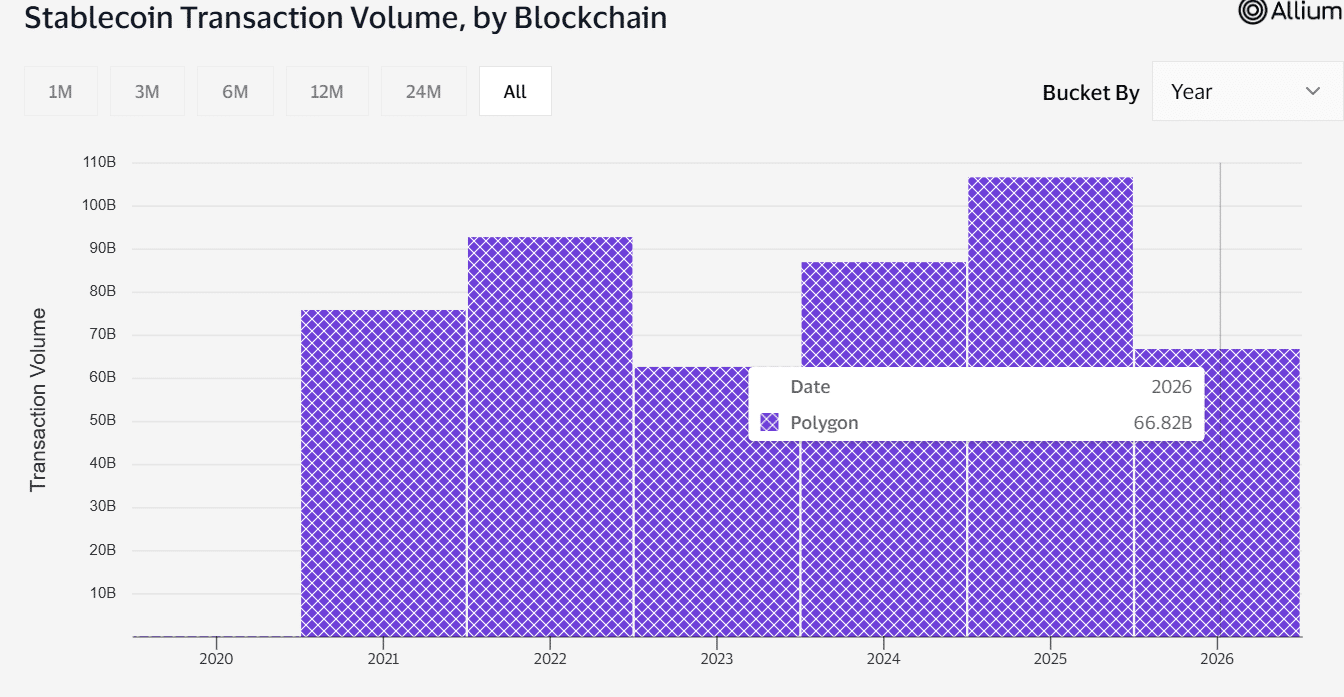
The growing transaction volumes demonstrate that institutional and retail users continue to rely on Polygon for efficient blockchain payments.
Rising Competition Challenges Polygon’s Market Position
While stablecoin activity has increased, Polygon’s share of the overall stablecoin settlement market has moved in the opposite direction.
Since 2023, its market share has fallen from 1.54% to approximately 0.72%. During the same period, competitors such as Solana and Base have rapidly expanded their presence, capturing significantly larger portions of the market.
That trend suggests transaction growth alone may not be enough to maintain competitive leadership. Polygon’s new payments strategy will likely be judged not only by company profitability but also by whether it strengthens the value proposition for POL holders and improves the network’s competitive position.
Also Read: Polygon POL Hits a Major Turning Point: Network Growth Explodes While Price Struggles
As Polygon enters its next phase, investors appear to be looking for more than ambitious business plans—they want a clear explanation of how the network’s commercial success will translate into lasting value for the community.
Disclaimer: The information in this article is for general purposes only and does not constitute financial advice. The author’s views are personal and may not reflect the views of Chain Affairs. Before making any investment decisions, you should always conduct your own research. Chain Affairs is not responsible for any financial losses.

I’m your translator between the financial Old World and the new frontier of crypto. After a career demystifying economics and markets, I enjoy elucidating crypto – from investment risks to earth-shaking potential. Let’s explore!