
|
Getting your Trinity Audio player ready...
|
- Around 60% of EU crypto users may be affected by unlicensed platforms after MiCA transition ends.
- Only a small fraction of crypto firms have secured MiCA approval so far.
- EU regulators are reviewing MiCA to address emerging areas like tokenization and stablecoins.
More than half of European Union crypto users could face disruptions as the final transition period for the Markets in Crypto-Assets (MiCA) regulation approaches. New research suggests that around 60% of EU users relying on unlicensed crypto platforms may lose access to services after the 1 July deadline unless providers secure approval.
The upcoming shift marks one of the biggest regulatory changes in the European crypto industry. While MiCA aims to create clearer rules for digital assets, the slow pace of licensing has raised concerns about whether users and companies are prepared for the new framework.
Licensing Shortfall Leaves Thousands of Crypto Firms in Uncertainty
Researcher Alex Obchakevich reported that only 194 crypto firms, representing about 6.5% of the market, had obtained MiCA authorization by May 2026. Meanwhile, more than 2,800 firms remained without licenses, based on data compiled from the European Securities and Markets Authority (ESMA).
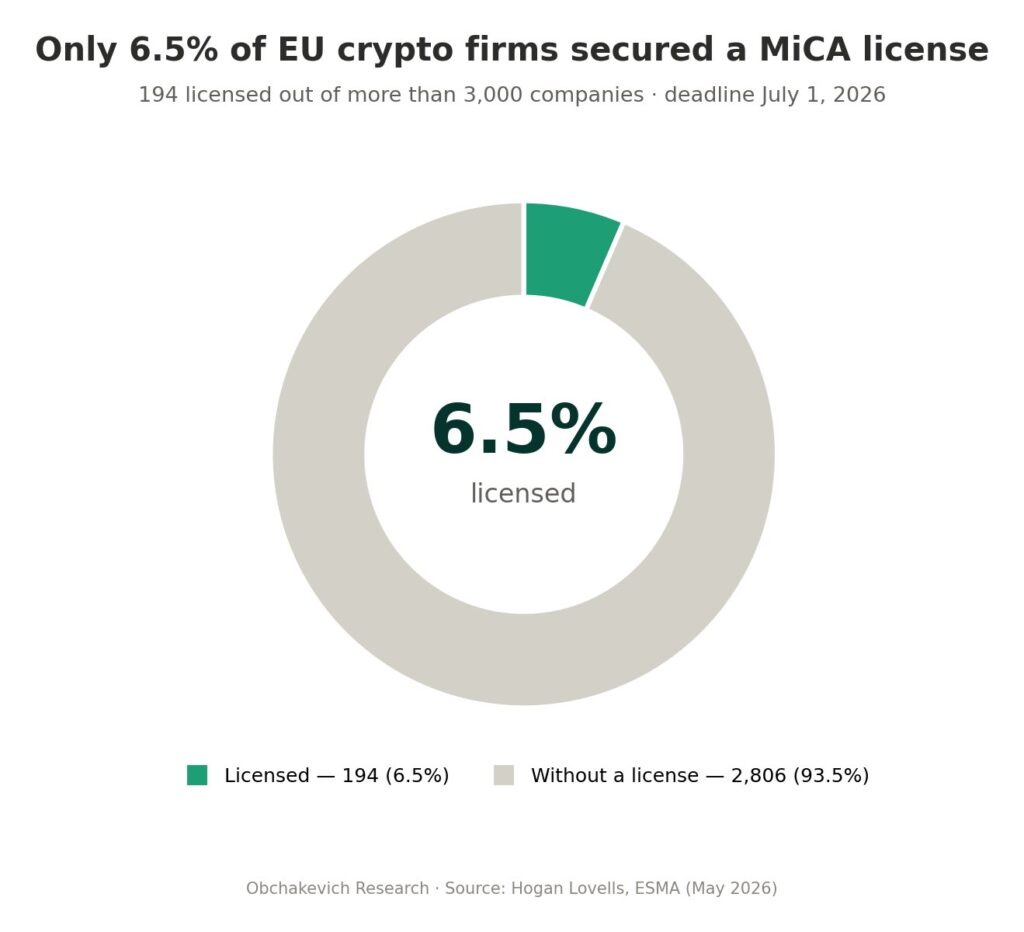
The impact could be significant because many European users still depend on platforms that have not completed the regulatory process. Unlicensed exchanges, brokers, and wallet providers may no longer be permitted to serve EU customers once the transitional period expires.
The researcher also highlighted that unapproved platforms represent a large portion of crypto app activity, accounting for roughly 7.6 million out of 18.5 million downloads.
MiCA Brings Unified Rules After Years of Fragmentation
Before MiCA, crypto regulation across Europe varied from country to country, creating different requirements for businesses operating in the region. The new framework introduces a single licensing approach for crypto asset service providers, including exchanges, custodians, and other digital asset platforms.
The transition period began after MiCA’s implementation in December 2024, allowing certain firms to continue operating under existing national rules while applying for approval.
Germany currently leads EU licensing activity with 55 approved firms, followed by the Netherlands with 29 and France with 19. However, the overall approval rate remains low as the deadline approaches.
Future MiCA Changes Could Address New Crypto Trends
MiCA’s stablecoin requirements became active in June 2024, while broader rules for crypto service providers followed later. However, the fast development of tokenization and other digital asset sectors has created new regulatory challenges.
The European Commission launched a review on 1 June 2026 to examine potential updates covering areas such as tokenization, stablecoins, and regulatory gaps. The consultation is expected to continue until the end of August.
Legal experts say the review could help strengthen Europe’s crypto oversight, but it remains unclear whether future changes will accelerate licensing or reduce risks for users.
Also Read: MiCA Shake-Up: New Rules Could Supercharge Euro Stablecoins
The MiCA deadline represents a major turning point for the EU crypto market. With thousands of platforms still awaiting approval, users may need to verify whether their providers are licensed before access restrictions begin.
Disclaimer: The information in this article is for general purposes only and does not constitute financial advice. The author’s views are personal and may not reflect the views of Chain Affairs. Before making any investment decisions, you should always conduct your own research. Chain Affairs is not responsible for any financial losses.

I’m a crypto enthusiast with a background in finance. I’m fascinated by the potential of crypto to disrupt traditional financial systems. I’m always on the lookout for new and innovative projects in the space. I believe that crypto has the potential to create a more equitable and inclusive financial system.