IOTA Is Trading Near Its All-Time Low. So Why Do Its Builders Keep Shipping?

- IOTA sits near its lows, but the Foundation’s roadmap is built around trade infrastructure, not the token chart.
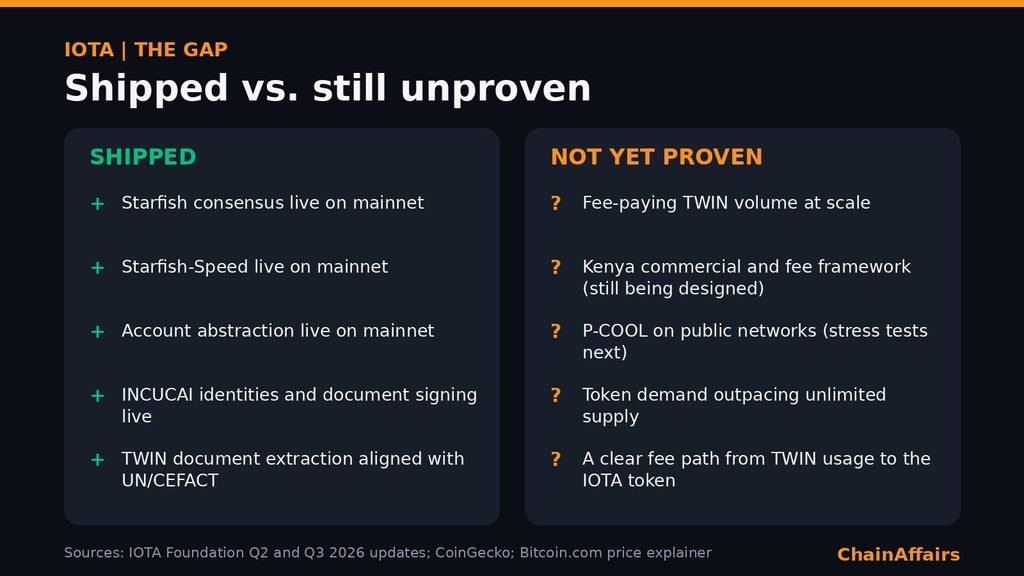
- Starfish, Starfish-Speed, account abstraction and a live national deployment all reached mainnet this year.
- Shipping isn’t usage, and usage isn’t token demand. That link is the open question.
- The next checkpoints are P-COOL stress tests and the commercial and fee frameworks for TWIN.
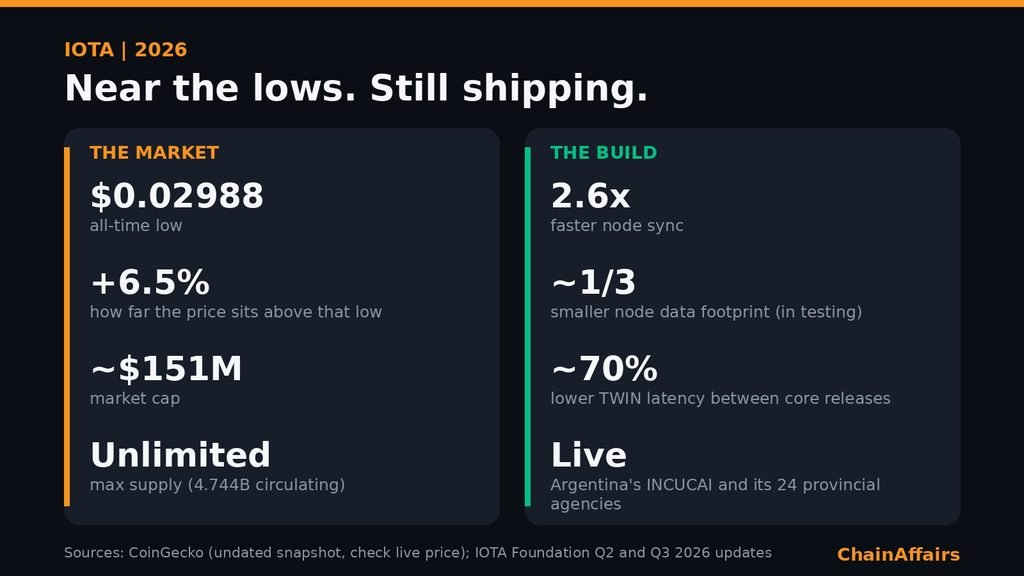
IOTA’s price chart and its release notes tell two different stories. CoinGecko data shows an all-time low of $0.02988, with the token trading only about 6.5% above it, on a market cap of roughly $151 million. Over the same stretch, the IOTA Foundation has shipped a new consensus engine, rebuilt its developer tools and put a national health authority’s identities on mainnet.
Both are true, and the gap between them is the story.
Why the builders aren’t slowing down
The Foundation isn’t steering by the token chart. In its Q2 update it said it is fully focused on supporting and scaling TWIN, the open digital trade infrastructure, with engineering, research, design and product teams merged into one pipeline aimed at global trade adoption. CoinGecko describes the Foundation as a non-profit headquartered in Berlin.
That changes what “keep shipping” means. This isn’t a startup spending a token treasury to prop up a price. It’s an organization that has pointed its whole roadmap at digital trade and is building toward it regardless of market mood.
Its communications have shifted too. The Foundation says its messaging moved from protocol-centric awareness toward institutional trust-building, emphasizing compliance, interoperability and real-world outcomes. The audience it’s courting is customs authorities, banks and trade bodies, not retail traders. That explains the quiet.
The roadmap actually landed
Most projects announce upgrades and slip. IOTA’s Starfish consensus work moved through its stages in order.
- Q3 2025: the non-sharded version of Starfish was deployed on devnet. A mid-2025 report had said a devnet deployment was anticipated in Q3, so that stage arrived as flagged.
- Q1 2026: Starfish reached testnet in version v1.16.0, and the account abstraction core landed on devnet.
- April 23, 2026: Starfish went live on mainnet.
- September 2026: Starfish-Speed, which lets validators commit blocks one round earlier so transactions reach finality sooner, reached mainnet after running on devnet in July and testnet in August. iota
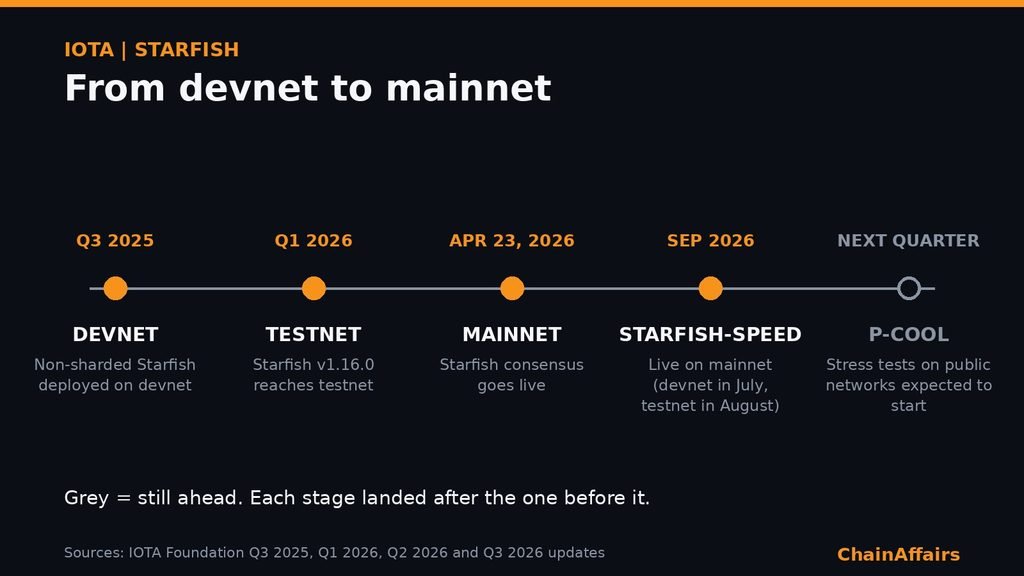
For a trade network, this order matters. Customs agencies and banks don’t adopt infrastructure that is still being tested. A track record of promised stages arriving in sequence is the kind of reliability institutional buyers look for, even when it does nothing for the price.
The unglamorous work that makes a network usable
Much of 2026’s output is plumbing, and plumbing is what enterprise adoption depends on.
- Faster, lighter nodes. Node sync is now 2.6 times faster, and nodes bootstrap from formal snapshots that carry what is needed to verify them, so operators no longer rely on whoever published the snapshot. Earlier in the year, storage optimizations cut the active node data footprint by about a third in testing.
- Stable developer tools. The Rust SDK and its bindings for other languages reached their first beta, and Move gained view functions for cheap, safe reads of onchain data.
- Better price data for apps. IOTA L1 connected to Pyth Pro, and Pyth Core was retired on IOTA on August 18. iota
- Research feeding the product. The team is working on Bluestreak, a design projected to cut consensus metadata on IOTA Mainnet by roughly 75%. In Q2 it submitted three peer-reviewed papers on consensus optimization, congestion control and network topology.
None of this will trend on social media. All of it lowers the cost and risk for the institutions IOTA wants as users.
A quantum angle worth noting
The quantum debate around Bitcoin focuses on how to move millions of coins to new signature schemes. IOTA has taken a different route. Account abstraction is live on mainnet, so developers can write custom sign-in logic, which prepares accounts for a transition to quantum-resistant signature schemes, several of which are being benchmarked.
This is preparation, not a finished defense. The Foundation says the schemes are still under testing. But building the switching mechanism into the account model early is the kind of design choice Bitcoin cannot easily make now.
Real deployments, early commercial terms
The pilots are further along than the price suggests. Argentina’s national organ-transplant authority, INCUCAI, moved its institutional identities and document signing onto IOTA Mainnet with Extrimian. It and its 24 provincial agencies hold verifiable digital identities, with no patient data onchain.
On trade, Kenya, Nigeria and Morocco were chosen as the first countries for the ADAPT initiative, and the UK secured five core signatories for its International Supply Network memorandum. TWIN’s document extraction service now aligns with UN/CEFACT standards, and platform releases cut latency by about 70% between core releases.
The money side of TWIN is still taking shape. In Kenya, the Foundation held working sessions with Trademark Africa to build a commercial model that can sustain itself, agreeing on how operations will be structured and how fees will work in future. Its legal and governance team is also working with TWIN’s strategic partners on who owns the IP, how it is licensed, and how the network will be funded over time. Taken together, this suggests the revenue model is still being designed, not yet running.
Where the market is looking instead
While the builders ship, the market is trading something else. CoinGecko’s snapshot shows IOTA’s 24-hour spot volume near $4.76 million against perpetual-futures open interest of about $7.75 million, with perps volume running 11.4 times spot volume and funding negative, meaning shorts are paying longs. That snapshot is undated, so check live figures, but the pattern points to a price set more by derivatives positioning than by buyers of the token.
The part the release notes don’t answer
Shipping is not the same as usage, and usage is not the same as token demand.
Projects built on IOTA, such as TWIN and ADAPT, need the IOTA token only to pay network fees, so project news doesn’t turn into token demand one for one. The token also has an unlimited max supply, with 4.744B in circulation against a total supply of 5.029B. Demand has to keep rising just to hold the price still.
Also Read: IOTA’s Manifesto at 10 Months: 7 Things Delivered, 5 Still Pending
Three ways this could play out
This is our analysis, not a forecast.
- Usage becomes fees. Fee frameworks are agreed, TWIN volume grows and fee-paying activity shows up onchain. The shipping pays off in token demand.
- Pilots stay pilots. The technology keeps improving but government and trade deployments stay small. The builders keep building, and the price keeps lagging.
- Usage grows, the token doesn’t. Trade networks run on IOTA without creating much token demand because fees are cheap or sponsored. Good for the network, flat for holders.
What to watch next
- P-COOL stress tests. Stress testing of the certificate-less transaction flow on public networks is expected to start next quarter.
- Commercial terms. Watch for the Kenya and UK fee frameworks to be agreed and published.
- Onchain activity. Rising transaction counts, fees and staking participation would show usage turning into demand.
IOTA’s builders keep shipping because their mandate is trade infrastructure, not the price. The risk is the one every infrastructure project faces: the technology can be ready long before the market is. Until fee-paying usage shows up onchain, the chart and the roadmap will keep telling different stories.
Price data changes quickly. Check live figures before relying on any number here.
Disclaimer: The information in this article is for general purposes only and does not constitute financial advice. The author’s views are personal and may not reflect the views of Chain Affairs. Before making any investment decisions, you should always conduct your own research. Chain Affairs is not responsible for any financial losses.

I’m your translator between the financial Old World and the new frontier of crypto. After a career demystifying economics and markets, I enjoy elucidating crypto – from investment risks to earth-shaking potential. Let’s explore!