
|
Getting your Trinity Audio player ready...
|
Bloom, the crypto trading platform, says an attack on a third-party module drained roughly $947,000 from a small group of its users. The team has promised to repay every affected user in full. The company also took all of its systems offline as a precaution. Here is what Bloom has said so far, and what remains unanswered.
What Bloom Confirmed
In an official security update posted on X, Bloom said its investigation had identified the exact attack vector and the scope of the incident. The company says the attacker exploited a third-party module through a complex Remote Code Execution (RCE) vulnerability.
The reported figures are fairly contained:
- Wallets affected: 49 addresses
- Users affected: 9
- Total losses: about 9,408 SOL, valued at roughly $947,000
At those numbers, the dollar figure implies a Solana price of about $100 at the time of the calculation.
Bloom’s headline message was blunt: no private keys were compromised, unaffected wallets are safe, and all affected users will be reimbursed. The company says no private keys were accessed and that it has ruled out broader exposure of users’ wallets.
Full Refunds Promised
Bloom says it will reimburse 100% of the stolen funds directly to secure wallets designated by the affected users. The company has not given a timeline for the payouts.
The team is also working to trace the stolen funds, explore recovery and freezing options, and identify the attacker. Bloom has not said whether it has found any trail on-chain or whether it has contacted exchanges or law enforcement.
Systems Offline, Re-Login Required
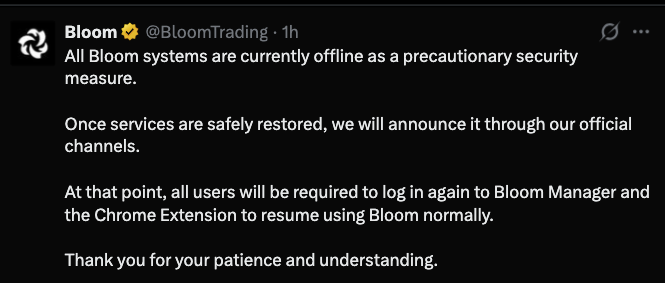
In a separate post, Bloom said all of its systems are offline as a precautionary security measure. It will announce on its official channels once services are safely restored. When they return, all users will have to log in again to Bloom Manager and the Chrome Extension before using the platform normally.
Forced re-authentication is a common step after a security incident, since it invalidates existing sessions. Bloom did not say that was its reason, so treat that as context rather than confirmation. Users should only use Bloom’s official channels for restoration updates, because incidents like this often attract phishing attempts that imitate the affected platform.
Questions Still Open
Bloom’s statement leaves a few things unclear. The first is how funds left 49 wallet addresses if no private keys were accessed. The company points to an RCE flaw in a third-party module, which would allow an attacker to run code in an environment they should not control. Bloom has not published a technical breakdown, and there has been no independent confirmation of the cause, the scope, or the claim that other wallets are unaffected.
The second is which third-party module was exploited, and whether other products using it are exposed. The statement does not name it.
The third is timing. Bloom has not said when services will return or when refunds will arrive.
Also Read : Wall Street Models Bitcoin for 2036, While UK Banks Block It Today
Why It Matters
Third-party dependencies are a recurring weak point in crypto software. A platform can do its own security work well and still be exposed through code it did not write. The total here is small by industry standards, and Bloom’s decision to cover losses in full and take its systems offline will help its case. How quickly it pays out, and how openly it explains what happened, will do more to decide whether users trust it afterward.
Bloom says its commitment to user safety, transparency and business continuity is unchanged, and that its team has built software since 2018 and worked in crypto since 2021.
What Users Should Do Now
Users should avoid links claiming to be Bloom support and rely only on the project’s verified X account. Anyone who connected a wallet to Bloom may want to review their wallet activity. Waiting for the official all-clear before logging in again is the safer path.
Disclaimer: The information in this article is for general purposes only and does not constitute financial advice. The author’s views are personal and may not reflect the views of Chain Affairs. Before making any investment decisions, you should always conduct your own research. Chain Affairs is not responsible for any financial losses.