

|
Getting your Trinity Audio player ready...
|
Key Takeaways
- JPMorgan projects Bitcoin at 10% annually over a decade, ahead of US stocks (7.5%) and gold (5.5%), but won’t call it a diversifier.
- Stand With Crypto logged 10,092 UK complaints in 90 days, with Lloyds, Barclays and NatWest receiving the most.
- The UK’s 2027 FCA regime doesn’t cover business bank account access, so licensed firms could still be shut out.
Bitcoin is being taken seriously and turned away in the same week. JPMorgan has added it to a decade-long investment outlook for the first time, while thousands of UK bank customers say they can’t send money to crypto platforms.
JPMorgan Puts Bitcoin on the Map
JPMorgan Asset Management published its 2027 Long-Term Capital Market Assumptions on Monday, an annual report covering more than 200 assets. It projects Bitcoin (BTC) returning 10% a year over the next decade, ahead of 7.5% for large-cap US stocks and 5.5% for gold.
The bank’s enthusiasm has limits. It does not make a case for Bitcoin as a portfolio diversifier because its correlations with other assets are unstable. JPMorgan calls it a speculative asset and a hedge against monetary easing.
A Forecast With a Wide Spread
The range around that 10% is large. The bull case is a 16.6% annual gain, while the bear case is an 11.2% annual loss. The modeling considered Bitcoin’s supply growth relative to money supply, its possible role alongside gold and network adoption.
Bitwise CIO Matt Hougan welcomed the inclusion, though his firm is far more optimistic. Bitwise projected in August 2025 that Bitcoin could reach $1.3 million by 2035, a base-case return of 28.3% a year.
Meanwhile, UK Customers Hit a Wall
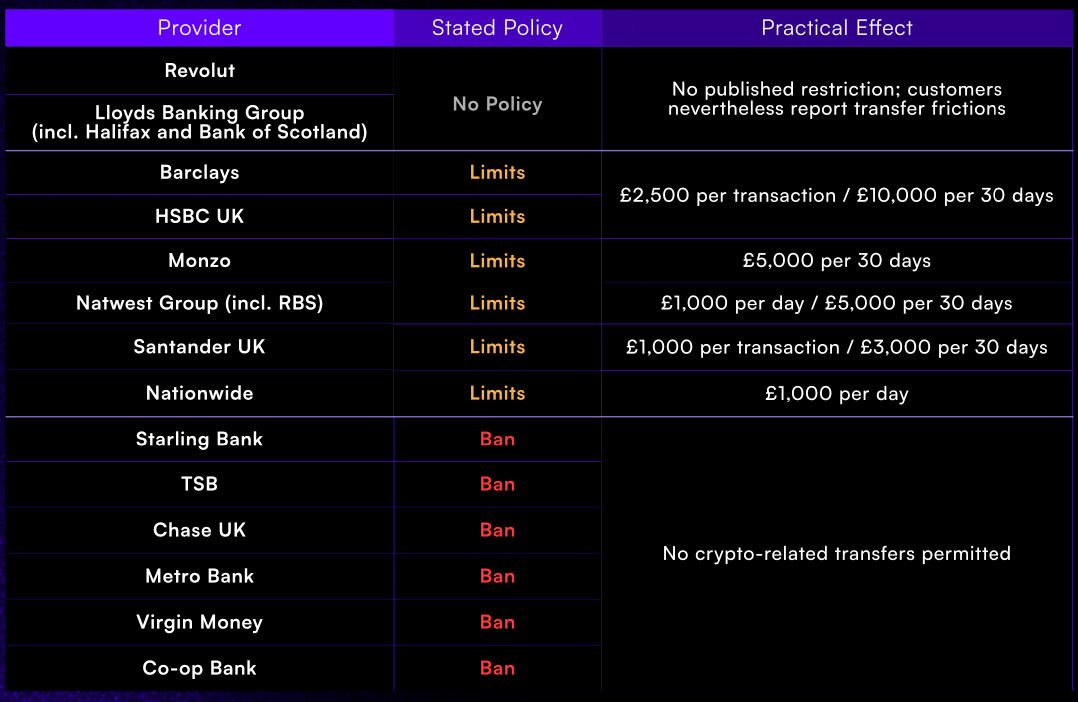
Institutional respect doesn’t help much if you can’t move money. Advocacy group Stand With Crypto says 9,803 people filed 10,092 complaints about UK bank restrictions on crypto transfers between May and August 2026. Cointelegraph reviewed the report on Tuesday.
Lloyds Banking Group drew the most complaints at 2,297, followed by Barclays with 1,569 and NatWest with 1,278. Barclays and HSBC UK were listed as capping transfers at £2,500 ($3,300) per transaction and £10,000 ($13,300) over 30 days. Six banks, including Starling Bank, TSB and Chase UK, were listed as banning crypto transfers outright.
The report classed Lloyds and Revolut as having no published restrictions despite the complaints. Revolut’s support page, however, says transfers to some crypto exchanges are unsupported.
Regulation May Not Close the Gap
The UK is preparing a new crypto regime for 2027, with mandatory Financial Conduct Authority approval in October 2027. Zumo founder and CEO Nick Jones says restricted banking is a common problem for UK crypto founders and could undermine the country’s ambition to become a global crypto hub.
He also warned that the new rules don’t cover access to business bank accounts. A firm could be fully authorized and still unable to open one, he said, unless there is coordinated action.
Also Read: $1 Billion Raised, $250M in Fees: The Brutal Math Behind 100 Crypto Shutdowns
Both stories point to the same tension. Large institutions increasingly treat Bitcoin as an asset worth forecasting, yet the banking system that ordinary users and crypto businesses depend on remains cautious, and its rules are inconsistent. Until the two line up, Bitcoin’s mainstream acceptance will stay partial.
Disclaimer: The information in this article is for general purposes only and does not constitute financial advice. The author’s views are personal and may not reflect the views of Chain Affairs. Before making any investment decisions, you should always conduct your own research. Chain Affairs is not responsible for any financial losses.

I’m your translator between the financial Old World and the new frontier of crypto. After a career demystifying economics and markets, I enjoy elucidating crypto – from investment risks to earth-shaking potential. Let’s explore!