
|
Getting your Trinity Audio player ready...
|
- EU and New York regulators are coordinating stablecoin supervision under a new agreement.
- The stablecoin market has surpassed $319 billion but is showing signs of consolidation.
- The framework improves data sharing, risk monitoring, and crisis response coordination.
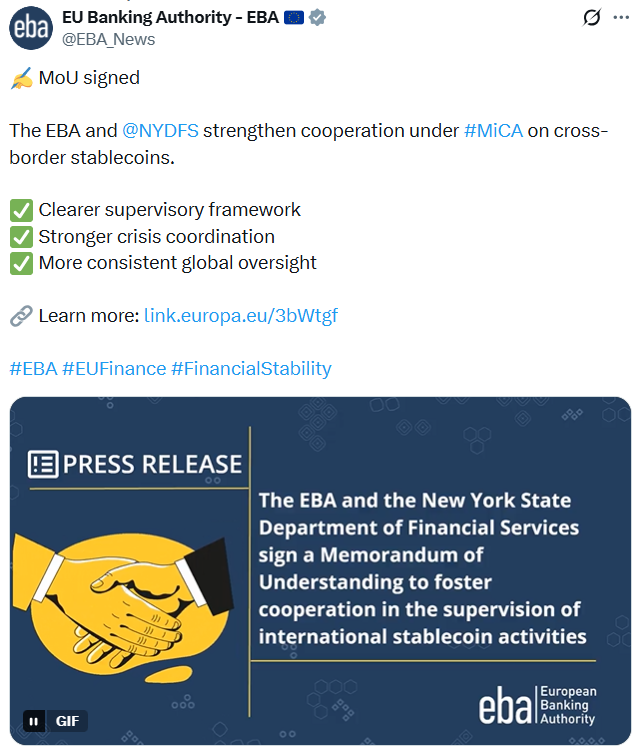
The European Union and New York are taking a coordinated step to strengthen oversight of the fast-growing stablecoin sector. A new agreement between the European Banking Authority (EBA) and the New York State Department of Financial Services (NYDFS) aims to improve cross-border supervision of digital dollar-pegged assets as global adoption continues to expand.
New EU–US Framework for Stablecoin Supervision
Under the memorandum of understanding, both regulators will share key supervisory data and align their approaches to monitoring stablecoin markets. The agreement falls under the EU’s Markets in Crypto-Assets (MiCA) regulation and reflects growing international concern about risks tied to digital assets used in payments and trading.
The cooperation framework allows authorities to exchange information on issuance volumes, circulation levels, holder distribution, and audit results. It also includes details on the regulatory status of specific stablecoin products and services. According to the NYDFS, the goal is to “enhance supervision of entities engaged in stablecoin activities” and improve detection of emerging risks in the sector.
Stablecoin Market Faces Rising Regulatory Attention
The global stablecoin market has expanded rapidly, now exceeding $319 billion in total value, according to data from DeFiLlama. However, growth has begun to stabilize as regulatory pressure increases and macroeconomic conditions shift.
Major US and European financial institutions have already begun testing stablecoins for cross-border payments, encouraged by clearer legal frameworks in both regions. In the United States, stablecoin regulations were signed into law in July, while the EU’s MiCA framework became fully active in late 2024.
Despite the momentum, industry observers suggest the market is entering a consolidation phase. Factors such as higher Treasury yields and tighter liquidity conditions have reduced demand for new stablecoin issuance.
Crisis Coordination and Market Stability Goals
Beyond routine supervision, the EBA–NYDFS agreement includes provisions for crisis coordination. Both agencies will work together during market disruptions or emergencies involving regulated stablecoin issuers.
However, the framework has limits: it applies only to supervised stablecoin-related activities and does not extend to all business operations of crypto firms. This distinction leaves broader crypto activity outside the scope of direct joint oversight.
Also Read: Eric Trump Criticizes New York City Bureaucracy Over Construction Delays
The partnership between EU and New York regulators signals a new phase of global coordination in digital asset oversight. As stablecoins become more embedded in financial systems, regulatory alignment across jurisdictions may play a key role in shaping their future stability and adoption.
Disclaimer: The information in this article is for general purposes only and does not constitute financial advice. The author’s views are personal and may not reflect the views of Chain Affairs. Before making any investment decisions, you should always conduct your own research. Chain Affairs is not responsible for any financial losses.

I’m your translator between the financial Old World and the new frontier of crypto. After a career demystifying economics and markets, I enjoy elucidating crypto – from investment risks to earth-shaking potential. Let’s explore!