

|
Getting your Trinity Audio player ready...
|
Two developments are commanding attention in digital asset markets this week: a bullish analyst call on a fintech firm using blockchain to reinvent credit, and new data suggesting some traders may have been one step ahead of Robinhood’s coin listing announcements. Together, they illustrate both the promise and the unresolved risks of a crypto market maturing at speed.
Bernstein sees Figure as a $67 stock — and a $4 trillion opportunity
Shares of Figure Technology Solutions have climbed nearly 10% over the past month, but Bernstein thinks the market is still sleeping on the stock. In a research note published Tuesday, the firm stood by its “Outperform” rating on Figure (FIGR) and a price target of $67 — roughly 67% above current trading levels.
The bull case isn’t really about home equity loans anymore. Figure began as a home equity line of credit originator, but Bernstein’s thesis rests on a bigger transformation: the company is evolving into a blockchain infrastructure and AI-driven credit platform. Tokenization — converting loans into tradable onchain assets with real-time settlement — sits at the heart of that shift.
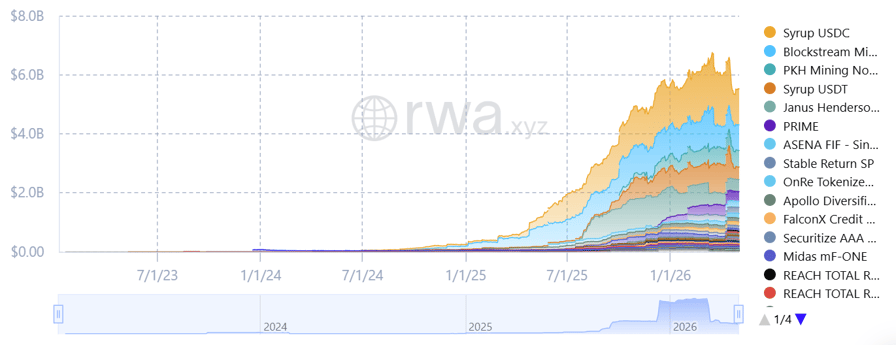
The firm estimates that the total addressable market for tokenized credit could reach $4 trillion annually, spanning mortgages, auto loans, HELOCs, and small-business lending. That’s a dramatically larger playing field than traditional fintech occupies. For context, the entire tokenized real-world asset sector is currently valued at around $5.5 billion — meaning the gap between today’s reality and the opportunity Bernstein is pointing to is vast.
Loan volumes are already surging
The growth backdrop is compelling. Figure’s loan volumes hit $1.34 billion in April, more than double the same month a year ago and the second straight month the company cleared the $1 billion threshold. Bernstein projects volumes will reach $16.5 billion by 2027, up from an estimated $8.4 billion in 2025.
Figure has also begun diversifying into auto loans through its Hastra ecosystem, where tokenized credit products are built to connect with decentralized finance markets. It’s not alone — Centrifuge has been building a similar bridge, bringing tokenized credit and U.S. Treasury products onto new blockchain networks and linking them to DeFi liquidity. But Figure’s combination of origination scale, blockchain infrastructure, and AI credit tools gives it a distinct positioning in this emerging market.
Kaiko flags pre-announcement trading patterns around Robinhood listings
On a different front, crypto analytics firm Kaiko has published findings that raise serious questions about market integrity around Robinhood’s token listing process. According to a report released Monday, open interest, funding rates, and onchain wallet activity repeatedly showed signs of positioning before Robinhood made listing announcements public.
One wallet address — publicly identified in Kaiko’s report — opened a long position on the Lighter token approximately an hour before Robinhood announced the listing in January. The same wallet later opened a short on a HOOD-linked perpetual contract hours before Robinhood reported quarterly revenue that missed analyst estimates, closing the position after the stock moved lower. The pattern is difficult to dismiss as coincidence.
Multiple other tokens showed similar dynamics. Zcash, Synthetix, and Near Protocol all recorded abnormal price gains in the hours leading up to their respective Robinhood listing announcements. Open interest and funding rates spiked in the pre-announcement window across several of these assets, reflecting consistent and repeated positioning.
Inside information — or just better signal reading?
Kaiko’s research analyst Laurens Fraussen offered a measured interpretation. The data doesn’t definitively prove insider trading. Sophisticated traders who understand derivatives market microstructure — how funding rate spikes, volume surges, and open interest changes can foreshadow listings — may have been reacting to public signals rather than acting on non-public information.
“Traders that know how microstructure works could have noticed the funding spikes, increase in volumes and open interest spikes, and position based on that,” Fraussen said.
Still, the statistical consistency of the pattern across multiple listings is striking. Kaiko concluded that the data points to either privileged access to Robinhood’s listing pipeline, or a remarkably reliable front-running approach built entirely on publicly observable signals. Either way, it’s a finding the industry — and regulators — will be watching closely.
What both stories share
Figure’s trajectory and the Robinhood front-running question sit at opposite ends of crypto’s maturation curve. One represents the constructive, infrastructure-building work of bringing traditional credit markets onchain at institutional scale. The other reflects the opacity and edge-case risks that still shadow a market operating faster than its oversight framework. Both deserve attention from anyone with money in the space.
Disclaimer: The information in this article is for general purposes only and does not constitute financial advice. The author’s views are personal and may not reflect the views of Chain Affairs. Before making any investment decisions, you should always conduct your own research. Chain Affairs is not responsible for any financial losses.

I’m a crypto enthusiast with a background in finance. I’m fascinated by the potential of crypto to disrupt traditional financial systems. I’m always on the lookout for new and innovative projects in the space. I believe that crypto has the potential to create a more equitable and inclusive financial system.