
|
Getting your Trinity Audio player ready...
|
- IOTA’s existing trade infrastructure lacked a liquid, globally accepted payment layer — USDT integration directly addresses this.
- Starfish consensus, Account Abstraction, and a 20–30x faster node sync tool mark significant technical progress toward production-scale trade.
- TWIN is now active in Kenya, the UK, and exploratory talks in Rwanda, with institutional interest rising in South Korea and the Middle East.
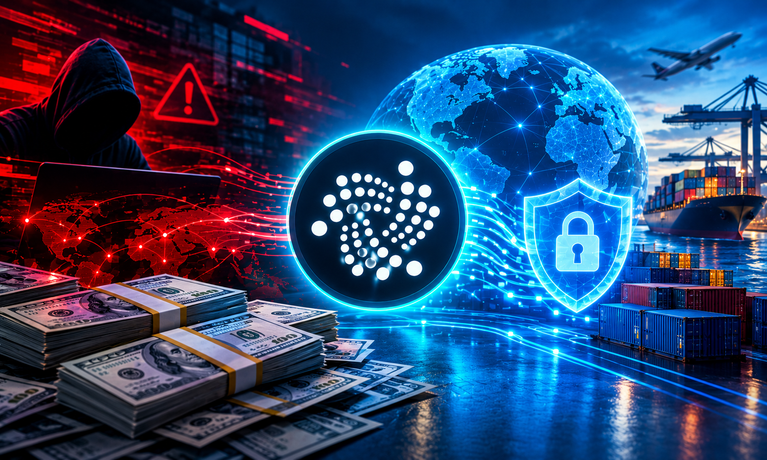
The IOTA Foundation ended Q1 2026 with momentum on multiple fronts — protocol upgrades, trade network deployments, and growing institutional interest. But beneath the technical milestones lies a more telling strategic signal: the Foundation has quietly made stablecoin integration its most urgent priority, and the chosen instrument is Tether’s USDT.
Why USDT, and Why Now
For all of IOTA’s infrastructure progress — digital identities, enterprise data exchange, and the Trade Worldwide Information Network (TWIN) — one gap has persisted. The network lacked a universally accepted settlement layer. Without it, on-chain trade finance workflows could move data but not money.
Community contributor Salima, whose analysis circulated widely on X in early February, framed it plainly: TWIN can already handle data and decentralized identifiers, and SALUS can push invoices, but none of that translates into finalized transactions without a stable, liquid asset backing them.
The Foundation’s reasoning for choosing USDT over alternatives comes down to market reality. USDT already functions as the dominant cross-border settlement instrument in emerging markets — precisely the regions IOTA’s TWIN network is targeting, including Kenya and Rwanda. Ideological or branding considerations were set aside in favor of what global trade already uses in practice.
Integration Challenges and the USDC Debate
The path to USDT deployment is not straightforward. As a non-EVM network, IOTA requires Tether to conduct thorough audits and an extended validation process before going live. Contracts have reportedly been signed and initial payments made, with the remaining work centered on compliance verification and staged implementation.
Not all community voices aligned behind the choice. Some pointed to USDC’s stronger fit with European regulatory frameworks, particularly MiCA, and its closer relationship with traditional banking infrastructure. The counter-argument held that while USDC may be preferred in regulated Western markets, USDT remains the standard for high-volume, cross-border settlement across much of the world — and IOTA’s trade ambitions are inherently global.
On the question of where MIOTA fits, the answer offered was architectural: USDT handles settlement, while MIOTA powers the underlying coordination, data transfer, and interoperability layer. The two serve distinct functions within the same system.
Protocol Gains and Market Expansion
Q1 also delivered meaningful protocol progress. The Starfish consensus mechanism reached Testnet, promising lower latency and stronger security for trade documentation. A new synchronization tool cut node recovery times from hours to minutes. Account Abstraction features went live across development and test environments, simplifying access for non-crypto enterprise users.
On the adoption side, TWIN secured a foothold in the UK’s Digital Trade Testbed at Teesside Port, established multi-node connectivity between Kenyan trade agencies, and opened conversations with Rwandan officials around a coffee export pilot. Institutional interest from South Korea and the Middle East has grown, with tokenized trade finance cited as the primary draw.
A regulated U.S. exchange listing was also flagged as a near-term objective for early 2026.
IOTA’s Q1 story is ultimately about closing the gap between technical capability and real-world usability. The infrastructure exists. The trade partnerships are forming. What remained missing was a settlement layer the world already trusts. The USDT integration is IOTA’s answer to that — pragmatic, market-driven, and central to everything the Foundation is building toward.
Disclaimer: The information in this article is for general purposes only and does not constitute financial advice. The author’s views are personal and may not reflect the views of Chain Affairs. Before making any investment decisions, you should always conduct your own research. Chain Affairs is not responsible for any financial losses.

I’m your translator between the financial Old World and the new frontier of crypto. After a career demystifying economics and markets, I enjoy elucidating crypto – from investment risks to earth-shaking potential. Let’s explore!