
|
Getting your Trinity Audio player ready...
|
- Gaming groups want sports event contracts excluded from prediction market platforms under the CLARITY Act.
- The CFTC and state gaming regulators are divided over who should control prediction markets.
- The dispute could become a major legal battle over the future of crypto-based event contracts.
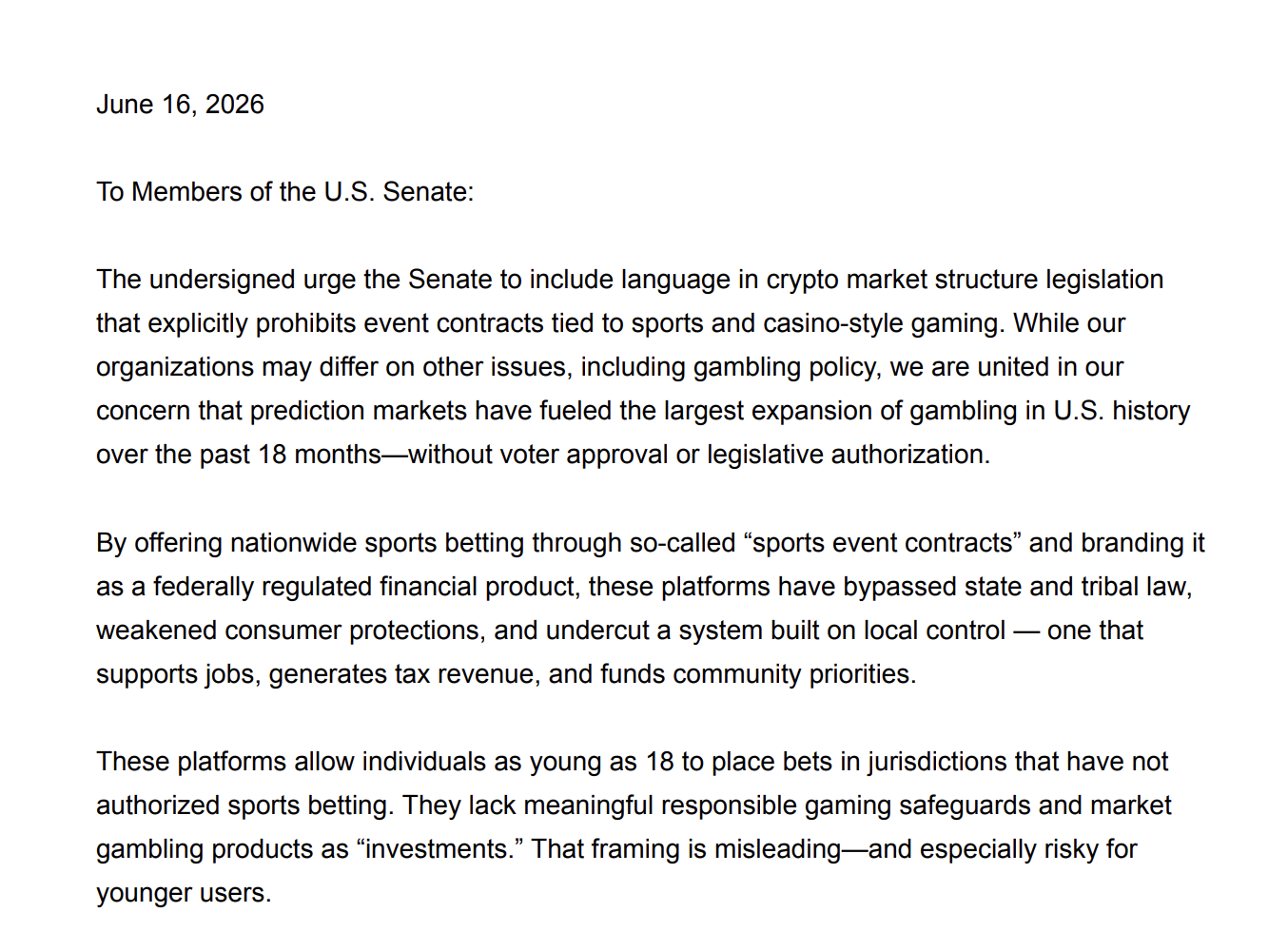
The growing battle over prediction markets in the United States has moved into the debate surrounding crypto regulation, with major gaming organizations and labor groups urging lawmakers to restrict sports-related event contracts. The groups argue that prediction markets offering sports contracts could blur the line between financial products and gambling, creating regulatory uncertainty.
The push comes as Congress considers the Digital Asset Market Clarity (CLARITY) Act, a major cryptocurrency regulation proposal that could reshape oversight of digital assets and expand the role of the Commodity Futures Trading Commission (CFTC). Opponents of sports prediction markets want the legislation to clearly prevent these platforms from offering contracts linked to sporting events.
Gaming Industry Raises Concerns Over Prediction Markets
Organizations including the Indian Gaming Association and the American Gaming Association have reportedly joined forces in opposing sports betting-style prediction contracts. They argue that platforms allowing users to trade outcomes of sporting events are effectively expanding gambling activities without approval from state regulators.
The groups said existing state and tribal gaming systems already oversee sports wagering and questioned whether the CFTC has the expertise to regulate a market traditionally handled by gaming authorities.
Their concerns highlight a wider dispute over whether prediction market platforms should be treated as financial exchanges or gambling services. Companies operating in this space argue that event contracts are derivatives products, placing them under federal commodities rules.
CFTC Authority Becomes a Key Issue
The debate has intensified as CFTC Chair Michael Selig has supported the agency’s authority over prediction markets. The regulator has argued that these contracts fall within its jurisdiction, a position that has placed it at odds with several state gaming authorities.
Platforms such as Kalshi and Polymarket have defended their operations by describing event contracts as swaps rather than traditional wagers. Their position is that federal oversight provides a consistent framework for prediction markets across the country.
However, gaming groups warn that allowing federal regulation alone could weaken state-level systems that have governed sports betting since the Supreme Court’s 2018 ruling in Murphy v. National Collegiate Athletic Association, which opened the door for states to legalize sports gambling.
Possible Supreme Court Battle Ahead
The conflict between federal regulators and state gaming officials could eventually reach the US Supreme Court, especially if the CFTC challenges state actions against prediction market platforms.
Supporters of the CLARITY Act expect the bill to continue moving through Congress, although lawmakers are still debating several issues, including stablecoin rules, ethics concerns and tokenized assets.
The outcome could determine how the United States approaches prediction markets for years to come. At stake is not only the future of sports-related contracts but also the broader question of whether digital asset platforms can operate in areas traditionally controlled by state regulators.
Also Read: NyesteCasino.com Reports: iGaming Industry Navigates Dual Pressures of Regulation and Growth
The fight over prediction markets reflects a larger struggle between innovation and existing regulatory structures. As lawmakers review the CLARITY Act, the final rules could shape the future of crypto markets, sports contracts and federal oversight in the United States.
Disclaimer: The information in this article is for general purposes only and does not constitute financial advice. The author’s views are personal and may not reflect the views of Chain Affairs. Before making any investment decisions, you should always conduct your own research. Chain Affairs is not responsible for any financial losses.

I’m your translator between the financial Old World and the new frontier of crypto. After a career demystifying economics and markets, I enjoy elucidating crypto – from investment risks to earth-shaking potential. Let’s explore!