
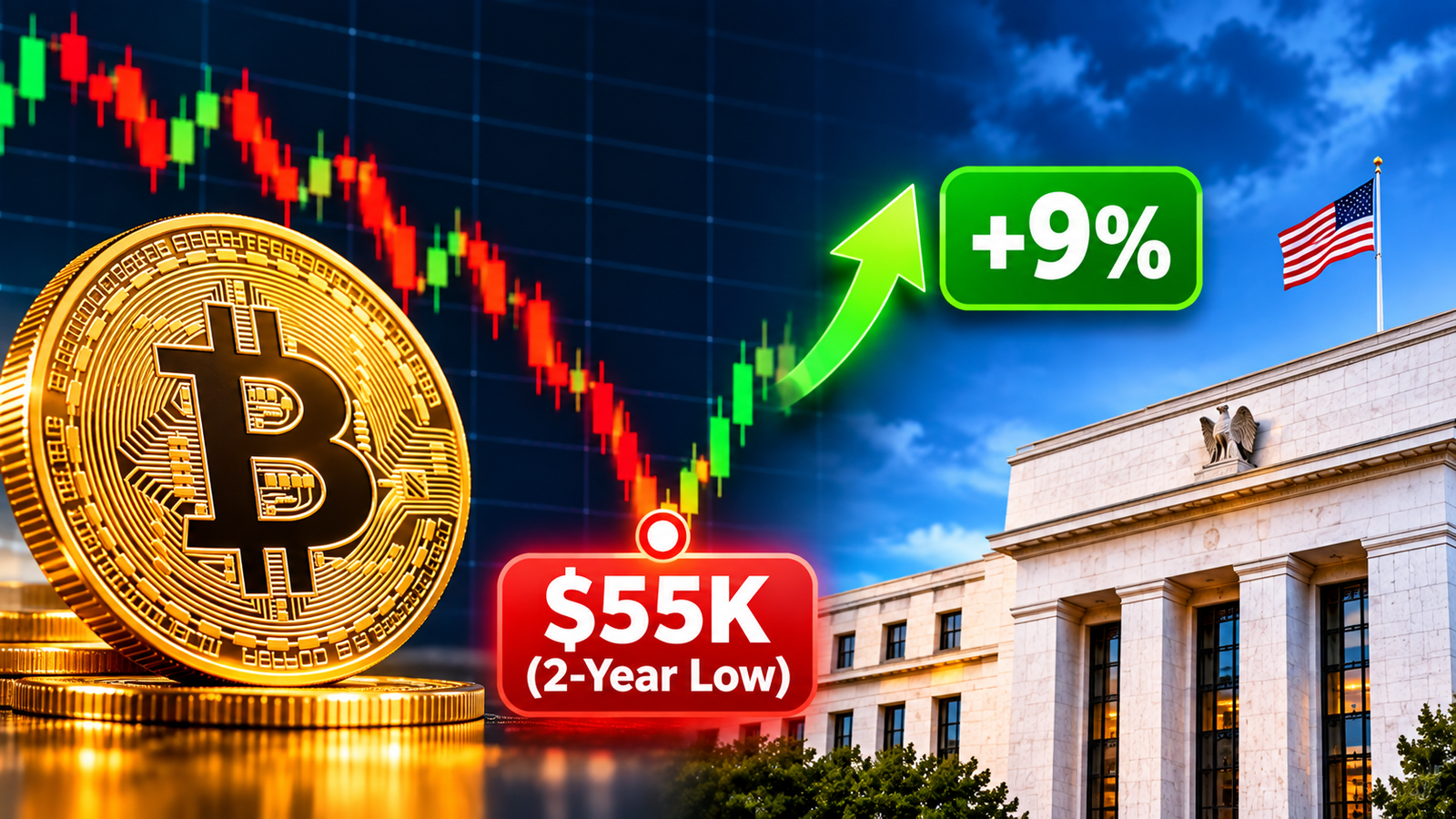
- Bitcoin dropped to $55,130 before rebounding above $60,000, after a $1.8B liquidation wave.
- US spot bitcoin ETFs lost $1.79B last week, the fourth straight week of outflows, while stablecoin supply keeps shrinking.
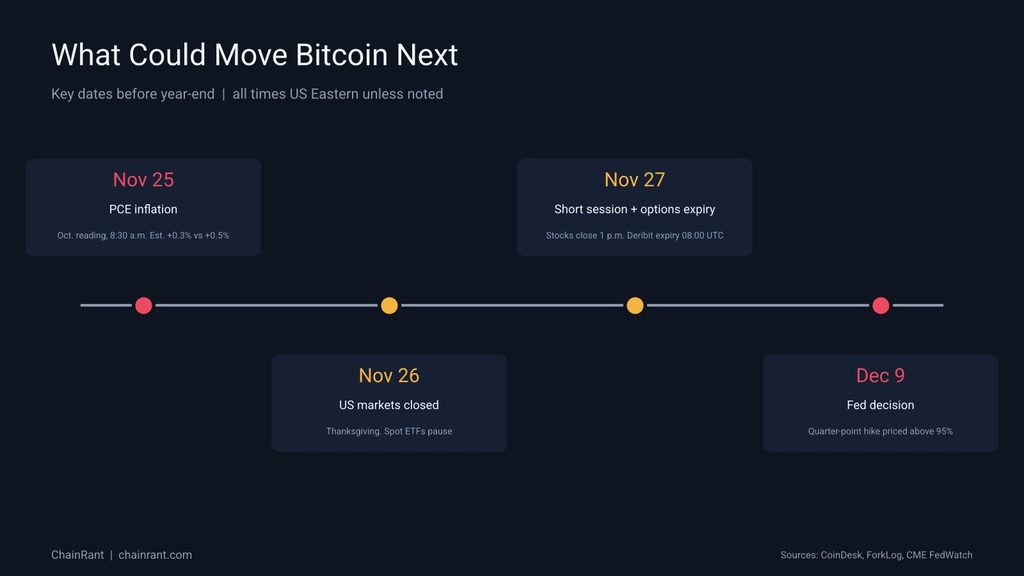
- Wednesday’s PCE report and the December 9 Fed decision are the next big tests for any recovery.
Bitcoin just survived its ugliest week in months. After a weekend plunge to $55,130, its lowest since September 2024, buyers pushed the price back above $60,000. But with ETF money still flowing out and the Fed preparing another rate hike, this bounce hasn’t convinced anyone that the worst is over.

A Week That Ended in Capitulation
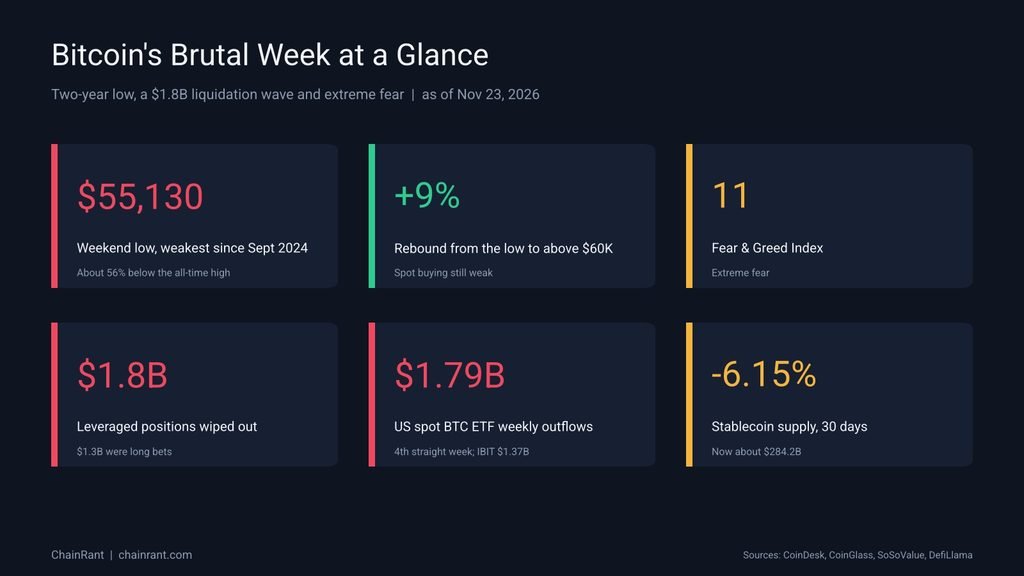
The week began calmly enough, with bitcoin trading near $64,500 on Monday morning. By the weekend it had dropped to $55,130, its weakest level since September 2024, roughly 56% below the all-time high. Ether briefly slipped under $1,550 before recovering, and Solana now trades near $72. forklogCoinDesk
Friday did the most damage. The selloff wiped out about $1.8 billion in leveraged positions, around $1.3 billion of them bets on rising prices, clearing a large cluster of longs between $59,000 and $62,000 that Glassnode had tracked for months. CryptoQuant’s Darkfost called it extreme capitulation, noting that holders realized more than $11.3 billion in losses over seven days, roughly eight times the gains. The Fear & Greed Index now reads 11, deep in extreme fear.
The pain wasn’t limited to crypto. The Nasdaq fell more than 4% on Friday, leaving it near bear-market territory, and Nvidia’s leadership turmoil after Jensen Huang’s resignation on November 12 has rattled the AI trade that has carried this year’s market.
Also Read: 4 Weeks, $4.14B Gone: Why Institutions Are Dumping Bitcoin ETFs Now
Why the Bounce Is Hard to Trust
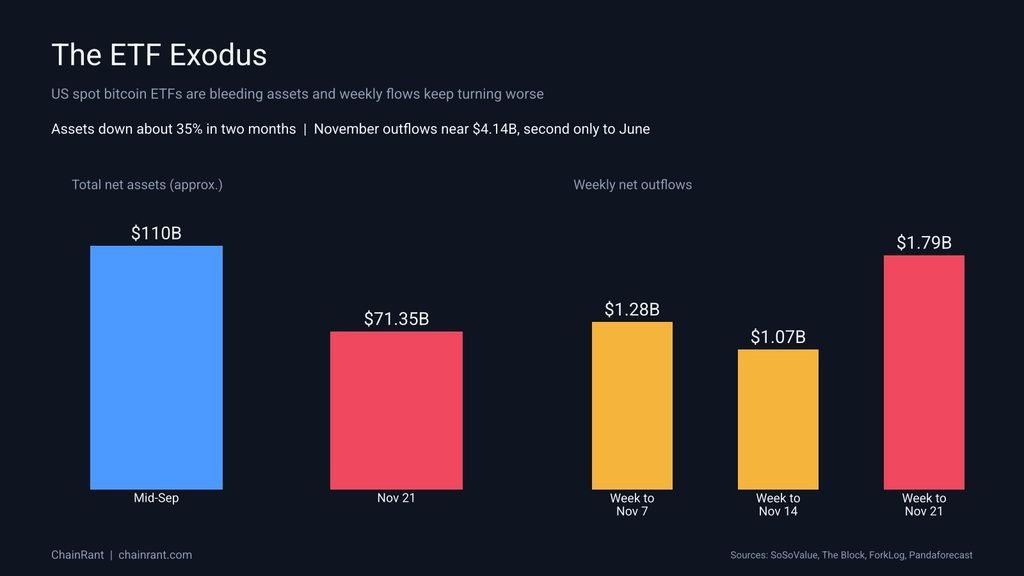
Institutions are still heading for the exit. US spot bitcoin ETFs lost about $1.79 billion last week, according to SoSoValue data reported by The Block. That’s the biggest weekly outflow since late June and the fourth straight week of withdrawals. BlackRock’s IBIT accounted for $1.37 billion. Total fund assets have shrunk to $71.35 billion from around $110 billion in mid-September, and ether ETFs shed another $314 million for an eighth consecutive weekly outflow.
Money is also leaving the crypto system itself. Total stablecoin market cap has dropped to about $284.2 billion, down roughly 6% in 30 days, which means less fresh capital waiting on the sidelines. Analysts at QCP Capital argue that a lasting recovery needs calmer tech stocks, steadier interest rates and proof that institutional money is coming back. Until then, they warn, short-covering rallies may struggle to grow into anything sustained.
The Fed is the other weight. More than 95% of traders expect a quarter-point hike in December, and bets on a half-point move have faded after last week’s rout. That puts extra focus on Wednesday’s PCE report, which is expected to show a 0.3% monthly rise, down from 0.5%. A hotter reading would revive the case for a bigger move, and that usually hurts assets like bitcoin first. Adding to the mood, a suspected $4.86 million vault drain sent Chainflip’s FLIP token down 30%.
Opinion: What to Expect for the Rest of 2026
This is an editorial view, not a forecast or financial advice.
I don’t think this is the bottom, and I don’t think it’s a collapse either. The most likely path to year-end is a wide, uncomfortable range between roughly $52,000 and $68,000.
The capitulation signs are encouraging: a big liquidation flush, heavy realized losses and extreme fear. But a bounce built on short covering isn’t a trend change, and the ingredients for a real recovery are still missing. Yields aren’t falling, the Nasdaq hasn’t stabilized and ETFs are still bleeding.
The Fed’s December 9 decision is the date that matters most. A clean quarter-point hike with cooler inflation could carry bitcoin back toward $65,000 to $68,000. A hot PCE print or hawkish guidance would likely mean a retest of $55,000, and a decisive break there opens the door to the low $50,000s.
I’d be skeptical of a “Santa rally.” The better signal for bulls is far less exciting: two or three straight days of ETF inflows alongside a steadier Nasdaq. Until we see that, expect sharp bounces that fade.
Disclaimer: The information in this article is for general purposes only and does not constitute financial advice. The author’s views are personal and may not reflect the views of Chain Affairs. Before making any investment decisions, you should always conduct your own research. Chain Affairs is not responsible for any financial losses.


I’m the cryptocurrency guy who loves breaking down blockchain complexity into bite-sized nuggets anyone can digest. After spending 5+ years analyzing this space, I’ve got a knack for disentangling crypto conundrums and financial markets.