

|
Getting your Trinity Audio player ready...
|
Swiss Bitcoin Pay, the Neuchâtel-based Bitcoin payment processor has temporarily taken its servers offline after detecting what it believes was a data breach. The company hasn’t confirmed the scope of the incident, what kind of data may have been exposed, or how many users could be affected — but it has said, importantly, that no customer funds or private keys appear to be at risk.
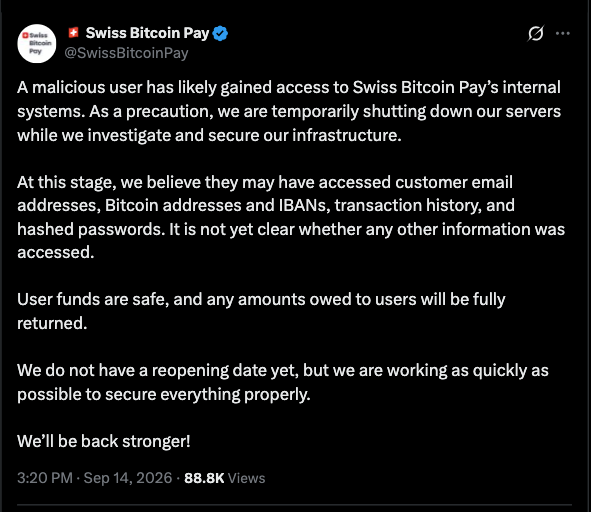
That distinction matters because of how the platform is built. Swiss Bitcoin Pay operates on a non-custodial model, meaning payments go directly into merchants’ own wallets rather than sitting in accounts the company controls. Even if attackers got into company servers, there was no central pot of customer Bitcoin for them to drain.
What the Company Has — and Hasn’t — Said
Swiss Bitcoin Pay Sàrl is a licensed Swiss Financial Intermediary, offering merchants a way to accept Bitcoin through both on-chain payments and the Lightning Network. It charges 1% on transactions merchants choose to keep in Bitcoin, and 1.5% for automatic conversion to fiat.
So far, the company has stayed quiet on specifics. No public statement has detailed how the breach was discovered, what systems were affected, or whether any merchant data — account details, transaction logs, or API keys — was accessed. What has changed is visible on the technical side: the company’s open-source app, available on both iOS and Android, along with its merchant API, are still up and running, and some security patches have reportedly gone out since the incident was detected.
Not the First Scare for Swiss Crypto Services
This isn’t an isolated event in Switzerland’s crypto payments scene. Back in August 2026, Pocket Bitcoin — a related but separate service — disclosed a data exposure affecting 5,411 customers. That incident was unconnected to what happened at Swiss Bitcoin Pay, and, notably, it also didn’t put customer funds at risk. Two separate scares within a matter of weeks is likely to draw more scrutiny to how these smaller, sovereignty-focused Bitcoin payment platforms secure their backend infrastructure, even when the money itself is designed to stay out of reach.
Founded in late 2022, Swiss Bitcoin Pay built its reputation around giving merchants — from restaurants to retail shops — full control over their Bitcoin, supporting tools like Bolt Cards for NFC-based tap-to-pay transactions.
Why “Non-Custodial” Doesn’t Mean “Unhackable”
The incident is a useful reminder that non-custodial doesn’t mean invulnerable. Wallets being out of a company’s hands protects against the worst-case scenario — stolen funds — but servers still store plenty of sensitive material: merchant account details, transaction histories, API keys, and potentially identifying information tied to real businesses.
The fact that Swiss Bitcoin Pay chose to shut its servers down entirely, rather than try to patch the issue while staying online, suggests the company treated the threat as serious enough to accept the disruption. As of now, it hasn’t released further detail on who was affected or what data was involved, leaving merchants who rely on the platform in a holding pattern until more information surfaces.

I’m your translator between the financial Old World and the new frontier of crypto. After a career demystifying economics and markets, I enjoy elucidating crypto – from investment risks to earth-shaking potential. Let’s explore!