|
Getting your Trinity Audio player ready...
|
Key takeaways
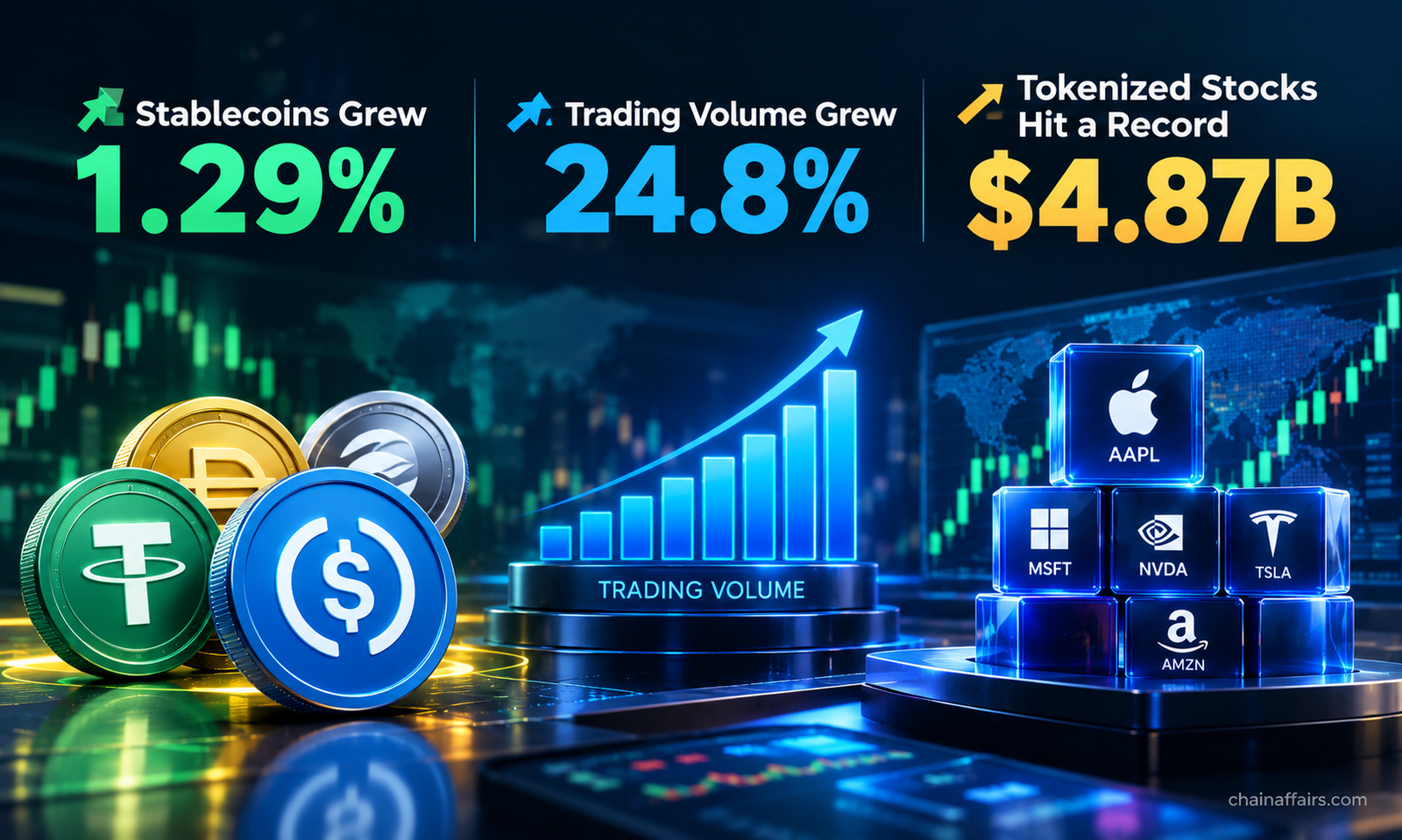
- Stablecoin market cap rose just 1.29% to $313B, but centralized exchange volume jumped 24.8% to $1.01T, the first month above $1T since March. Tether and USDC handled 96.1% of that volume.
- Total on-chain RWA AUM slipped 0.52% to about $34B, but tokenized bonds and money market funds fell 8.1% to $17.3B while tokenized stocks hit a record $4.87B (+13.7%) and private credit rose 7.15% to $5.62B.
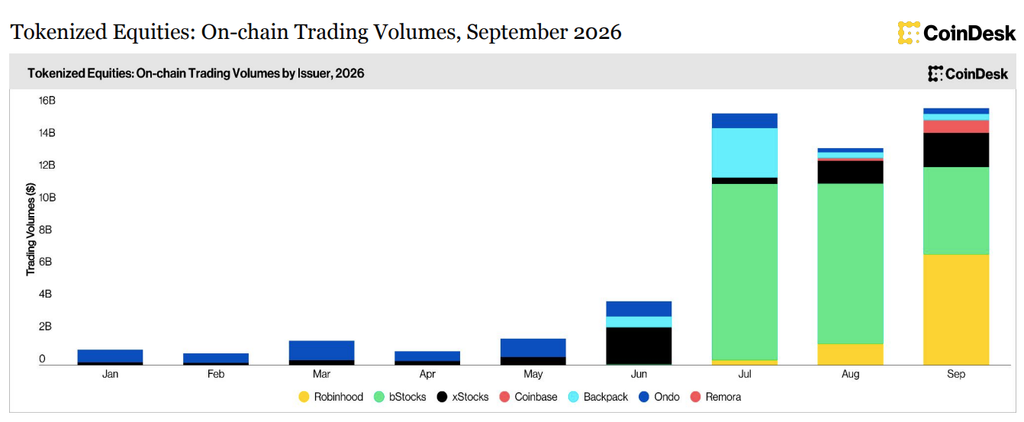
- On-chain equity volume hit a record $15.6B, and Robinhood leapfrogged bStocks to take 42.0% of it, up from 9.7% in August.
If September’s data tells one story, it’s that activity is outrunning capital. Stablecoin supply barely moved, yet trading volume jumped by a quarter. Tokenized stocks set records while the once-dominant tokenized Treasury funds shrank. CoinDesk’s September 2026 Stablecoins & Tokenized Assets Report, with data correct as of September 30, lays out a market that is broadening fast and getting more crowded at the top.
Stablecoins Slow Supply, Fast Trading
Stablecoin market capitalization rose 1.29% to $313 billion, its second straight monthly gain. That’s a modest result. The sector has added roughly $7.5 billion since the end of July, but total supply remains below the records set earlier this year.
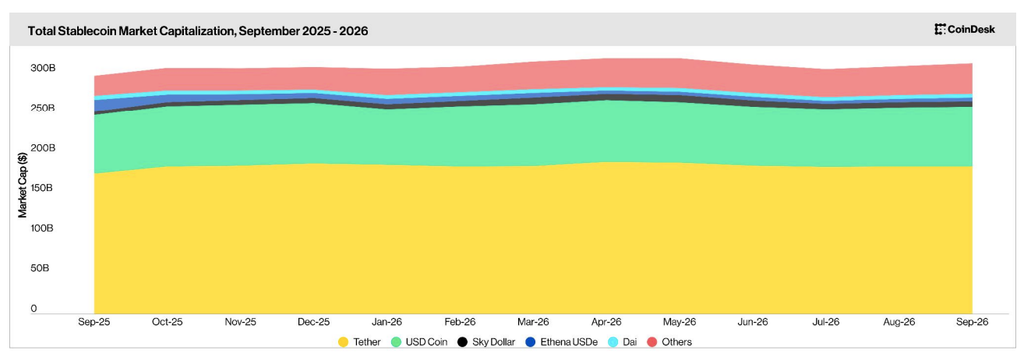
Meanwhile, the broader digital asset market grew 8.46% in the month, so stablecoin dominance slipped to 10.5% from 11.3% in August. In plain terms, crypto rallied and stablecoins didn’t keep pace.
Trading told a different story. Stablecoin-pair volume on centralized exchanges rose 24.8% to $1.01 trillion, up from $812 billion in August and the first month above $1 trillion since March. More trading on little extra supply means the same dollars are turning over faster.
A Two-Horse Race, With Challengers Circling
Concentration is still extreme. Tether accounted for 72.1% of stablecoin trading volume, with USDT-pair volume rising 25.8% to about $731 billion. USDC’s volume grew faster, up 29.2% to $243 billion, which lifted its share to 24.0%. Together the two handled 96.1% of all stablecoin-pair volume.
On supply, Tether’s market cap edged up 0.17% to $184 billion, but its share slipped to 58.7% from 59.4% as smaller coins grew. USDC rose 0.70% to $74.6 billion, its highest since May, and holds 23.8% of supply.
The challengers are where it got interesting:
- Ethena’s USDe jumped 20.2% to $4.90 billion, the biggest gain in the top ten, overtaking DAI to become the fourth-largest stablecoin. It has recovered about $1.03 billion from its July low.
- Ripple USD rose 6.4% to $2.52 billion.
- World Liberty Financial’s USD1 gained 5.6% to $4.43 billion.
- Global Dollar fell 5.1% and PayPal USD slipped 2.4%.
USDe’s rebound deserves context. CoinDesk’s chart shows it still sits far below its autumn 2025 peak, so this is a recovery, not a return to form.
Also Read: IOTA’s Showcases Are Either the Real Thing or the Best-Dressed Pilot Program in Crypto
Circle’s Big Month
Circle had the busiest September. It launched its Arc mainnet on September 16, a Layer 1 that uses USDC for gas, with more than 100 institutional and ecosystem participants. USDC supply on Arc hit roughly $649 million shortly after launch before ending the month near $465 million. Launch-day figures flatter, so month-end is the number to watch.
Distribution got a boost too. Binance added Arc support, invested $100 million in Circle and renewed its five-year partnership. Circle’s tokenized fund USYC moved the other way, falling 13.4% to $2.40 billion.
Tokenized Assets: The Rotation Away From Treasuries
Total on-chain real-world asset AUM slipped 0.52% to about $34 billion after touching an intra-month high of $35.1 billion on September 8. The headline was flat, but the mix changed.
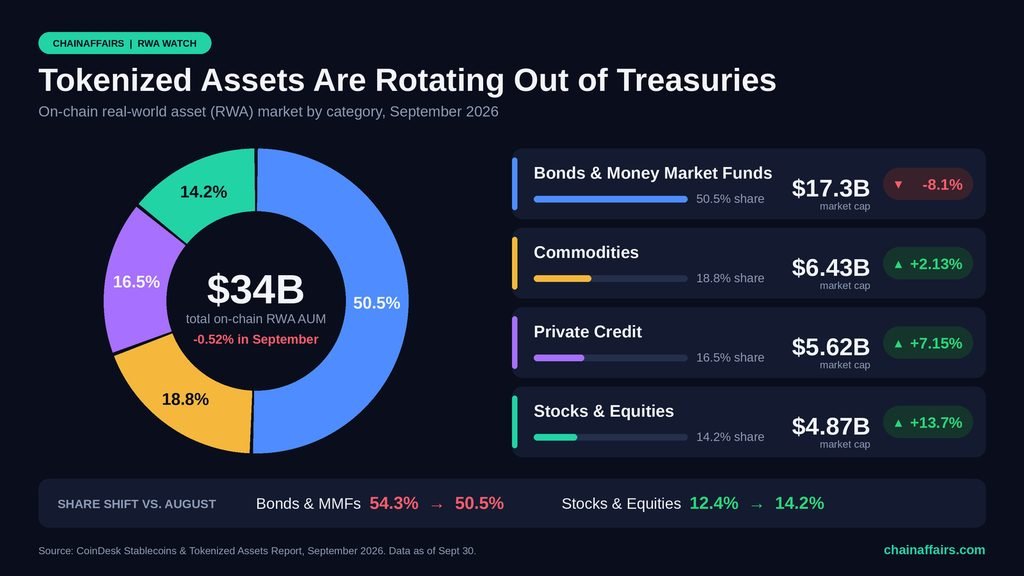
Tokenized bonds and money market funds still lead, but their share fell from 54.3%. BlackRock’s BUIDL dropped 19.6% to $2.24 billion, while mid-sized products grew, including Spiko’s euro fund, WisdomTree’s Treasury fund and Franklin Templeton’s iBENJI. The three largest funds now hold 40.1% of the category, down from 41.3%. The report doesn’t say why capital is leaving, so any explanation is speculation.
Commodities had a third straight monthly gain, but gold dominates. Tether Gold rose 10.0% to $3.46 billion and PAX Gold fell 5.2% to $1.81 billion, together holding 82.0% of the sector.
Tokenized Stocks Break Records
The standout was equities. Tokenized stock market cap hit a record $4.87 billion, led by Securitize at $1.62 billion (33.3% share), then Ondo at $1.00 billion and xStocks at $874 million. The top three hold 71.9% of the market.
Trading was wilder. On-chain tokenized equity volume rose 16.4% to a record $15.6 billion, edging past July’s $15.4 billion. Market share moved fast:
- Robinhood volume surged 407% to $6.57 billion, lifting its share to 42.0% from 9.7% in a single month.
- bStocks fell 45.5% to $5.42 billion, dropping to second place.
- xStocks rose 48.5% to $2.11 billion, and Coinbase nearly quintupled to $804 million.
A rough read: monthly trading volume ran about three times the value of tokenized equities outstanding. That points to a trading-driven market rather than a buy-and-hold one, although the report’s volume and AUM figures cover different sets of venues, so treat the ratio as indicative.
Ethena also said it plans to bring tokenized U.S. equities into USDe’s backing, pairing Binance bStocks with short equity perpetual positions.
The Institutional Backdrop
The report’s news log shows traditional finance moving in. U.S. Bank launched its USBDC stablecoin, the SEC issued a temporary “Innovation Exemption” for on-chain trading of tokenized U.S. stocks, UK banks completed live tokenized sterling deposit transactions, and BlackRock received authorization for a Hong Kong dollar digital liquidity fund. The report doesn’t link any of these to the volume records, so the timing is suggestive, not proven.
Report Source : CoinDesk Stablecoins & Tokenized Assets Report, September 2026.
For now, September’s lesson is simple: the money is moving, but it isn’t all moving in the same direction.
Disclaimer: The information in this article is for general purposes only and does not constitute financial advice. The author’s views are personal and may not reflect the views of Chain Affairs. Before making any investment decisions, you should always conduct your own research. Chain Affairs is not responsible for any financial losses.

I’m the cryptocurrency guy who loves breaking down blockchain complexity into bite-sized nuggets anyone can digest. After spending 5+ years analyzing this space, I’ve got a knack for disentangling crypto conundrums and financial markets.