|
Getting your Trinity Audio player ready...
|
They come dressed in slick artwork, celebrity endorsements, and promises of generational wealth. NFT rug pulls have cost investors hundreds of millions of dollars — and they’re getting harder to distinguish from legitimate projects. As the market matures, so do the scammers. Here’s what every collector and trader needs to know before minting another token.
The Anatomy of an NFT Rug Pull
An NFT rug pull follows a predictable — yet devastatingly effective — playbook. A team launches a collection, builds artificial hype through social media and influencer partnerships, drives a successful mint, and then disappears. Promises of games, metaverse integrations, and exclusive holder benefits evaporate overnight. What’s left is a worthless JPEG and an empty roadmap.
The scale of the problem is staggering. According to blockchain analytics firms, NFT-related fraud accounted for billions in losses at the height of the 2021–2022 bull market, with rug pulls representing the single largest category of theft.
NFT Rug Pull Warning Signs You Can’t Afford to Ignore
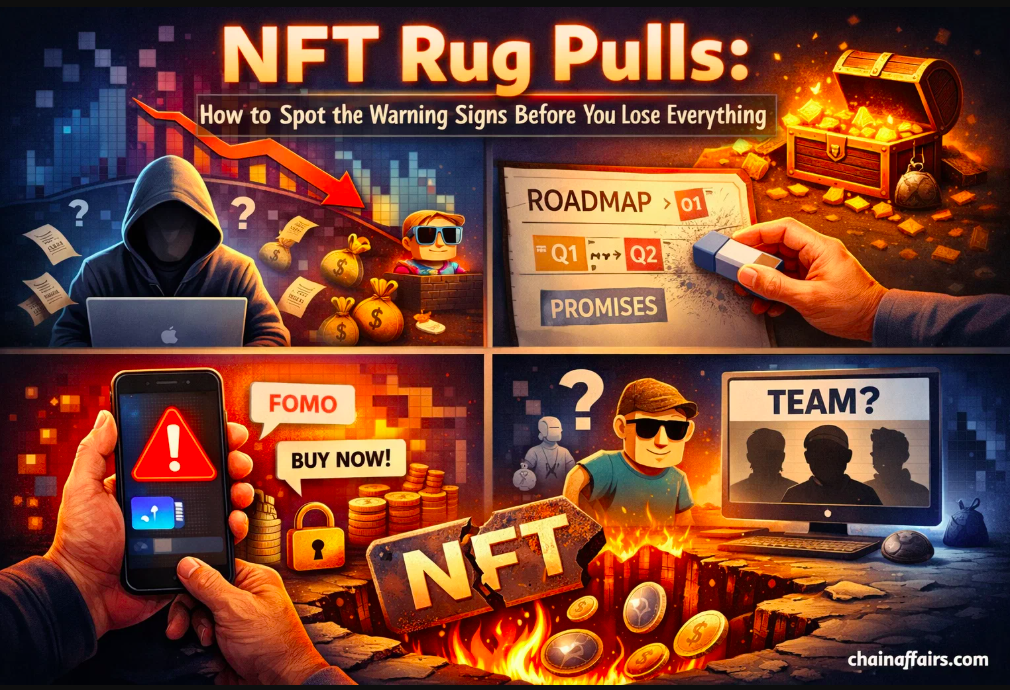
1. Anonymous Teams With No Verifiable History The most persistent warning sign is anonymity without accountability. Pseudonyms alone aren’t disqualifying — some credible artists operate under aliases — but the absence of any verifiable professional track record, prior work, or doxxed team members should raise immediate red flags. Search the founders across platforms. If nothing comes up, that silence speaks volumes.
2. Locked or Heavily Moderated Communities Healthy NFT communities welcome hard questions. If a project’s Discord bans users for raising concerns, mutes criticism, or floods channels with bot activity to simulate engagement, you’re likely looking at a managed illusion. Authentic communities have friction — debates, disagreements, and open dialogue.
3. Vague or Unverifiable Roadmaps Ambitious roadmaps sell mints. But promises without timelines, third-party partnerships that can’t be independently confirmed, or utility claims that lack any technical foundation are classic manipulation tactics. Always ask: what has this team actually shipped before?
4. Suspicious Smart Contract Permissions This is where on-chain forensics become essential. Before minting, examine the smart contract on Etherscan or a tool like Rugdoc.io. Key questions: Can the developer mint unlimited tokens post-launch? Do they hold a pause function that can freeze transfers? Is the royalty wallet controlled by a single address? Each of these is a structural vulnerability that bad actors exploit.
5. Abnormal Wallet Concentration Use tools like Bubblemaps or Nansen to map token distribution. If 10–15 wallets hold the overwhelming majority of a collection’s NFTs — especially when those wallets were funded from the same source — coordinated dumping is a realistic and imminent risk.
6. The Hype-to-Substance Ratio Paid influencer campaigns, countdown timers, and artificial scarcity tactics are not inherently malicious — but when they far outweigh any demonstrable product progress, the marketing itself becomes the warning. Legitimate projects build; fraudulent ones perform.
Also Read: How to Spot a Rug Pull Before It Happens 2025: 7 Proven On-Chain Warning Signs
How to Protect Yourself Before You Mint
Due diligence doesn’t have to be complicated. Before committing funds to any NFT project, run through this quick checklist:
- Verify the team — search names, handles, and wallet histories across LinkedIn, Twitter, and GitHub.
- Check the contract — use Token Sniffer, Rugdoc, or Etherscan to flag malicious functions.
- Review liquidity locks — confirm that secondary market liquidity is locked and for how long.
- Audit community health — look for genuine discourse, not manufactured excitement.
- Search for coverage — legitimate projects attract independent press; scams rarely survive scrutiny.
The Bigger Picture
NFT rug pulls aren’t simply a technical problem — they’re a trust problem. As long as the barrier to launching a fraudulent collection remains low and the potential payout remains high, bad actors will keep entering the space. Regulatory clarity may eventually raise the floor, but until then, the responsibility falls squarely on the investor.
In a market where a single mint decision can define or destroy a portfolio, skepticism isn’t cynicism — it’s survival.
Always conduct independent research before investing in any NFT project. This article is for informational purposes only and does not constitute financial advice.
Disclaimer: The information in this article is for general purposes only and does not constitute financial advice. The author’s views are personal and may not reflect the views of Chain Affairs. Before making any investment decisions, you should always conduct your own research. Chain Affairs is not responsible for any financial losses.

I’m your translator between the financial Old World and the new frontier of crypto. After a career demystifying economics and markets, I enjoy elucidating crypto – from investment risks to earth-shaking potential. Let’s explore!