|
Getting your Trinity Audio player ready...
|
Stay Ahead of IOTA Trends—Join our IOTA Telegram channel!
- EVs can barter energy via IOTA, using mutual return agreements instead of money, with zero transaction fees.
- Simulation results showed up to 69% cost savings for EV owners and improved grid stability during outages.
- IOTA’s role expands beyond energy, with applications in trade finance, logistics, and EU-compliant sustainability tracking.
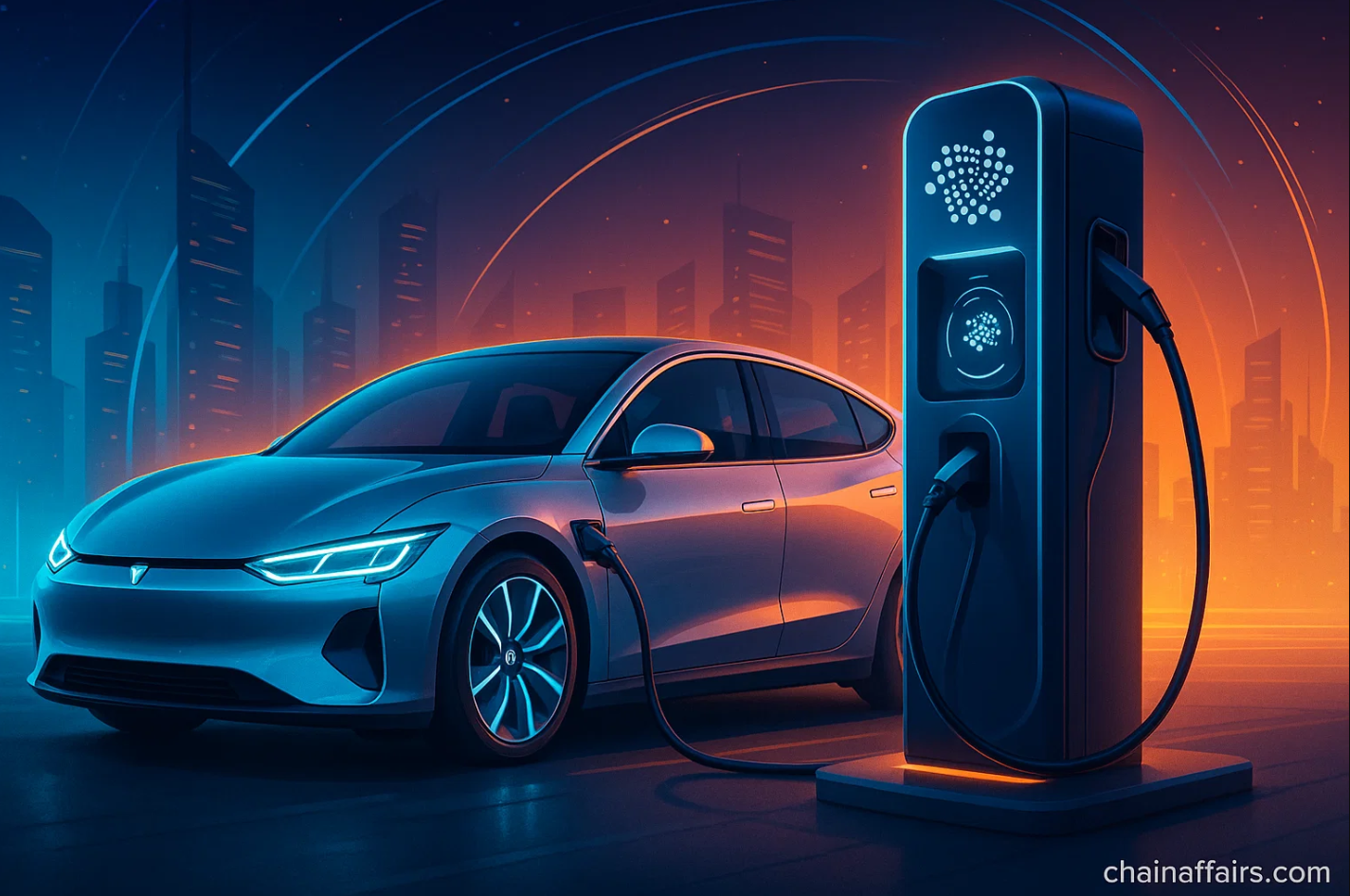
A new study suggests that electric vehicles (EVs) could one day power each other and the grid directly, without money changing hands. The research, published in IEEE Transactions on Green Communications and Networking, outlines a framework built on IOTA technology that enables energy trading through mutual return agreements instead of traditional financial payments.
IOTA Enables Energy Bartering Between EVs
The study, led by researchers Muhammad Rizwan, Ammar Hawbani, Xingfu Wang, Shivanshu Shrivastava, Pelin Angin Ulkuer, and Liang Zhao, introduces a model where each EV acts as a mobile energy source. Vehicles can share or receive power from other EVs or the grid, with all exchanges recorded on IOTA’s fee-free, scalable ledger.
Instead of paying in currency, participants agree to return equivalent energy later, making the system a form of energy bartering. Technology enthusiast Salima summarized the concept on X: “Goodbye money, hello energy bartering.”
This approach avoids the transaction costs and congestion seen in conventional blockchains, while enabling millions of micro-energy trades instantly.
Simulation Results: 69% Cost Savings and Grid Stability
Using a Stackelberg game model, the framework allowed EVs to submit energy offers while the grid operator selected the most efficient deals. Simulations showed:
- Up to 69.23% lower energy costs for EV owners compared to standard setups.
- Improved grid resilience, with idle vehicles supplying backup power during simulated outages.
These results highlight both economic and infrastructural benefits, suggesting that IOTA could be key to future decentralized energy networks.
Alos Read: IOTA Identity Could End $450B Counterfeit Crisis — Here’s How
Beyond Energy: IOTA’s Expanding Role
While the EV study demonstrates IOTA’s potential in energy, the technology already powers initiatives across multiple industries:
- Trade finance: Tokenized invoices and digitized mineral supply chains in Singapore and East Africa.
- Logistics: Smart containers tracking cargo conditions and enabling secure, remote-controlled deliveries.
- Sustainability & compliance: An EU pilot for battery lifecycle tracking, from manufacturing to recycling, ensuring GDPR-compliant data storage.
As Salima noted, “IOTA isn’t just crypto — it’s the backbone of tomorrow’s energy economy.”
Outlook
The proposed framework could fundamentally reshape EV-grid interaction, making vehicles not just consumers but active energy participants. If adopted, it promises lower costs, higher efficiency, and stronger grid stability — paving the way for a new era of decentralized, money-free energy trade powered by IOTA.
Disclaimer: The information in this article is for general purposes only and does not constitute financial advice. The author’s views are personal and may not reflect the views of Chain Affairs. Before making any investment decisions, you should always conduct your own research. Chain Affairs is not responsible for any financial losses

I’m your translator between the financial Old World and the new frontier of crypto. After a career demystifying economics and markets, I enjoy elucidating crypto – from investment risks to earth-shaking potential. Let’s explore!