|
Getting your Trinity Audio player ready...
|
The sudden collapse of MANTRA’s OM token this week sent shockwaves through the crypto market, raising serious concerns over transparency, insider control, and the integrity of tokenized asset projects. Within an hour, OM plummeted over 90%, wiping out more than $5.5 billion in market capitalization. With the team allegedly holding 90% of the token supply, investor fears of insider trading and market manipulation quickly took hold.
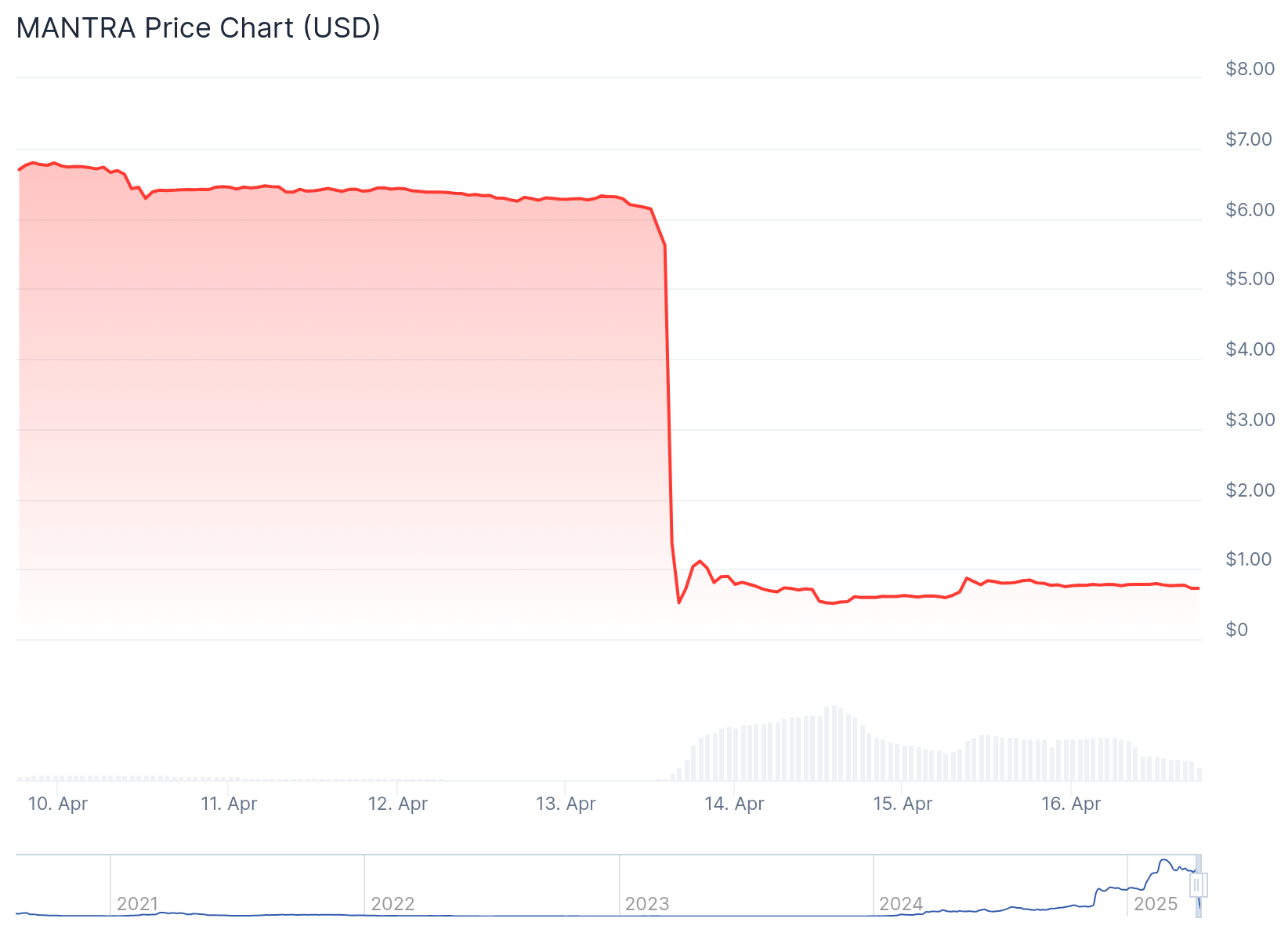
Experts from Blocksquare, Credefi, and QuantHive shared insights with BeInCrypto on the broader implications of the crash. “It’s a classic case of low transparency meeting high concentration risk,” said Credefi CEO Ivo Grigorov, referring to the 3.9 million OM tokens deposited to OKX from a wallet linked to the MANTRA team. The crash triggered $66.97 million in forced liquidations within 12 hours, compounding losses.
QuantHive’s analysis revealed a dramatic sentiment shift. “Previously, Alpha wallets were accumulating OM. But in just 48 hours, $2.5 million was sold versus $1.6 million bought,” noted Felix Huang, indicating a sharp decline in confidence.
Who dropped the price of $OM?
— Lookonchain (@lookonchain) April 14, 2025
Before the $OM crash(since Apr 7), at least 17 wallets deposited 43.6M $OM($227M at the time) into exchanges, 4.5% of the circulating supply.
According to Arkham’s tag, 2 of these addresses are linked to Laser Digital.
Laser Digital is a strategic… pic.twitter.com/zB8yAPRPSO
The crash was worsened by whale sell-offs. Blockchain analytics identified 43.6 million OM tokens—4.5% of circulating supply—deposited to exchanges, signaling major investor exits.
Reports of prior mismanagement, including OTC deals and delayed airdrops, further tainted MANTRA’s credibility. “This kind of collapse reflects deeper concerns that had been building for months,” Grigorov said. Blocksquare’s Denis Petrovcic emphasized that trust and transparency are non-negotiables for Web3: “Communities are not just spectators—they are stakeholders.”
Also Read: Why Mantra’s OM Token Experienced a 90% Crash: A Look into the Market Forces at Play
Despite the fallout, experts stress that the Real World Asset (RWA) sector remains strong. “It’s a blow to one project, not to the RWA movement,” said Petrovcic, highlighting that serious builders are anchored in legal frameworks and long-term utility.
Ultimately, the MANTRA incident serves as a cautionary tale—underscoring the need for transparency, decentralized governance, and public accountability. For the RWA space, it’s not a death knell—but a defining moment for higher standards.
Disclaimer: The information in this article is for general purposes only and does not constitute financial advice. The author’s views are personal and may not reflect the views of Chain Affairs. Before making any investment decisions, you should always conduct your own research. Chain Affairs is not responsible for any financial losses.

I’m your translator between the financial Old World and the new frontier of crypto. After a career demystifying economics and markets, I enjoy elucidating crypto – from investment risks to earth-shaking potential. Let’s explore!