
|
Getting your Trinity Audio player ready...
|
- IOTA combines Delegated Proof-of-Stake — where token holders delegate voting power to validators — with the Starfish BFT protocol to achieve fast, energy-efficient, and fault-tolerant consensus across all three of its networks.
- Starfish reaches transaction finality in just three communication rounds using a DAG structure that allows parallel block proposals, separates headers from payloads, and uses erasure coding to cut redundant data broadcasts.
- The protocol maintains stable performance even when up to one-third of validators fail or act maliciously — a structural guarantee rather than a best-case assumption.
Blockchain networks live and die by their consensus mechanism. Get it wrong and you end up with slow finality, centralization risk, or runaway energy costs. IOTA has built its answer around two interlocking systems: Delegated Proof-of-Stake to govern who participates, and a purpose-built Byzantine Fault Tolerant protocol called Starfish to do the actual work of ordering and confirming transactions. The combination is now live across all three IOTA networks.
How validators and token holders share the load
IOTA’s consensus starts with its dPoS layer. Token holders don’t run validators themselves — they delegate their voting weight to operators who do. Those validators form the Consensus Committee, a group that stays fixed for the duration of each epoch to keep the system stable. Their job is to accept incoming transactions, keep a consistently ordered ledger, and prevent double-spends.
Validators are financially incentivized to behave — staking rewards flow to those who participate honestly, and the threat of lost delegation keeps them accountable to the token holders who backed them. It’s a structure designed to balance decentralization with operational efficiency: not everyone needs to run a node, but no single entity controls the outcome.
What Starfish actually does differently
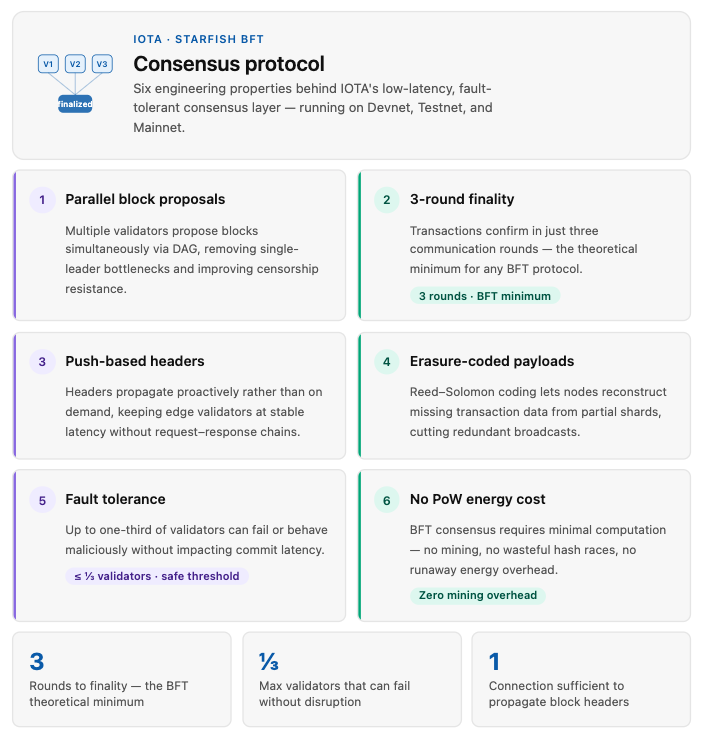
Starfish is the BFT engine underneath all of this. It uses a Directed Acyclic Graph structure rather than a traditional linear chain, which means multiple validators can propose blocks at the same time instead of waiting their turn behind a single elected leader. That parallel approach is where much of the speed advantage comes from.
Finality is reached in three rounds of communication — matching the theoretical minimum for any BFT system. Block headers and transaction data travel separately: headers are pushed proactively to peers rather than pulled on demand, so validators at the edge of the network with slower connections don’t fall behind waiting for round-trip responses. Transaction payloads use Reed–Solomon erasure coding, meaning nodes can reconstruct missing data from partial shards rather than requiring full redundant broadcasts.
Also Read: Can IOTA’s Starfish Solve Validator Delays? What the New Upgrade Means
The protocol is also built to keep running when things go wrong. Up to one-third of validators by stake can go offline, crash, or actively attempt to disrupt consensus without meaningfully affecting commit times. That fault tolerance, combined with the push-based header propagation, gives Starfish what its designers call deterministic and predictable commit performance — the network doesn’t degrade gradually, it holds its performance floor.
Why the architecture choices matter
Each design decision in Starfish addresses a specific failure mode seen in earlier consensus systems. Single-leader protocols create latency spikes whenever that leader is slow or unreachable. Pull-based header dissemination means edge nodes accumulate round-trip delays. Full transaction broadcasting wastes bandwidth as networks scale. Starfish handles each of these through structural solutions rather than brute-force throughput increases.
The result is a consensus layer that is energy-efficient relative to proof-of-work chains, more resilient to network disruption than many BFT predecessors, and designed to maintain consistent performance rather than just peak performance. For a network positioning itself as infrastructure for real-world applications — from supply chain tracking to financial settlement — that predictability matters as much as raw speed.
🔗 Reference: Starfish Paper
Disclaimer: The information in this article is for general purposes only and does not constitute financial advice. The author’s views are personal and may not reflect the views of Chain Affairs. Before making any investment decisions, you should always conduct your own research. Chain Affairs is not responsible for any financial losses.

I’m your translator between the financial Old World and the new frontier of crypto. After a career demystifying economics and markets, I enjoy elucidating crypto – from investment risks to earth-shaking potential. Let’s explore!