

|
Getting your Trinity Audio player ready...
|
For years, the pitch was simple. When markets panic, Bitcoin is where you hide. It was meant to be a hard-capped, government-proof store of value, the digital version of the metal people buy when they stop trusting everything else.
This past week offered a live test, and Bitcoin did not pass.
The week the “safe haven” story broke
On November 5, the crypto market lost roughly $140 billion in four hours as Bitcoin dropped below $76,000, triggering more than $1 billion in liquidations. The cause wasn’t a crypto-specific disaster. A sell-off on Wall Street sent shockwaves through digital assets.
A true safe haven rises or holds steady when stocks wobble. Bitcoin did the opposite. By the following morning, it was trading around $75,600, down 6% in 24 hours, while Ethereum fell nearly 8%. The Fear and Greed Index sat at 28, a reading that signals real anxiety.
That is not how gold behaves. It is how a high-beta tech stock behaves.
A one-way correlation
The more uncomfortable problem is that Bitcoin seems to follow stocks down but not up. In August, global equities hit record highs while Bitcoin and the broader crypto market failed to keep pace. Now that stocks have stumbled, crypto has fallen hard alongside them.
Traders call this the worst of both worlds. You take the downside of risk assets without the full upside. Even a post-election bounce this month ran into resistance and faded. October closed down 7.3%, Bitcoin’s second straight losing October.
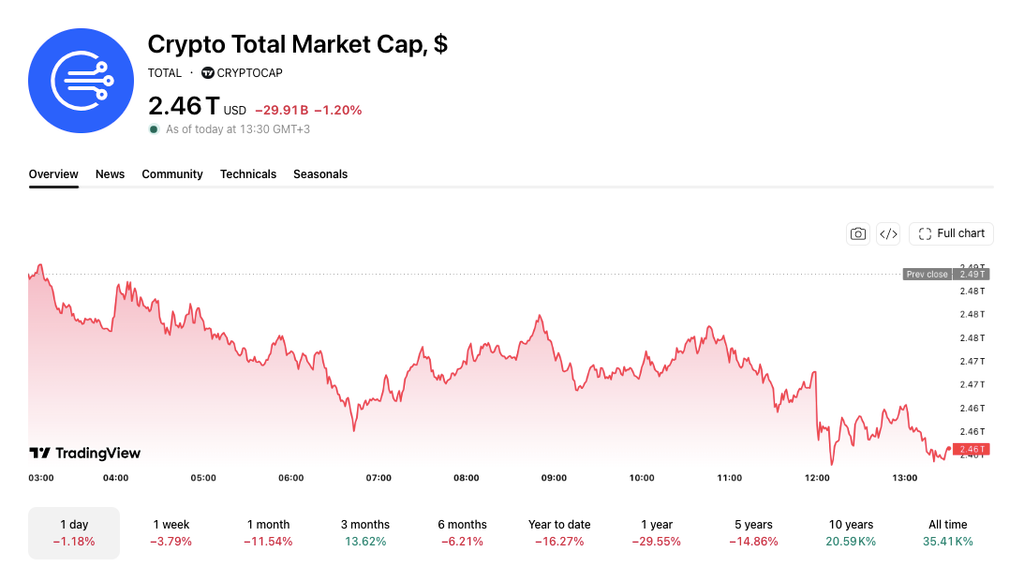
The wider picture is worse. Total crypto market value is about 38.5% below its record of $4.28 trillion, set in October 2025. A year of “digital gold” has produced a drawdown of more than a third.
Why the label stuck anyway
The digital gold story was never entirely wrong. Bitcoin’s supply is capped, and no central bank can print more of it. Those are real properties.
But scarcity alone doesn’t make a safe haven. Gold earned that status over centuries of surviving wars, defaults and currency collapses. Bitcoin has existed for about 17 years, and most of its price history has been driven by leverage, liquidity and sentiment. When liquidity tightens and traders get forced out of leveraged positions, Bitcoin gets sold like everything else.
Institutions made this worse by adopting Bitcoin as a portfolio asset. Once it sits in the same funds and treasuries as tech stocks, it trades with them. Strategy Inc. announced another purchase of 811 Bitcoin worth $65.5 million even as the price slid, which shows conviction but also shows how concentrated corporate exposure has become.
Also Read: Crypto Spent Hundreds of Millions on the Midterms. What Did It Actually Buy?
So what is Bitcoin, then?
Maybe the honest answer is that Bitcoin is a young, volatile, liquidity-sensitive asset with a long-term thesis that hasn’t been proven. That isn’t an insult. It’s a description.
The case for Bitcoin may still hold over a decade. But investors who bought it as portfolio insurance this year have learned it isn’t insurance yet. Insurance pays out when things go wrong, and this week it didn’t.
Dropping the digital gold label would make the market healthier. It would stop new buyers from assuming protection that doesn’t exist, and it would force the industry to defend Bitcoin on its real merits rather than a borrowed narrative.
Until Bitcoin can hold its value when stocks fall, calling it digital gold is marketing, not analysis.
Disclaimer: The information in this article is for general purposes only and does not constitute financial advice. The author’s views are personal and may not reflect the views of Chain Affairs. Before making any investment decisions, you should always conduct your own research. Chain Affairs is not responsible for any financial losses.

I’m the cryptocurrency guy who loves breaking down blockchain complexity into bite-sized nuggets anyone can digest. After spending 5+ years analyzing this space, I’ve got a knack for disentangling crypto conundrums and financial markets.