
|
Getting your Trinity Audio player ready...
|
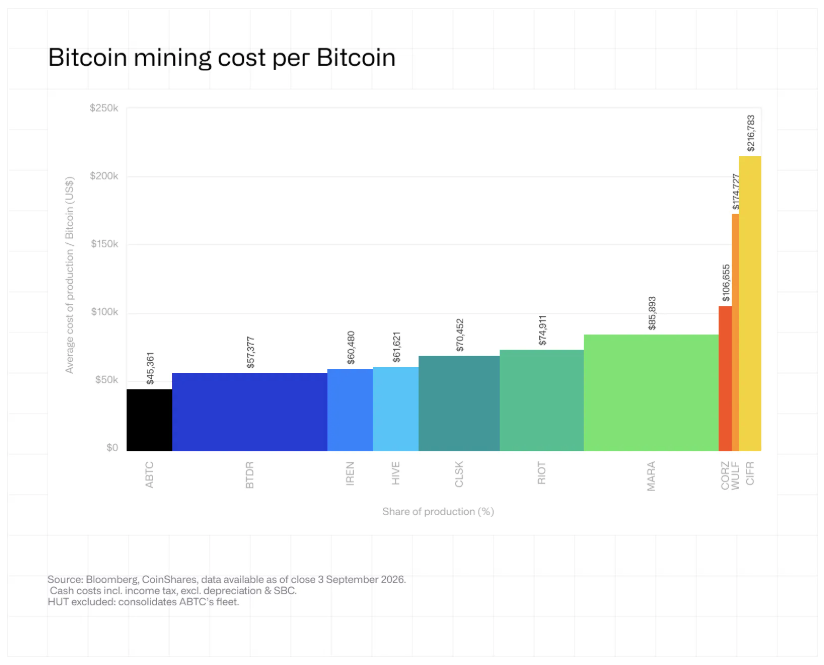
Public Bitcoin mining companies collectively slipped below cash breakeven in the second quarter of 2026, and the numbers explain why. The weighted average pre-tax cash cost to produce a single Bitcoin hit roughly $75,500 during the quarter, while Bitcoin itself closed at $58,400. That gap meant a meaningful chunk of the listed mining sector was losing money on every coin it produced, even before accounting for taxes or debt.
The figures come from CoinShares’ latest quarterly mining report, which also flagged a record-low monthly average hash price of $27.7 per petahash per second per day in June — a measure of how much revenue miners earn for the computing power they deploy. When that number falls, mining gets less profitable regardless of how efficient a company’s operation is.
Hashrate Fell for the First Time Since China’s Mining Ban
Adding to the pressure, Bitcoin’s network hashrate — the total computing power dedicated to mining — sat about 50% below its longer-term trend during the quarter, marking the first six-month hashrate decline since China banned mining outright in 2021. That’s a notable signal, since hashrate had spent 2024 and 2025 climbing sharply, eventually topping 1.2 zettahashes per second earlier in 2026. It’s since pulled back but remains close to 1 zettahash per second, meaning the network is still operating near record capacity even as individual miners bleed cash.
Not every company was hit equally. Operators with cheaper power contracts or more efficient equipment stayed closer to breakeven, while others reported production costs well above $100,000 per coin — nearly double what Bitcoin was trading for at quarter’s end. Bitcoin’s price itself tells part of the story: at roughly $76,700 as of this writing, it remains less than half of its October 2025 peak of $126,080, leaving miners squeezed from both the cost side and the revenue side simultaneously.
Companies Are Paying to Walk Away From Equipment
The clearest sign of how serious the squeeze has become is that some miners are now paying real money just to get out of hardware commitments. Core Scientific disclosed in a filing with the SEC that it terminated a contract with Block Inc. and Proto Global LLC, canceling delivery of next-generation mining equipment representing about 15 exahashes of capacity. The cancellation produced a $41.9 million loss in the second quarter alone, on top of deposits the company had already paid under the original 2024 purchase agreement.
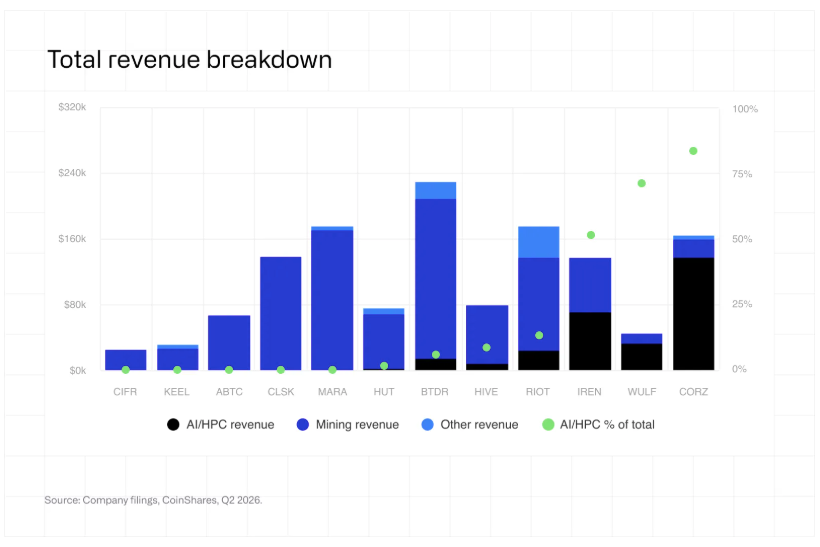
Core Scientific’s move fits into a broader shift it’s been making toward high-density colocation services for AI customers — a business that already generates the majority of the company’s revenue, while income from its own mining operations has dropped sharply. CoinShares described payments like this as part of a wider pattern across the industry, characterizing it plainly as miners paying to stop mining.
Sites Are Being Repurposed, Not Necessarily Abandoned
The report noted that at least 35 exahashes of mining capacity are set to leave the public company cohort entirely, as several firms either exit mining altogether or convert their facilities into high-performance computing sites. Other listed miners have sold off Bitcoin reserves, scaled back expansion plans, or announced full exits from mining as a business.
There’s a strategic logic behind converting rather than closing. Existing energized sites — meaning locations that already have power infrastructure and grid connections in place — are becoming increasingly valuable as more US states impose restrictions on new data-center interconnections. That scarcity gives miners with existing sites leverage to pivot toward AI infrastructure leasing rather than simply shutting down.
Also Read: XRP Holders Have 118 Days to Get Their Tax Records in Order — Here’s Why It Matters
What’s Still Unclear
Whether this quarter marks the start of a lasting decline in Bitcoin’s hashrate or just an acceleration of mining facilities converting into AI data centers remains genuinely uncertain. What the cash-cost data and contract-cancellation charges do show clearly is that a significant slice of the public mining industry is currently operating underwater — and some companies view a one-time loss as worth taking if it means exiting the business faster.
Disclaimer: The information in this article is for general purposes only and does not constitute financial advice. The author’s views are personal and may not reflect the views of Chain Affairs. Before making any investment decisions, you should always conduct your own research. Chain Affairs is not responsible for any financial losses.

I’m your translator between the financial Old World and the new frontier of crypto. After a career demystifying economics and markets, I enjoy elucidating crypto – from investment risks to earth-shaking potential. Let’s explore!