
|
Getting your Trinity Audio player ready...
|
- Pantera and S&P introduced the first S&P Digital Asset Index featuring 18 cryptocurrencies.
- Bitcoin and XRP were excluded from the first confirmed assets, fueling widespread debate.
- The index appears to prioritize blockchain fundamentals, revenue, and utility over market capitalization.
The launch of the first S&P Digital Asset Index by Pantera Capital and S&P Dow Jones Indices has ignited discussion across the cryptocurrency market, but not for the reasons many expected.
Coming as Bitcoin climbed above $66,000, the announcement added momentum to an already optimistic market. Yet attention quickly shifted away from the launch itself and toward a surprising detail: Bitcoin and XRP are not among the first confirmed assets in the index.
Instead, the initial confirmed cryptocurrencies include Ethereum, BNB, Solana, Hyperliquid, and Tron, raising questions about whether institutional investors are beginning to prioritize blockchain fundamentals over market capitalization.
A Different Approach to Crypto Investing
Unlike many existing crypto benchmarks that primarily track the largest digital assets by market value, the new S&P Digital Asset Index appears to emphasize networks demonstrating measurable economic activity and ecosystem growth.
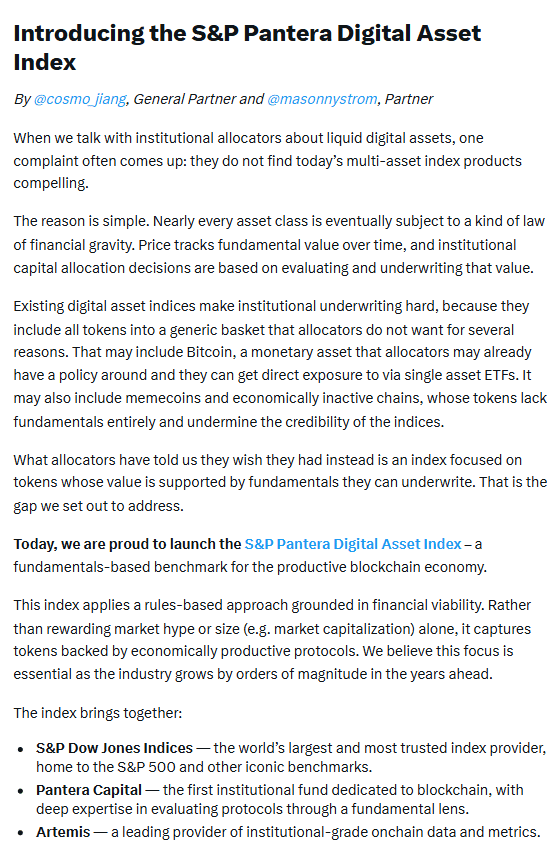
While only five of the planned 18 assets have been publicly confirmed, they share several common characteristics. Each network has spent years improving scalability, expanding decentralized applications, and increasing on-chain usage through upgrades and protocol development.
That distinction has fueled speculation that future institutional investment products could increasingly focus on blockchain utility rather than simply following the biggest names in the market.
Revenue and Utility Take Center Stage
Supporters of the index argue that blockchain networks producing consistent economic value deserve greater attention than assets benefiting mainly from brand recognition or liquidity.
According to data highlighted by analysts, the confirmed index constituents collectively generated approximately $3 billion in annualized revenue over the past six months despite challenging market conditions.
That figure has strengthened the argument that blockchain fundamentals—including network usage, transaction activity, and sustainable fee generation—could become more influential in institutional portfolio construction.
Jon Ma, who helped develop the index alongside Pantera Capital and S&P Dow Jones Indices, described it as a “fundamental index for crypto,” reflecting a methodology centered on network quality rather than size alone.
Why Bitcoin and XRP Are Driving the Conversation
Although the confirmed assets attracted interest, much of the market reaction centered on the absence of Bitcoin and XRP.
Bitcoin remains the largest cryptocurrency by market capitalization and often serves as the industry’s benchmark asset, while XRP continues to rank among the most widely traded digital currencies. Their omission has sparked debate over whether future institutional products will increasingly separate store-of-value assets from blockchain networks generating ongoing economic activity.
If similar methodologies gain wider adoption, investors could begin evaluating cryptocurrencies through a different lens—placing greater emphasis on protocol revenue, developer activity, and real-world utility.
Also Read: XRP Whale Activity Crashes 97%: Is a Bigger Price Drop Coming?
The S&P Digital Asset Index may represent more than just another benchmark. It could signal an evolving framework for how institutional investors assess digital assets.
As more capital enters the crypto market through structured investment products, the divide between momentum-driven assets and fundamentally productive blockchain networks may become increasingly pronounced. Whether this approach reshapes investment flows remains uncertain, but the debate surrounding the index suggests that fundamentals are becoming a more important part of the crypto investment conversation.
Disclaimer: The information in this article is for general purposes only and does not constitute financial advice. The author’s views are personal and may not reflect the views of Chain Affairs. Before making any investment decisions, you should always conduct your own research. Chain Affairs is not responsible for any financial losses.

I’m your translator between the financial Old World and the new frontier of crypto. After a career demystifying economics and markets, I enjoy elucidating crypto – from investment risks to earth-shaking potential. Let’s explore!