|
Getting your Trinity Audio player ready...
|
- Hyperliquid processed roughly $212 billion in 30-day perp trading volume, far ahead of Solana.
- HYPE reached a new all-time high above $73 and briefly traded above SOL.
- Solana retains a larger market cap largely due to its significantly larger circulating supply.
The race for dominance in decentralized perpetual futures trading is becoming increasingly competitive, and Hyperliquid is emerging as one of the biggest winners of the current crypto market cycle. As speculative activity accelerates across digital assets, fresh on-chain data suggests that Hyperliquid is widening its lead over Solana in one of the most important sectors of decentralized finance.
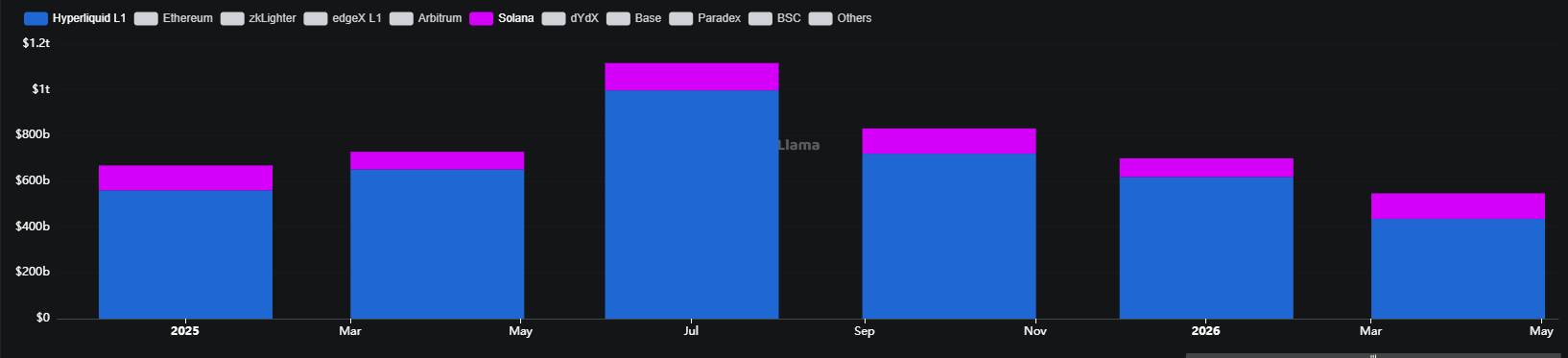
According to data from DeFiLlama, perpetual decentralized exchange (perp DEX) volume surged to $1.89 trillion during the first quarter of 2026, nearly double the volume recorded during the same period a year earlier. The sharp increase highlights growing trader participation and renewed risk appetite across crypto markets.
Hyperliquid Strengthens Its Position in Perpetual Trading
Despite the rapid growth in overall trading activity, the leading platforms have remained largely unchanged. Hyperliquid and Solana continue to dominate decentralized perpetual trading, while Ethereum remains far behind despite its broader influence across DeFi.
However, the gap between the top two players is expanding. Recent data shows Hyperliquid processing approximately $212 billion in trading volume over the past 30 days, significantly ahead of Solana’s roughly $74 billion.
That advantage is increasingly reflected in market performance. Hyperliquid’s native token, HYPE, started June by reaching a new all-time high above $73. The token has gained nearly 200% since early 2025, outperforming many major cryptocurrencies during the same period.
HYPE Surpasses SOL in Price, but Not in Valuation
One of the most discussed developments came when HYPE briefly traded above SOL on a per-token basis. While the crossover was short-lived, it attracted considerable attention from traders and investors who view Hyperliquid as a rising force within decentralized finance.
Yet token price alone does not tell the full story.
Although HYPE and SOL traded at similar levels, Solana still maintains a market capitalization more than twice the size of Hyperliquid’s. The primary reason lies in token supply.
Solana has more than 570 million tokens in circulation, compared with roughly 250 million HYPE tokens. As a result, identical token prices produce vastly different market valuations, giving Solana a substantial advantage despite Hyperliquid’s stronger recent momentum.
Tokenomics Become the Next Battleground
As Hyperliquid captures more trading volume and user activity, its ecosystem is generating demand that directly benefits HYPE. Revenue generated through platform activity increasingly flows back into the token’s economy, strengthening its growth narrative.
For Solana, this dynamic highlights the importance of managing supply. Ongoing efforts to reduce token inflation could become increasingly significant as competition intensifies.
If Hyperliquid continues attracting traders, liquidity, and capital at its current pace, the rivalry may extend beyond trading volume and token performance. Over time, market capitalization could become the next major battleground between the two ecosystems.
Also Read: Hyperliquid Falls After Arthur Hayes Sells Entire HYPE Position
Hyperliquid’s rapid rise is reshaping the decentralized derivatives landscape. While Solana still enjoys a sizeable valuation lead, Hyperliquid is steadily gaining ground through stronger trading activity, growing user engagement, and impressive token performance. The coming months may determine whether Solana’s market cap advantage remains secure or whether Hyperliquid can convert its momentum into an even larger share of the crypto market.
Disclaimer: The information in this article is for general purposes only and does not constitute financial advice. The author’s views are personal and may not reflect the views of Chain Affairs. Before making any investment decisions, you should always conduct your own research. Chain Affairs is not responsible for any financial losses.

I’m your translator between the financial Old World and the new frontier of crypto. After a career demystifying economics and markets, I enjoy elucidating crypto – from investment risks to earth-shaking potential. Let’s explore!