
|
Getting your Trinity Audio player ready...
|
Key Takeaways
- IOTA has moved from the Tangle through Chrysalis, Stardust, Rebased and Starfish, yet the token trades around $0.05, more than 99% below its $5.69 peak.
- StarfishSpeed cuts consensus latency, but upgrades alone haven’t created token demand. Circulating supply has grown about 25% in a year while the price fell roughly 80%.
- Nearly 50,000 notarizations in four weeks (about 1,800 a day) is an early adoption signal, but small next to the advertised 50,000+ TPS capacity.
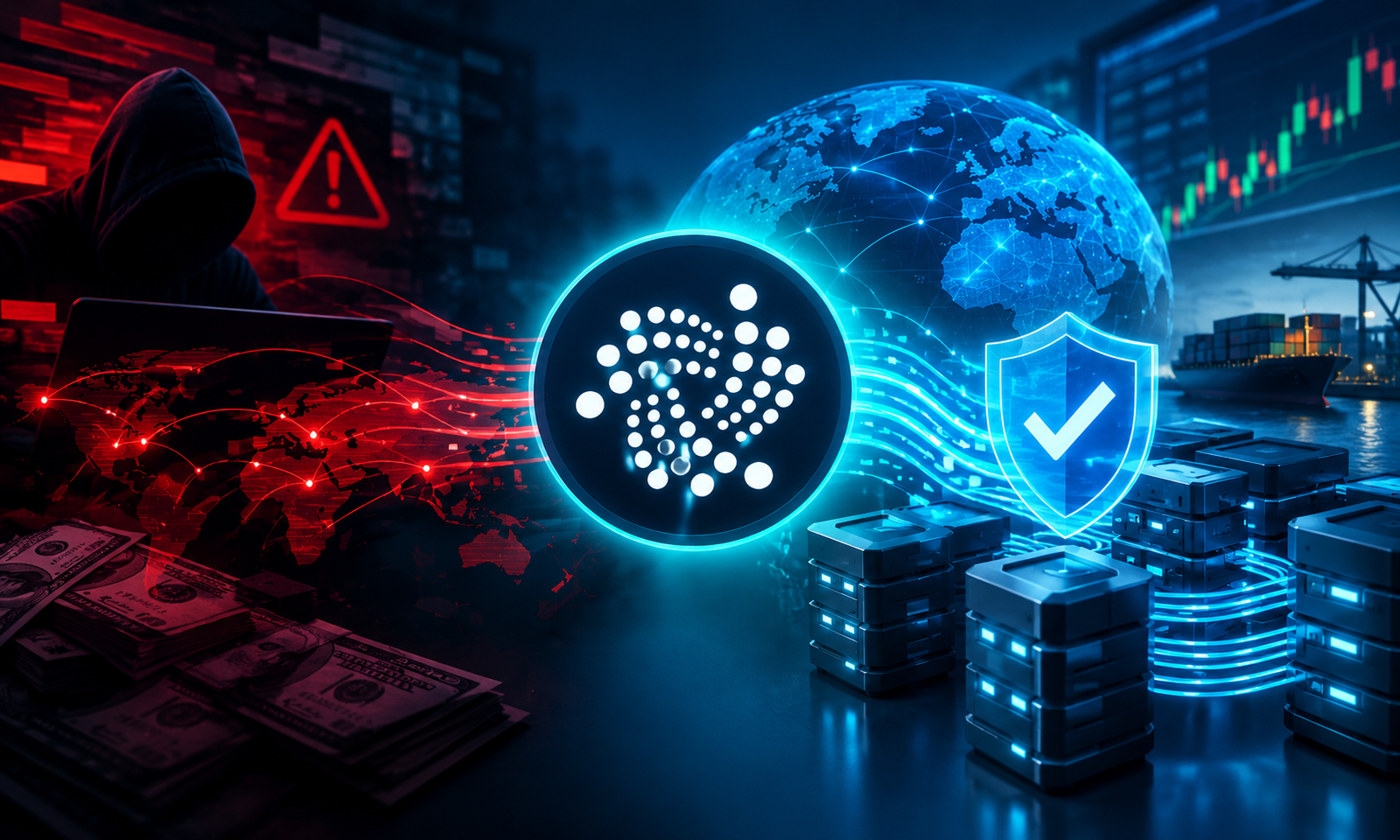
IOTA in 2026 has very little in common with the project that launched in 2015. It dropped the MIOTA label, moved on from its original Internet of Things pitch, and has swapped out its core architecture several times. The token hasn’t followed. IOTA’s all-time high is $5.69, while the price today sits around $0.05. That is a drop of more than 99%, and it is now the central question for holders: has all the engineering changed anything for the coin?
From the Tangle to a Programmable Layer 1
IOTA began with the Tangle, a DAG-based ledger aimed at machine-to-machine payments. It relied on a Foundation-run Coordinator for protection, and removing it (Coordicide) turned into one of the longest research efforts in the project’s history.
Chrysalis, or IOTA 1.5, was the first major rebuild. It introduced UTXO-based transactions, new addresses and APIs, better node software and a big performance boost. Stardust followed with native assets and smart-contract features. It also reworked the tokenomics. Total supply rose from the 2.78 billion IOTA of the early days to 4.6 billion, with new tokens released through an ecosystem fund over several years. A validator committee replaced the Coordinator.
Rebased: The Biggest Reset Yet
On May 5, 2025, IOTA moved to a Move-based mainnet with delegated Proof-of-Stake. The genesis ceremony shut down the Stardust mainnet and IOTA EVM together, and the network relaunched with the Foundation and 12 other validators. The Foundation later said it had onboarded more than 40 validators.
The ecosystem around it grew quickly. The Swirl liquid staking protocol launched, along with MSafe multisig, Zodia Custody support and the IOTA Scan explorer. MoveVM is the main execution environment, with an IOTA EVM layer for Solidity apps, and a fee-burning mechanism adds deflationary pressure.
Starfish and StarfishSpeed Sharpen the Engine
IOTA switched on Starfish consensus in April 2026. In September, Protocol 36 activated StarfishSpeed, an optimistic commit rule that shortens latency in good conditions and keeps the sturdier path as a fallback. The update also touches validator selection, networking, synchronization, storage and transaction validation.
IOTA’s release notes show a steady stream of fine-tuning. Protocol version 33 spreads the minimum checkpoint interval over a sliding window of 20 checkpoints on mainnet. A redesigned leader schedule using reputation scoring is also listed for mainnet. On testnet, the default soft leader timeout was cut from 100 ms to 5 ms. Coinbase’s IOTA page describes sub-second finality and capacity above 50,000 transactions per second.
Usage Is Growing, But It Is Small
Recent analysis reported nearly 50,000 digital certificate notarizations on mainnet over four weeks. That works out to roughly 1,800 a day. It is real activity, and much better than another roadmap slide. It is also tiny next to the advertised capacity.
Other efforts are in motion. IOTA’s TWIN platform targets cross-border trade and supply chains, and trade-finance applications, interoperability tests and DeFi experiments are underway. A LayerZero test token pointing toward USDT0 hints at a stablecoin route. None of these has yet shown sustained, measurable demand for the IOTA token.
What the Market Is Saying
The numbers are blunt. In September 2025, IOTA traded near $0.24 with a market cap of about $883 million and 3.75 billion coins circulating. Today the price is about $0.05, market cap about $236 million, circulating supply about 4.66 billion, and it ranks around #134. That is a price roughly 80% lower in a year, with about a quarter more tokens in circulation. Supply released through the ecosystem fund has diluted holders while the chain kept improving. Another small unlock of about 12.4 million IOTA is scheduled for September 30.
Every upgrade so far has made IOTA a better network. None has yet made the IOTA token a must-hold asset.
The next chapter depends on adoption that shows up on-chain: independent apps, active developers, real users, deeper liquidity, and a clear link between network use and demand for the coin. If digital identity, trade finance and interoperability move past pilots, the market will finally have data to price. Until then, IOTA’s story remains one of strong engineering and weak token performance.
Disclaimer: The information in this article is for general purposes only and does not constitute financial advice. The author’s views are personal and may not reflect the views of Chain Affairs. Before making any investment decisions, you should always conduct your own research. Chain Affairs is not responsible for any financial losses.


I’m a crypto enthusiast with a background in finance. I’m fascinated by the potential of crypto to disrupt traditional financial systems. I’m always on the lookout for new and innovative projects in the space. I believe that crypto has the potential to create a more equitable and inclusive financial system.