

|
Getting your Trinity Audio player ready...
|
- IOTA Audit Trails extends IOTA Notarization from single proofs to ordered, multi-writer histories with onchain permissions.
- Sensitive data stays offchain, while hashes, references and non-sensitive metadata are anchored onchain so anyone can verify authenticity and order.
- IOTA’s page lists no customers or usage figures yet, so real adoption in customs, compliance and product passports is the thing to watch.
Ask two companies in a supply chain which version of events is correct, and each will usually pull up its own database. IOTA’s Audit Trails product is built for that problem. It gives every party in a workflow one shared, ordered history that anyone with access can verify directly, with no exported reports and no central administrator to trust.
From single proofs to full histories
Audit Trails builds on IOTA Notarization, which anchors a single item such as a file hash, certificate or status on the network. The new layer adds order, permissions and lifecycle rules. Instead of proving that one document existed, a trail records what happened, in what sequence and who had the authority to add each entry.
The workflow has three steps. An organization creates a trail, setting its metadata, tags, permissions and lifecycle rules. Authorized users, wallets or services then append records. Finally, any authorized party can inspect the order of records, the permissions, the metadata and the state of the trail.

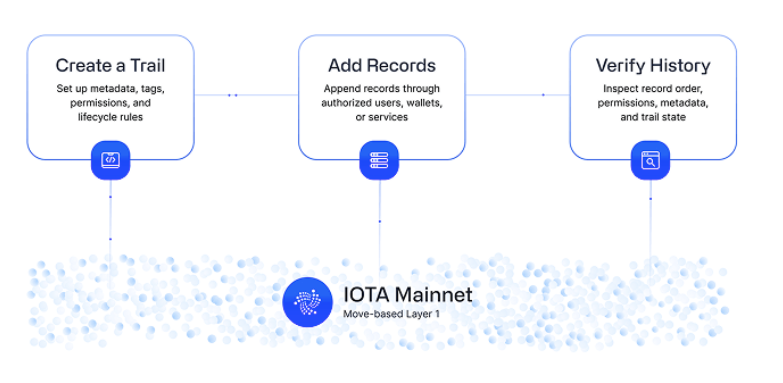
A key feature is that trails support multiple writers. Several organizations can add to the same history, with each entry ordered and verifiable, which matters when a shipment, a filing or a product moves between parties that don’t share a system.
Permissions built around real workflows
Different participants play different roles, and the product reflects that through four controls. Roles define who can perform specific actions. Capabilities let an owner hand those roles to users, wallets or services. Tags organize records and limit who can add to which category. Locking rules govern when records can be added, deleted or locked. All of it is enforced onchain, not through a separate admin panel.
Also Read: IOTA Q3 2026 Update: Faster Finality, Verifiable Nodes and a Real-World Trade Push
Proving records without exposing them
Audit Trails doesn’t ask companies to publish sensitive documents. Confidential files, reports and source data stay in private systems, and only hashes, references or non-sensitive metadata are anchored on IOTA. Any participant can then confirm the order and authenticity of the records without seeing the private content.
It’s worth keeping a caveat in mind, which is my own analysis and not a claim from IOTA’s page. A ledger can show that a record hasn’t been altered since it was written, but it can’t show the original data was accurate when someone entered it. Governance and sound entry practices still matter.
Where IOTA sees it being used
The product page lists five areas where records are business-critical:
- Supply chains: handovers, inspections, certifications and maintenance events
- Legal and compliance: contracts, filings, approvals and regulated records
- Customs and trade: declarations, inspections and clearance steps
- Product passports: lifecycle evidence, provenance and sustainability claims
- IoT and automation: machine events, sensor proofs and maintenance actions
The developer documentation includes setup guides and examples for customs clearance, clinical research and Digital Product Passports.
What builders get
Audit Trails ships as part of the IOTA Notarization Toolkit. Developers can define trails, records, permissions, tags and lifecycle controls with a Move package, work in Rust through typed clients and transaction builders, or integrate through WebAssembly bindings for JavaScript and TypeScript apps. Examples and docs are published alongside.
The product also fits IOTA’s wider Trust Framework, which pairs Notarization with IOTA Identity, for connecting actors, organizations and credentials to workflows, and IOTA Hierarchies, for delegating trust across digital ecosystems.
Disclaimer: The information in this article is for general purposes only and does not constitute financial advice. The author’s views are personal and may not reflect the views of Chain Affairs. Before making any investment decisions, you should always conduct your own research. Chain Affairs is not responsible for any financial losses.


Crypto and blockchain enthusiast.