
|
Getting your Trinity Audio player ready...
|
Key Takeaways:
- Ethereum leaders urge L1s to become L2s to benefit from Ethereum’s security and community.
- Vitalik Buterin promotes minimal L2 architecture focused on sequencers and provers.
- Ethereum’s zkEVM integration roadmap will further support scalable, secure L2 solutions.
As the blockchain ecosystem evolves, Ethereum leaders are proposing a future where rival layer-1 networks shift course—and become layer-2s on Ethereum. The latest comments from Jason Chaskin of the Ethereum Foundation and co-founder Vitalik Buterin mark a pivotal moment in Ethereum’s expansion strategy.
Jason Chaskin Cites Celo as the Blueprint
On Monday, Jason Chaskin, who leads app relations and research at the Ethereum Foundation, proposed that many layer-1 blockchains could benefit by transitioning into Ethereum layer-2s. Celo’s recent move was highlighted as a successful example, having reduced inflation, simplified codebases, sped up transactions, and embedded deeper into Ethereum’s expansive ecosystem.
Unironically, I think most alt-L1s will become L2s@Celo showed the playbook:
— chaskin.eth (@jchaskin22) July 14, 2025
– Halved inflation from 2% to 1%
– Reduced block times from 5s to 1s
– Eliminated 300k+ lines of legacy code
– Fully integrated into Ethereum’s ecosystem, the largest dev community in crypto
– Carbon… https://t.co/1gFlwalxR8
Chaskin emphasized Ethereum’s advantage in developer support, saying it “has the largest dev community in crypto.” His comments sparked wide discussion among blockchain developers and industry observers.
Vitalik Buterin Advocates Minimalist L2 Architecture
On Wednesday, Ethereum co-founder Vitalik Buterin joined the conversation and offered a minimalistic framework for building efficient Ethereum layer-2 networks. Buterin proposed that aspiring L2s should focus solely on running a sequencer and prover—roles that dictate transaction order and verify execution via cryptographic proofs.
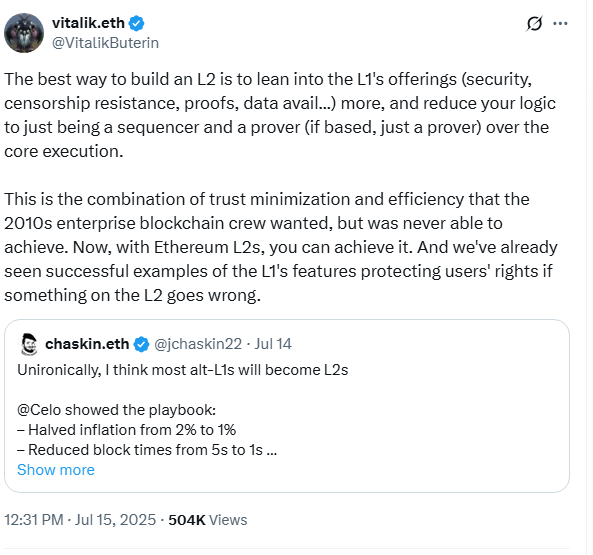
By offloading security, data availability, and censorship resistance to Ethereum, L2s can achieve the dream of “trust minimization and efficiency” that enterprise blockchains once aimed for but failed to realize. Buterin noted that Ethereum L2s can now offer real user protection by leaning on Ethereum’s foundational safeguards.
Ethereum’s zkEVM Roadmap Reinforces the Vision
Buterin’s comments came shortly after the Ethereum Foundation published its plan to implement a zero-knowledge Ethereum Virtual Machine (zkEVM) within a year. According to protocol support developer Sophia Gold, the network intends to replace traditional execution with ZK-proofs, enabling validators to verify transactions without reprocessing entire blocks.
Also Read: Solana Closes in on Ethereum as Tokenized Real-World Assets Surge Past $25.5B
This integration will strengthen Ethereum’s ability to support high-performance L2s and bolster the very architecture Buterin advocates for.
The message from Ethereum’s leadership is clear: stop competing, start integrating. With zkEVM advancements and successful case studies like Celo, the case for becoming an Ethereum L2 is growing stronger by the day.
Disclaimer: The information in this article is for general purposes only and does not constitute financial advice. The author’s views are personal and may not reflect the views of Chain Affairs. Before making any investment decisions, you should always conduct your own research. Chain Affairs is not responsible for any financial losses.

I’m a crypto enthusiast with a background in finance. I’m fascinated by the potential of crypto to disrupt traditional financial systems. I’m always on the lookout for new and innovative projects in the space. I believe that crypto has the potential to create a more equitable and inclusive financial system.