

|
Getting your Trinity Audio player ready...
|
- ESMA added 12 crypto-asset service providers, raising the MiCA-approved list to 321 firms.
- New approvals include European banks and fintech companies from Germany, France and Spain.
- Regulators added three more entities to MiCA’s non-compliant crypto register.
European crypto regulation continues to take shape as the European Securities and Markets Authority (ESMA) expands its official Markets in Crypto-Assets (MiCA) register. The latest update added 12 new crypto-asset service providers (CASPs), increasing the number of approved entities operating under the European Union’s licensing framework to 321.
The move highlights the growing participation of traditional financial institutions and crypto companies seeking regulatory approval under MiCA, which aims to create a unified rulebook for digital asset businesses across the bloc.
Germany, France and Spain Lead Latest MiCA Approvals
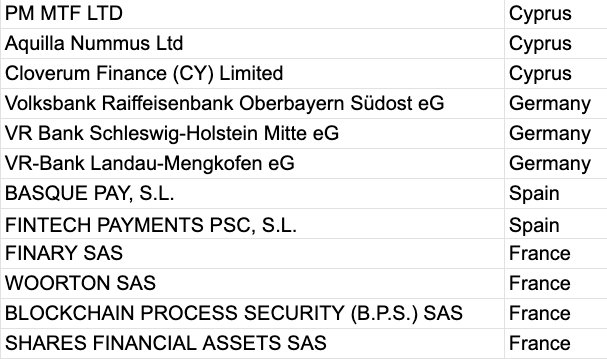
ESMA’s July 31 update included several established financial and fintech companies from major European markets. Among the newly listed firms were three German cooperative banks: Volksbank Raiffeisenbank Oberbayern Südost, VR Bank Schleswig-Holstein Mitte and VR-Bank Landau-Mengkofen.
The additions also included companies from France and Spain. French firms added to the register were Finary, Woorton, Blockchain Process Security and Shares Financial Assets. Spain’s new entries included Basque Pay and Fintech Payments.
The growing number of approved CASPs suggests that banks and financial service providers are increasingly preparing to offer crypto-related products within a regulated environment.
MiCA Compliance List Expands After Transitional Deadline
The latest additions came after the July 1 transitional deadline for crypto companies operating under the EU’s MiCA framework. The regulation requires firms providing services such as crypto trading, custody and transfers to obtain authorization from national regulators before being included in the official ESMA register.
For businesses, inclusion on the MiCA register provides recognition that they meet regulatory requirements. For users and investors, the register is designed to offer greater transparency when choosing crypto service providers.
However, the expansion also shows that compliance remains a challenge for some market participants.

ESMA Flags More Non-Compliant Crypto Entities
Alongside the new approvals, ESMA updated its list of non-compliant crypto entities by adding three companies: Cervo Rendisco, Flandenzo and Corona Fondenza. The firms were flagged by Italy’s financial regulator, Commissione Nazionale per le Società e la Borsa (CONSOB).
The non-compliant register now contains 167 entries, reflecting ongoing regulatory efforts to identify companies operating outside the MiCA framework.
Other MiCA-related registers remained unchanged in the latest update. The number of authorized e-money token (EMT) issuers stayed at 41, while no asset-referenced token (ART) issuers were listed.
Also Read: MiCA Deadline Ends: 5 Major Changes Reshaping Europe’s Crypto Market in 2026
ESMA’s latest MiCA register update shows the European crypto market moving deeper into a regulated phase. With banks and fintech firms joining the approved list, the framework is becoming a key requirement for companies seeking access to EU crypto markets. At the same time, regulators continue monitoring firms that fail to meet compliance standards.
Disclaimer: The information in this article is for general purposes only and does not constitute financial advice. The author’s views are personal and may not reflect the views of Chain Affairs. Before making any investment decisions, you should always conduct your own research. Chain Affairs is not responsible for any financial losses.


I’m your translator between the financial Old World and the new frontier of crypto. After a career demystifying economics and markets, I enjoy elucidating crypto – from investment risks to earth-shaking potential. Let’s explore!