
|
Getting your Trinity Audio player ready...
|
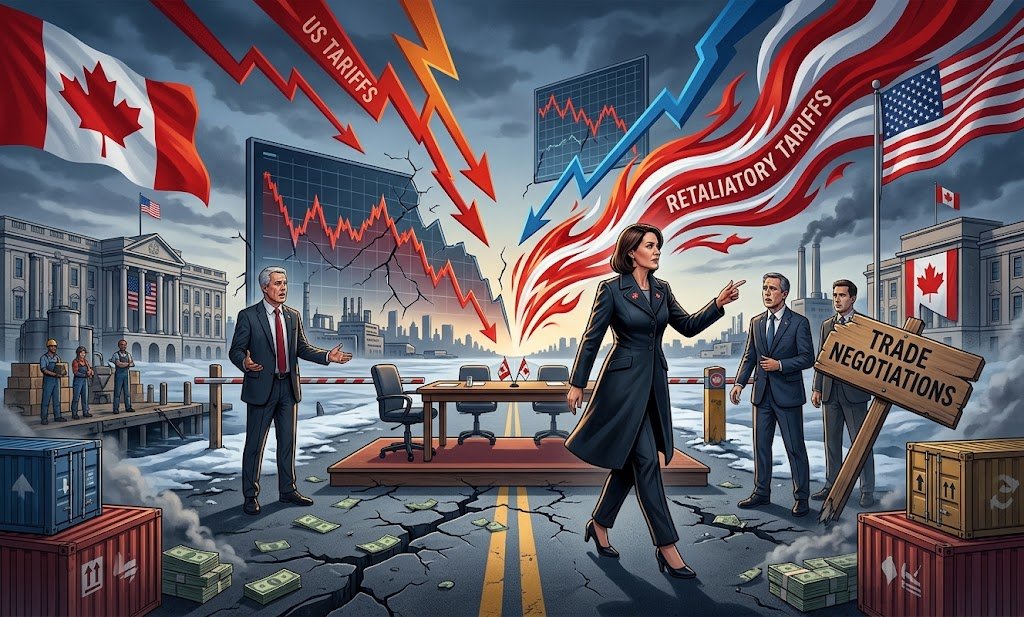
Trade negotiations between Ottawa and Washington collapsed late Friday night as Canada formally rejected a proposed bilateral deal. The sudden breakdown leaves hundreds of billions of dollars in cross-border commerce dangling over an economic precipice, unleashing sweeping 50% U.S. tariffs on Canadian exports and sparking immediate retaliatory threats.
Speaking shortly before a midnight deadline, U.S. Trade Representative Jamieson Greer voiced sharp frustration over Ottawa’s decision.
“This is a missed opportunity for Canada to partner with the United States, which is the fastest-growing economy in the G7,” Greer said, claiming Washington had offered significant tariff relief on steel, aluminum, autos, and lumber in exchange for structural concessions.
Those concessions proved a bridge too far for Ottawa. Washington insisted that Canadian provinces lift long-standing bans on U.S. alcohol sales, restore American corporate access to government procurement contracts—such as Elon Musk’s Starlink satellite service—and reconsider deadlocked energy infrastructure, including the Keystone XL pipeline.
Prime Minister Mark Carney ordered his negotiating team back to Ottawa, calling last-minute American demands “unfair, uneconomic,” and detrimental to Canadian sovereignty. Vowing a firm response, Carney promised Canada would match the incoming U.S. levies “dollar for dollar” to protect domestic industries.
The decision aligns with a wary Canadian public; recent polling shows 56% of voters back a hardline stance against Washington rather than making major trade concessions. Prominent provincial leaders, including Quebec Premier Christine Fréchette and Manitoba Premier Wab Kinew, signaled deep skepticism over Washington’s reliability as a partner, echoing warnings from trade experts that U.S. policy has grown fundamentally unpredictable.
Also Read: Japan Inflation Hits 2026 High: 3 Reasons the BOJ Could Hike Rates in September
The cross-border economic clash comes at a delicate moment for the White House. The Trump administration is grappling with record $40 trillion federal debt, soaring mortgage rates, and energy-driven inflation fueled by conflict in Iran. As petrol and diesel prices climb, long-term U.S. Treasury yields hit 19-year highs, signaling deepening anxiety among global investors.
With consumer confidence hovering at near-record lows and midterm elections approaching, the trade rupture threatens to further disrupt integrated North American supply chains, leaving both nations navigating an increasingly volatile economic rift.
Disclaimer: The information in this article is for general purposes only and does not constitute financial advice. The author’s views are personal and may not reflect the views of Chain Affairs. Before making any investment decisions, you should always conduct your own research. Chain Affairs is not responsible for any financial losses.


I’m your translator between the financial Old World and the new frontier of crypto. After a career demystifying economics and markets, I enjoy elucidating crypto – from investment risks to earth-shaking potential. Let’s explore!