
|
Getting your Trinity Audio player ready...
|
- IOTA launched Starfish consensus on testnet to improve resilience during validator delays
- The DAG-based protocol reduces communication overhead while maintaining throughput
- The upgrade aligns with IOTA’s push toward real-world infrastructure deployment
IOTA has introduced a new consensus protocol called Starfish on its testnet, aiming to improve how the network performs when validators fall out of sync. Announced by the IOTA Foundation on February 11, 2026, the upgrade focuses on maintaining ledger progress even during unstable connectivity or uneven validator performance.
The rollout positions Starfish as a testing track while the existing Mysticeti consensus continues securing the mainnet. The change reflects IOTA’s effort to prepare its infrastructure for real-world deployment conditions where network reliability cannot be guaranteed.
Improving Network Progress When Validators Lag
Traditional consensus approaches often rely on close coordination among validators. When one participant slows down, the entire network can be forced to wait. Starfish introduces a model where the ledger continues advancing while delayed validators recover in parallel.
This shift could make distributed systems more resilient in environments with fluctuating connectivity, such as IoT networks, logistics platforms, or cross-border trade systems. By allowing asynchronous recovery, IOTA aims to prevent localized issues from stalling the broader network.
DAG-Based Consensus With Lower Communication Costs
According to the Starfish whitepaper, the protocol uses a partially synchronous Byzantine Fault Tolerant design built on a Directed Acyclic Graph (DAG). Tests show the approach maintains stable throughput while lowering communication overhead, even when Byzantine faults are introduced.
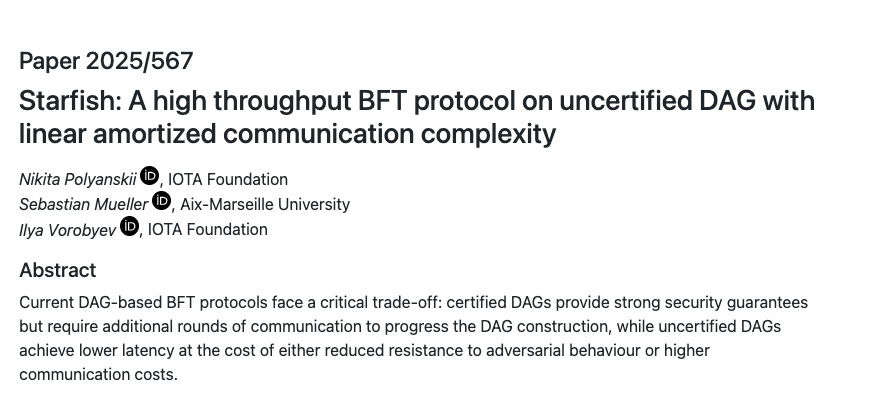
A key feature is “Encoded Cordial Dissemination,” which combines erasure coding with Data Availability Certificates. Validators distribute encoded shards of transaction data so blocks can be reconstructed once enough pieces are received. Committed leader blocks then verify data availability, reducing the need for extra consensus rounds.
This design aims to balance efficiency and security while supporting large-scale ledger deployments.
Building Toward Real-World Adoption
The Starfish rollout comes shortly after IOTA’s digital trade initiative expanded in the United Kingdom through collaboration with Teesside University. That pilot uses IOTA technology to digitize trade documentation and streamline border processes.
Together, these developments signal a broader push toward production-ready infrastructure. If Starfish performs as expected, it could strengthen IOTA’s positioning as a network designed for real-world operational demands rather than purely theoretical performance metrics.
Also Read: IOTA Charts Post-Speculation Path as Schiener Calls 2025 a Year of Crypto Fatigue
Starfish represents a pragmatic step in IOTA’s evolution, focusing on reliability under imperfect conditions rather than idealized performance. By allowing network progress despite validator delays, the protocol could improve the practicality of distributed ledgers in sectors where uptime and resilience matter most.
If successful on testnet, the upgrade may eventually shape how IOTA approaches consensus at scale.
Disclaimer: The information in this article is for general purposes only and does not constitute financial advice. The author’s views are personal and may not reflect the views of Chain Affairs. Before making any investment decisions, you should always conduct your own research. Chain Affairs is not responsible for any financial losses.

I’m your translator between the financial Old World and the new frontier of crypto. After a career demystifying economics and markets, I enjoy elucidating crypto – from investment risks to earth-shaking potential. Let’s explore!