
|
Getting your Trinity Audio player ready...
|
- Brazil’s central bank has banned the use of crypto and stablecoins in regulated cross-border payment systems (eFX).
- The move targets rising stablecoin usage, which now dominates most crypto-related flows in the country.
- Crypto remains legal in Brazil, but authorities are pushing transactions back into monitored foreign exchange channels.
Brazil’s central bank has tightened its grip on crypto-linked financial activity, introducing new limits on how virtual assets can be used in cross-border payments. The move targets a fast-growing segment of the market—particularly stablecoins—without imposing a full ban on crypto transactions.
New eFX Rules Block Crypto in Payment Channels
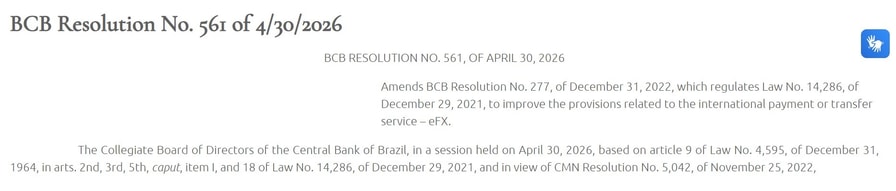
The Banco Central do Brasil (BCB) has issued Resolution No. 561, updating its regulatory framework for international payments under the eFX category. The rule requires that all transactions between eFX providers and foreign counterparts be conducted strictly through traditional foreign exchange channels or via non-resident Brazilian real accounts.
In practice, this means virtual assets—including cryptocurrencies and stablecoins—can no longer be used within these regulated payment flows. The restriction also applies to companies operating under transitional arrangements, even if they have not yet secured full authorization.
Firms currently outside the approved eFX categories can continue operating temporarily, but must apply for authorization by May 31, 2027. Until then, they must comply with the same restriction: no crypto-based settlement for cross-border transfers within the eFX system.
Not a Crypto Ban—But a Strategic Restriction
Despite the stricter rules, the central bank has not outlawed cryptocurrency use in Brazil. Instead, the regulation narrows where and how digital assets can be used, specifically excluding them from supervised international payment infrastructure.
This distinction is key. Crypto transactions can still occur outside the regulated eFX framework, but the central bank is clearly steering formal financial flows back into monitored foreign exchange systems.
The policy reflects a broader effort to maintain oversight of capital movements while preserving the integrity of Brazil’s financial system.
Stablecoin Growth Raises Regulatory Concerns
The crackdown comes as stablecoins increasingly dominate Brazil’s crypto activity. According to central bank officials, nearly 90% of crypto-related flows in recent years have been tied to stablecoins.
BCB Governor Gabriel Galipolo has flagged several risks linked to this trend, including tax evasion, money laundering, and questions around asset backing. These concerns have driven regulators to act more decisively.
In parallel, the central bank is evaluating stricter rules—or even potential bans—on stablecoins issued by entities outside its supervision. Officials warn that foreign-issued or real-denominated stablecoins could undermine monetary sovereignty and create regulatory imbalances.
Also Read: Brazil Shuts Down 27 Prediction Market Platforms in Sweeping Regulatory Crackdown
Brazil’s latest move signals a clear regulatory direction: crypto may remain part of the financial ecosystem, but not within critical payment infrastructure without oversight.
As the country continues integrating digital assets into its legal framework, the focus appears to be on control rather than prohibition—ensuring innovation does not come at the cost of financial stability.
Disclaimer: The information in this article is for general purposes only and does not constitute financial advice. The author’s views are personal and may not reflect the views of Chain Affairs. Before making any investment decisions, you should always conduct your own research. Chain Affairs is not responsible for any financial losses.

I’m your translator between the financial Old World and the new frontier of crypto. After a career demystifying economics and markets, I enjoy elucidating crypto – from investment risks to earth-shaking potential. Let’s explore!