
|
Getting your Trinity Audio player ready...
|
The crypto exchange’s second consecutive quarterly loss lays bare just how exposed it remains to market swings — but its CEO is betting the long game on stablecoins, AI payments, and an onchain future.
When Bitcoin shed nearly a third of its value in a matter of weeks, someone had to absorb the blow. For Coinbase, that cost came in at $394.1 million — a net loss for the first quarter of 2026 that underscores how tightly the exchange’s fortunes are still tethered to the digital assets it holds and the retail traders who buy and sell them.
A $482 Million Crypto Loss Drives the Damage
The headline figure only tells part of the story. Buried beneath the net loss is a $482 million write-down on cryptocurrency held for investment — a direct consequence of Bitcoin’s drop from above $97,000 in January to around $63,000 by early February. The entire crypto market followed BTC lower, and Coinbase, holding digital assets on its own books, couldn’t sidestep the fallout.

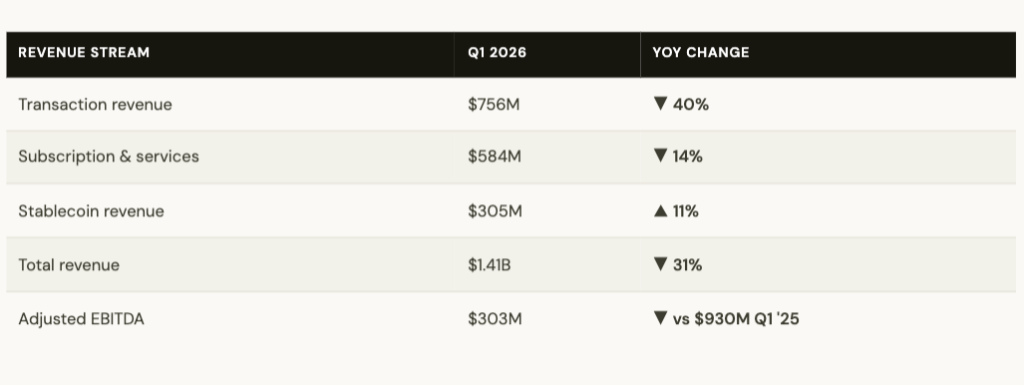
Total revenue came in at $1.41 billion, falling 31% compared to the same period a year ago. Transaction revenue — the lifeblood of any exchange — tumbled 40% year-on-year to $756 million as trading volumes dried up alongside prices. Subscription and services revenue proved more resilient, declining a more manageable 14% to $584 million. This is the second straight quarter in the red for Coinbase, following a $667 million loss in Q4 2025 — a streak that will test investor patience heading into the summer.
Stablecoins, Institutions, and Armstrong’s Long Game
Not everything moved in the wrong direction. Stablecoin revenue climbed 11% to $305 million, cementing it as one of Coinbase’s most dependable income lines — and one far less sensitive to daily price swings. The company also captured an 8.6% share of global crypto trading volume during the quarter, a marker management pointed to as evidence of competitive strength even in a down market.
“Despite the crypto market being down, the fundamental growth of the onchain economy is strong.”— Brian Armstrong, CEO, Coinbase
CEO Brian Armstrong used the earnings moment to reframe the narrative. In a video posted to X, he described Coinbase’s evolution from a spot-trading platform into a destination for derivatives, commodities, futures, and prediction market contracts. He also highlighted the company’s expanding role in AI-enabled payments — including USDC integration for AI agents — and positioned Coinbase as the regulated stablecoin gateway of choice for developers and institutions building on blockchain rails.
There’s a generational shift happening, and Coinbase is uniquely positioned to capture it:
— Brian Armstrong (@brian_armstrong) May 7, 2026
1) The onchain economy has reached escape velocity
2) Coinbase's full stack platform is powering it
3) The next frontier is agentic and on Coinbase
Our thesis is simple: crypto is the… pic.twitter.com/5iJY8aeCfe
The push toward institutional revenue streams is deliberate. Coinbase has long been painfully exposed to retail trading cycles that spike when prices rise and collapse when they fall. Diversifying into subscription products, stablecoin infrastructure, and institutional custody offers a path to revenues that don’t swing with every Bitcoin candle.
Also Read: Coinbase Sued Over Frozen $55M Crypto — Who Really Owns the Funds?
The Market’s Verdict
Investors weren’t entirely convinced. Coinbase shares dropped roughly 6% in after-hours trading to $182, suggesting the market needed more than optimistic framing to overlook two consecutive quarters of losses and a revenue trajectory that fell short of expectations. The real test will come in Q2, when crypto markets have shown some recovery — and when Coinbase’s strategic bets on stablecoins and onchain infrastructure will need to start showing up more clearly at the bottom line.
Disclaimer: The information in this article is for general purposes only and does not constitute financial advice. The author’s views are personal and may not reflect the views of Chain Affairs. Before making any investment decisions, you should always conduct your own research. Chain Affairs is not responsible for any financial losses.

I’m a crypto enthusiast with a background in finance. I’m fascinated by the potential of crypto to disrupt traditional financial systems. I’m always on the lookout for new and innovative projects in the space. I believe that crypto has the potential to create a more equitable and inclusive financial system.