|
Getting your Trinity Audio player ready...
|
- Starfish decouples network progress from validator synchronization, meaning one slow or offline node no longer forces the whole blockchain to wait — a fundamental shift from IOTA’s previous Mysticeti engine.
- The upgrade directly serves TWIN (Trade Worldwide Information Network), where tokenized trade documents require continuous network availability across unreliable, multi-jurisdiction infrastructure.
- Starfish has graduated from testnet to production, signaling IOTA’s push toward enterprise-grade reliability for regulated industries that cannot tolerate downtime.
When a cargo ship sits in port waiting for digital paperwork to clear, every hour costs money. For blockchain infrastructure powering international trade, network downtime isn’t a technical inconvenience — it’s a commercial crisis. IOTA’s latest protocol upgrade, called Starfish, targets exactly that problem by making its blockchain keep processing transactions even when parts of the network go dark.
The Problem With Traditional Blockchain Consensus
Every blockchain needs a way for its participants — called validators — to agree on which transactions are legitimate and in what order they occurred. Most systems handle this well under ideal conditions. The trouble starts when real-world messiness creeps in: slow internet connections in one country, a validator going offline for maintenance, latency spikes across international data centers.
Under many consensus designs, these hiccups force the whole network to pause and wait for the laggards. In global trade — where shipments span dozens of jurisdictions with wildly uneven digital infrastructure — those pauses are a serious liability.
IOTA’s previous consensus engine, Mysticeti, delivered impressive speed on well-behaved networks but struggled when conditions degraded. Nodes that fell behind had to stop creating new blocks until they caught up, and that delay rippled outward, slowing everyone else down.
What Starfish Actually Does Differently
Starfish breaks the link between a validator falling behind and the rest of the network slowing down. Instead of waiting for every node to synchronize before moving forward, the network continues making progress while lagging validators quietly catch up in the background. Recovery becomes a background process, not a system-wide event.
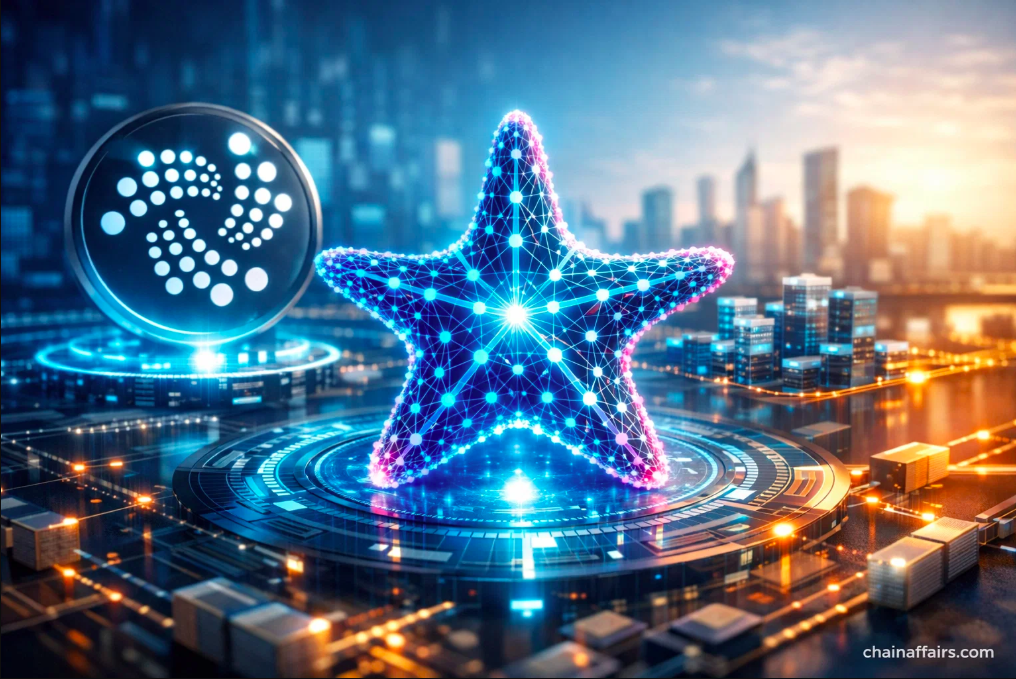
The name is intentional: a starfish can regenerate from a single arm without dying, and the upgrade lets individual validators recover independently without disrupting the rest of the network. Technically, this involves decoupling consensus progress from strict causal history requirements — nodes no longer need to wait for “missing ancestors” in the block structure before continuing.
The practical result is that the network behaves more consistently regardless of where in the world a validator is running or what kind of internet connection it has.
Also Read: Inside Starfish: The Consensus Protocol Powering IOTA’s Speed, Security, and Scale
Why This Matters for Global Trade Infrastructure
IOTA is the backbone of TWIN — the Trade Worldwide Information Network — a public infrastructure project aimed at connecting governments, customs agencies, logistics operators, and businesses across borders. On TWIN, documents like bills of lading, certificates of origin, and compliance records are tokenized and recorded on-chain, meaning their legal and commercial value depends entirely on the network staying up and maintaining accurate transaction ordering.
For that use case, the stakes around reliability are high. A consensus mechanism that stalls under imperfect conditions isn’t just a performance issue — it’s an adoption barrier. Enterprises and government agencies evaluating distributed ledger technology for critical infrastructure have historically cited exactly this uncertainty as their top concern.
Starfish directly addresses that concern by making robustness a design principle rather than a nice-to-have.
What Comes Next
The upgrade has moved from IOTA’s testnet to the mainnet, meaning it’s now live infrastructure rather than experimental code. The IOTA Foundation frames Starfish not as the final destination but as a maturation milestone — evidence that the protocol can be trusted at production scale under real-world conditions, not just controlled environments.
The remaining questions are practical ones: how the upgrade performs across TWIN’s actual deployment geography over time, and whether the reliability improvements translate into accelerated adoption by the trade and logistics organizations the network is designed to serve. The engineering answer is in place. The market answer is still being written.
Disclaimer: The information in this article is for general purposes only and does not constitute financial advice. The author’s views are personal and may not reflect the views of Chain Affairs. Before making any investment decisions, you should always conduct your own research. Chain Affairs is not responsible for any financial losses.

I’m your translator between the financial Old World and the new frontier of crypto. After a career demystifying economics and markets, I enjoy elucidating crypto – from investment risks to earth-shaking potential. Let’s explore!