
|
Getting your Trinity Audio player ready...
|
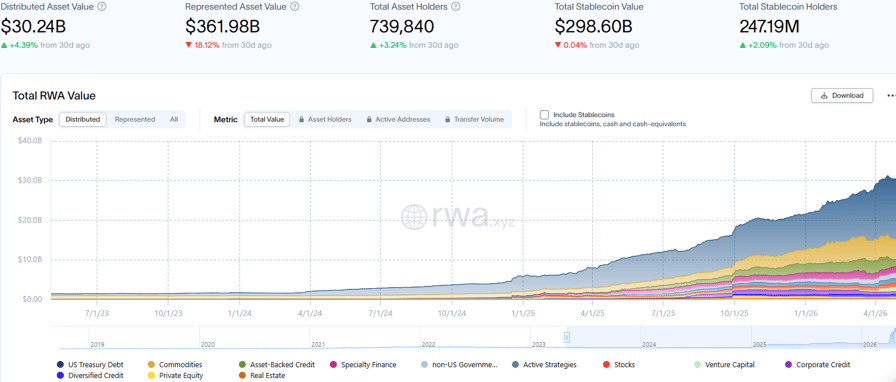
- Tokenized real-world assets surged over 420% in 2025, reaching $30.2 billion.
- Tokenized US Treasurys led growth, climbing above $15 billion.
- Future growth may depend on tokenized equities, funds, and private credit.
The tokenized real-world asset (RWA) market is having a breakout year, with total market value rising more than 420% since January 2025. Fresh institutional demand, stronger regulation, and growing appetite for yield-generating blockchain products have pushed the sector from a niche crypto experiment into a fast-growing corner of digital finance.
Data from RWA.xyz shows the market expanded from roughly $5.8 billion at the start of the year to over $30.2 billion by the end of April. The biggest driver of that growth has been tokenized US Treasurys, which climbed from $3.9 billion to more than $15 billion in just four months.
Tokenized Treasurys Lead RWA Growth
Analysts say tokenized Treasurys have become the foundation of the RWA boom because they combine traditional low-risk yield with blockchain accessibility.
Instead of relying on legacy financial infrastructure, investors can now gain exposure to short-term US government debt through blockchain networks, offering round-the-clock settlement, faster access, and broader global reach.
This shift has attracted both crypto-native users seeking stable returns and institutions looking for compliant onchain financial products.
Alongside Treasurys, tokenized commodities have also posted strong gains. Gold-backed digital assets, in particular, have benefited from global uncertainty and geopolitical tensions, as investors increasingly turn to safe-haven assets with 24/7 liquidity.
Regulation Brings Institutions Into Crypto Tokenization
Clearer regulation has played a major role in accelerating adoption.
Europe’s Markets in Crypto-Assets Regulation (MiCA) has given institutional investors greater confidence to explore blockchain-based financial products. Industry analysts note that earlier RWA growth was often driven by speculation, but the sector has matured significantly since 2024.
Major financial firms have helped validate the space. In 2024, BlackRock launched its USD Institutional Digital Liquidity Fund (BUIDL), giving investors onchain exposure to short-term Treasurys. Fidelity later entered the market with its tokenized interest-bearing product, signaling that traditional finance is taking tokenization seriously.
As competition increases, issuers are now differentiating themselves through regulatory compliance, product diversity, and stronger distribution channels.
What Comes Next for the RWA Market?
Despite rapid growth, analysts believe the next phase of expansion cannot rely solely on tokenized Treasurys.
Future upside will likely depend on broader adoption of tokenized equities, funds, and private credit products. These areas could significantly expand the addressable market and attract new forms of capital.
While growth may slow as early institutional allocations settle, 2025 is increasingly being viewed as a turning point for tokenization.
The RWA market is no longer just a crypto trend—it is becoming a bridge between traditional finance and blockchain infrastructure.
Also Read: OpenVPP Launches 2.0 as Over $25M in Tokenized RWAs Power Next-Generation Energy Settlement on Base
The explosive rise of tokenized real-world assets in 2025 highlights a larger transformation happening across finance. With regulatory clarity improving and major institutions entering the market, RWAs are moving from experimental products to mainstream investment tools.
If tokenized stocks, funds, and private credit gain traction next, the sector’s current $30 billion market could be just the beginning.
Disclaimer: The information in this article is for general purposes only and does not constitute financial advice. The author’s views are personal and may not reflect the views of Chain Affairs. Before making any investment decisions, you should always conduct your own research. Chain Affairs is not responsible for any financial losses.

I’m a crypto enthusiast with a background in finance. I’m fascinated by the potential of crypto to disrupt traditional financial systems. I’m always on the lookout for new and innovative projects in the space. I believe that crypto has the potential to create a more equitable and inclusive financial system.