|
Getting your Trinity Audio player ready...
|
- Carrot is shutting down after severe losses linked to the Drift Protocol exploit.
- The hack triggered widespread contagion across interconnected DeFi platforms.
- April saw over $630M in crypto stolen, raising major security concerns.
Solana’s decentralized finance (DeFi) sector has taken another hit as Carrot, a yield-generating protocol built on Solana, announced it will shut down permanently following the ripple effects of the recent Drift Protocol exploit. The closure highlights how interconnected DeFi platforms remain—and how a single breach can trigger widespread disruption.
Carrot confirmed the decision in a public statement, citing severe financial damage caused by the Drift incident. Users have until May 14 to withdraw their funds before the platform begins unwinding its leveraged positions.
Drift Exploit Triggers DeFi Contagion
The Drift exploit, which occurred on April 1, stands as one of the largest crypto hacks of 2026. Attackers reportedly spent months orchestrating a social engineering campaign that ultimately granted them administrative control over the platform. Once inside, they drained more than half of Drift’s total value locked (TVL), causing losses estimated at around $285 million.
The impact didn’t stop there. Several projects connected to Drift’s infrastructure—including Carrot—felt immediate pressure. Carrot relied on Drift’s liquidity pools to generate yield, leaving it highly exposed when the exploit occurred.
Other platforms, such as Gauntlet, PrimeFi, and Elemental DeFi, also experienced fallout, underscoring how tightly linked many DeFi protocols have become.
Carrot’s TVL Collapse Signals Deeper Issues
Before the exploit, Carrot held approximately $28 million in total value locked. That figure has since plunged to roughly $2 million—a decline of about 93%, according to data from DefiLlama. The steep drop reflects a rapid loss of user confidence and liquidity.
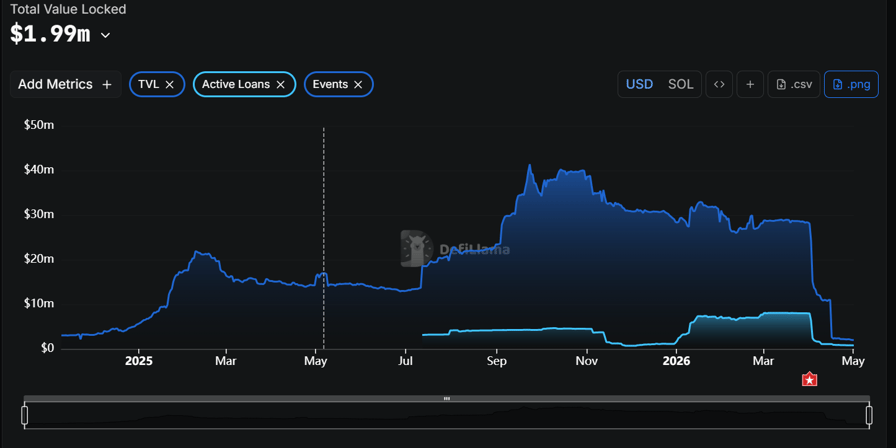
In its statement, Carrot emphasized that user funds remain withdrawable, though all leveraged positions will be reduced to zero. This process is intended to free up liquidity and enable users to redeem remaining assets tied to the platform’s CRT token.
Despite the shutdown, the team said it will continue supporting recovery efforts related to Drift and assist in distributing any recovered funds.
Rising Crypto Losses Add to Market Pressure
April has proven to be a difficult month for crypto security. Data shows that roughly $630 million was stolen across 25 separate incidents, making it the worst month for losses since early 2025. The Drift exploit and the $293 million attack on liquid staking protocol Kelp together accounted for the vast majority of those losses.
Also Read: PoW to PoS to PoB: Nexus AiCOS Defines “Proofs of Behavior” as the On-Chain Credit Standard on Base
These events are likely to intensify scrutiny around DeFi risk management, governance, and security practices—especially for protocols dependent on shared infrastructure.
Carrot’s shutdown marks a clear example of DeFi contagion in action. While the Drift exploit directly targeted one protocol, its effects quickly spread across an interconnected ecosystem. For users and developers alike, the episode reinforces a key lesson: in DeFi, risk is rarely isolated. As the industry evolves, stronger safeguards and better risk segmentation may be essential to prevent similar collapses in the future.
Disclaimer: The information in this article is for general purposes only and does not constitute financial advice. The author’s views are personal and may not reflect the views of Chain Affairs. Before making any investment decisions, you should always conduct your own research. Chain Affairs is not responsible for any financial losses.

I’m your translator between the financial Old World and the new frontier of crypto. After a career demystifying economics and markets, I enjoy elucidating crypto – from investment risks to earth-shaking potential. Let’s explore!