
|
Getting your Trinity Audio player ready...
|
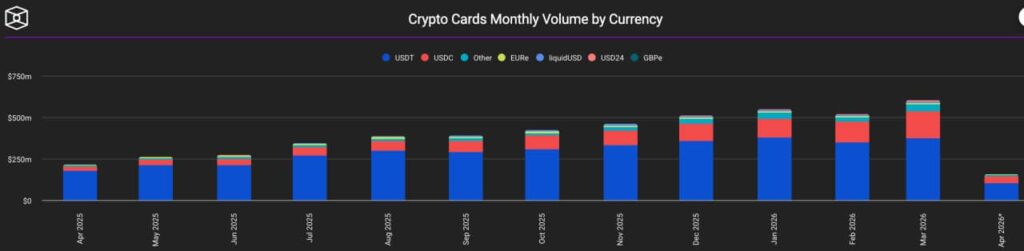
- Crypto card usage surged 211% year-over-year, hitting $600M monthly volume.
- Southeast Asia leads adoption, highlighting real-world utility beyond speculation.
- Bitcoin remains range-bound near $70K as geopolitical risks drive volatility.
Crypto is no longer just a speculative asset class—it is steadily becoming a usable payment method. That shift became clearer in March 2026, when crypto-linked card spending crossed $600 million in monthly volume, marking a sharp 211% increase from the same period last year. The milestone reflects a deeper structural change in how digital assets are used, moving beyond trading into everyday transactions.
At the same time, macro uncertainty continues to shape crypto markets. Bitcoin is holding near $71,000, but geopolitical tensions and energy market volatility are influencing short-term price direction.
Crypto Cards Gain Real-World Utility
The rise in crypto card usage highlights a key evolution: users are increasingly spending, not just holding, their digital assets. Monthly transaction volume has now reached $6.5 billion cumulatively, across more than 21 million transactions.
A major driver behind this growth is reduced friction. Crypto-linked debit and prepaid cards allow users to spend stablecoins or other digital assets directly at checkout. Behind the scenes, these assets are converted into local currency via traditional card networks, making the process seamless for both users and merchants.
Visa dominates this space, processing roughly 97% of March’s total volume. This reflects not just market share, but the network’s deep integration with global point-of-sale infrastructure.
Emerging Markets and Blockchain Dynamics
Adoption is not evenly distributed. Southeast Asia accounts for about 60% of global stablecoin payment volume, suggesting crypto cards are serving as a primary financial tool in regions with limited banking access.
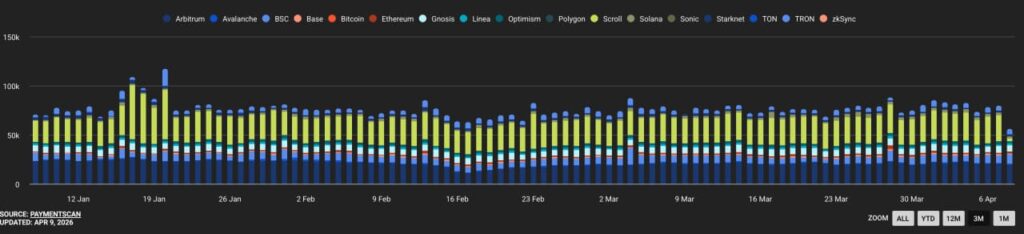
On the blockchain side, TRON leads with 35% of payment volume, followed by BNB Chain at 15%. These networks benefit from lower transaction fees, making them more practical for everyday payments compared to higher-cost alternatives.
New entrants like KAST, Tria, and Solana-based payment cards are also expanding the ecosystem, enabling crypto spending across millions of merchants globally.
Bitcoin Holds $70K as Geopolitics Drive Volatility
While payment adoption strengthens crypto’s long-term case, short-term price action tells a more cautious story. Bitcoin is trading near $71,000, slightly down over the past 24 hours, as doubts emerge over a fragile U.S.-Iran ceasefire.
Energy markets are reacting quickly. Brent crude has rebounded toward $97 per barrel after a sharp drop, signaling renewed uncertainty. This matters for crypto because rising oil prices can feed inflation concerns, influencing central bank policy and risk appetite.
Technically, Bitcoin remains within its $65,000–$73,000 range. Key support sits near $70,500, while resistance around $71,700 has already rejected upward momentum. A breakdown in geopolitical stability could push prices lower, while easing tensions may reopen the path toward $73,000 and beyond.
Also Read: Iran’s Bitcoin Mining Crashes 77% — Here’s Why the Network Didn’t Break
The surge in crypto card spending signals a meaningful shift in adoption, with digital assets increasingly used for real-world payments. At the same time, Bitcoin’s price remains tightly linked to macro forces, particularly geopolitical risk and inflation expectations.
Together, these trends show a maturing market: one where utility is rising even as volatility persists.
Disclaimer: The information in this article is for general purposes only and does not constitute financial advice. The author’s views are personal and may not reflect the views of Chain Affairs. Before making any investment decisions, you should always conduct your own research. Chain Affairs is not responsible for any financial losses.

I’m a crypto enthusiast with a background in finance. I’m fascinated by the potential of crypto to disrupt traditional financial systems. I’m always on the lookout for new and innovative projects in the space. I believe that crypto has the potential to create a more equitable and inclusive financial system.