|
Getting your Trinity Audio player ready...
|
- Solana processed $650B in stablecoin transactions in February 2026.
- Total stablecoin market volume is approaching $2 trillion monthly.
- Liquidity inflows and new products are accelerating blockchain adoption.
Stablecoin activity on Solana has accelerated sharply, with transaction volume hitting $650 billion in February 2026. The surge marks one of the fastest growth rates among major blockchain networks and reflects a broader expansion across the digital asset market, where total monthly stablecoin volume is now nearing $2 trillion.
The jump signals a shift in market momentum, driven by rising liquidity, new asset issuance, and increasing integration between traditional finance and blockchain systems.
Stablecoin Growth Gains Momentum Across Networks
Solana’s stablecoin volume nearly tripled month-over-month in February, placing it among the top contributors to overall market activity. While Ethereum and Tron continue to lead in total volume, Solana has emerged as the fastest-growing network in recent months.
The broader trend shows steady expansion. Throughout 2024, monthly stablecoin volumes ranged between $400 billion and $700 billion. By mid-2025, totals surpassed $800 billion, eventually crossing $1.2 trillion by year-end. Now, early 2026 estimates place the market between $1.8 trillion and $1.9 trillion per month.
This rapid rise highlights growing reliance on stablecoins for payments, trading, and liquidity management across global markets.
Liquidity Inflows and New Issuance Drive Activity
A key driver behind Solana’s growth has been a surge in liquidity inflows. Circle minted approximately $750 million in USDC on Solana within a 24-hour window, adding significant dollar liquidity to the network. Earlier in 2026, Circle issued $4.25 billion in USDC over just seven days, reinforcing a pattern of rapid capital deployment.
New stablecoin products have also contributed to the expansion. Western Union introduced USDPT, while Jupiter launched JUPUSD, increasing the diversity of assets circulating on-chain.
Meanwhile, Ripple partnered with Convera to expand stablecoin-enabled payments. The collaboration links blockchain infrastructure with traditional financial systems, potentially accelerating institutional adoption.
Market Comparison and Price Trends
The scale of stablecoin activity now rivals traditional financial markets. Monthly volumes approach nearly nine times the $208 billion recorded in gold futures on CME Group, underscoring the growing importance of digital dollar liquidity.
Also Read: RIV Coin Launches on Solana to Bridge Institutional Capital with DeFi Infrastructure
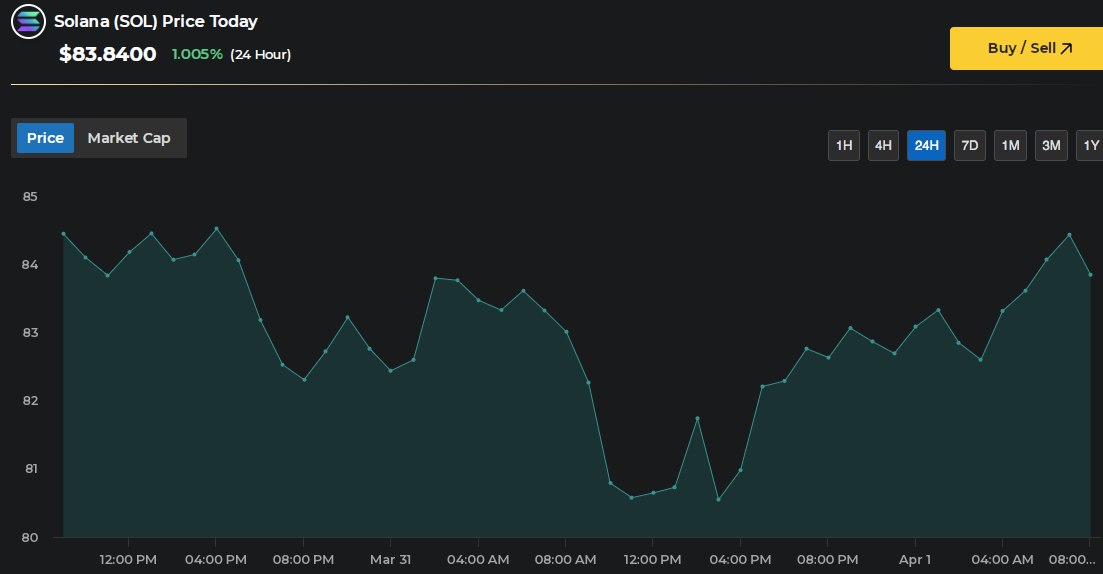
At the same time, Solana’s native token showed steady market participation. The asset traded around $83.84, recovering from earlier lows near $80. Trading volume rose nearly 30% to $4.87 billion, reflecting increased investor engagement alongside the surge in network activity.
Solana’s rapid rise in stablecoin activity highlights a broader transformation in the crypto market. As liquidity flows intensify and new financial products emerge, stablecoins are becoming a central pillar of global digital finance. While Ethereum and Tron maintain dominance, Solana’s growth trajectory suggests it could play a larger role in shaping the next phase of blockchain-based payments and settlement.
Disclaimer: The information in this article is for general purposes only and does not constitute financial advice. The author’s views are personal and may not reflect the views of Chain Affairs. Before making any investment decisions, you should always conduct your own research. Chain Affairs is not responsible for any financial losses.

I’m your translator between the financial Old World and the new frontier of crypto. After a career demystifying economics and markets, I enjoy elucidating crypto – from investment risks to earth-shaking potential. Let’s explore!