|
Getting your Trinity Audio player ready...
|
- Capital ₿’s continued accumulation toward a long-term goal of holding 1% of Bitcoin’s total supply reflects growing corporate comfort with BTC as a treasury asset, even after a 46% drawdown.
- Pi Cycle Top, MVRV Z-Score, and Puell Multiple collectively suggest Bitcoin is in a mid-cycle grind, not approaching a major top or bottom.
- With average mining costs near $88,000 and the Puell Multiple below 1, historical patterns point toward a tightening supply environment.
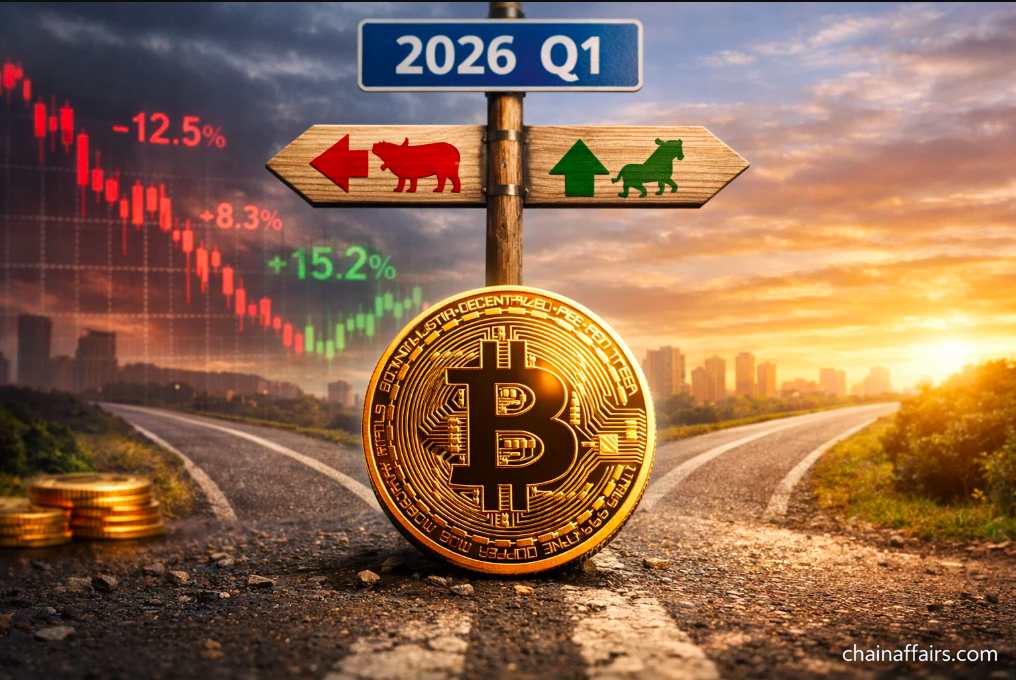
Bitcoin is ending the first quarter of 2026 the way a seasoned boxer ends a tough round — upright, breathing, but clearly absorbing punches. Trading around $68,600, the world’s largest cryptocurrency has shed roughly 46% from its $126,000 peak in 2025, a decline that has tested conviction across retail and institutional investors alike.
Yet beneath the surface narrative of decline, the data tells a more nuanced story. The current pullback fits neatly into post-halving historical correction patterns, and several key on-chain indicators suggest this is consolidation, not collapse.
What the Metrics Are Actually Saying
Three long-term indicators paint a consistent picture heading into Q2.
The Pi Cycle Top, widely used to identify market euphoria, shows no sign of triggering. The 111-day moving average sits near $80,700–$80,900, while its counterpart — the 350-day moving average doubled — stands at roughly $197,000. These two lines would need to converge dramatically for a top signal to fire. That gap makes one thing clear: Bitcoin is nowhere near the kind of overheated peak that preceded previous crashes.

The MVRV Z-Score, which measures how far the current price deviates from its “fair value,” sits at 0.48 — firmly in neutral territory. Holders are broadly at breakeven or in modest profit, a position that historically leaves room for appreciation before the market becomes dangerously overvalued.
Perhaps most telling is the Puell Multiple, which currently sits around 0.67. This metric reflects miner revenue relative to the one-year average, and anything below 1.0 signals distress. Miners are hurting — average production costs hover near $88,000 per coin, making current prices deeply unprofitable for many operations. Historically, these conditions have preceded supply squeezes: squeezed miners sell less, inventories tighten, and prices recover.
Institutions Aren’t Waiting on the Sidelines
While retail sentiment wavers, institutional behavior tells a different story. Capital ₿, Europe’s first publicly listed Bitcoin treasury company, made headlines this month by acquiring 44 additional Bitcoin for approximately €2.7 million, at roughly €61,763 per coin. The purchase lifted its total holdings to 2,888 BTC, now valued at around €267 million.
The Paris-listed firm has been methodically accumulating since late 2024, with purchases ranging from small monthly buys to batches of over 600 BTC at a time. Its stated ambition — holding 1% of Bitcoin’s total supply by 2033 — signals the kind of generational conviction that doesn’t waiver on a bad quarter.
Board Director Alexandre Laizet cited a year-to-date BTC yield of 0.72%, reflecting a disciplined, yield-focused approach rather than speculative accumulation. The firm recently raised €3 million through share subscription warrants and completed an additional €500,000 capital increase, giving it a clear liquidity runway for further buying.
The strategy reflects a broader institutional shift. Even as Bitcoin trades far below its all-time high, companies like Capital ₿ continue treating it as a legitimate treasury reserve — a store of value increasingly appealing in an environment of geopolitical uncertainty and energy market instability.
What Q2 Might Actually Look Like
The setup for April through June leans toward gradual recovery rather than dramatic reversal. If Bitcoin holds the $67,000–$68,000 support zone and ETF inflows resume — alongside continued whale accumulation — analysts expect a drift toward the $80,000–$85,000 range by quarter-end, with $90,000 possible in stronger months.
Catalysts that could accelerate the move include potential central bank rate cuts, clearer regulatory frameworks, and fresh corporate adoption. On the downside, prolonged range-bound trading or broader equity weakness could keep prices anchored between $70,000 and $75,000, with $65,000 a possibility on sharp risk-off events.
The market’s maturity is increasingly visible. The frenzy of the 2024 halving and 2025 ETF wave has faded into something more measured: patient long-term holders, accumulating institutions, and miners under pressure in a market finding its footing. If the current indicators continue trending toward neutral-to-bullish, Q2 could mark the shift from digestion back to momentum.
Disclaimer: The information in this article is for general purposes only and does not constitute financial advice. The author’s views are personal and may not reflect the views of Chain Affairs. Before making any investment decisions, you should always conduct your own research. Chain Affairs is not responsible for any financial losses.

The latest Crypto News on Blockchain, Crypto, NFTs, Bitcoin, DOGE, XRP, Cardano IOTA, SHIB, ETH, DeFi, and the Metaverse.