
|
Getting your Trinity Audio player ready...
|
- Bitcoin ETF inflows signal strong institutional accumulation near $75K.
- Short-term holders are selling aggressively into price strength.
- Market shows a split between long-term confidence and short-term caution.
Bitcoin is edging closer to a critical breakout level, buoyed by a steady return of institutional demand. At the time of writing, BTC is trading at $74,263, up 6.8% over the past seven days. The rally has been underpinned by a strong streak of spot Bitcoin ETF inflows, suggesting large investors are quietly rebuilding exposure.
Yet beneath the surface, a different trend is emerging. On-chain data reveals that short-term holders are increasingly using price strength to exit positions, creating a push-and-pull dynamic that could shape Bitcoin’s next major move.
Bitcoin ETF Inflows Signal Renewed Institutional Confidence
Institutional demand has regained momentum after a volatile stretch earlier in the quarter. Spot Bitcoin ETFs recorded $199.37 million in net inflows on March 17, extending a seven-day streak of positive flows. Total net assets across Bitcoin ETFs have climbed to $96.74 billion, marking a notable recovery from early March lows when outflows dominated.
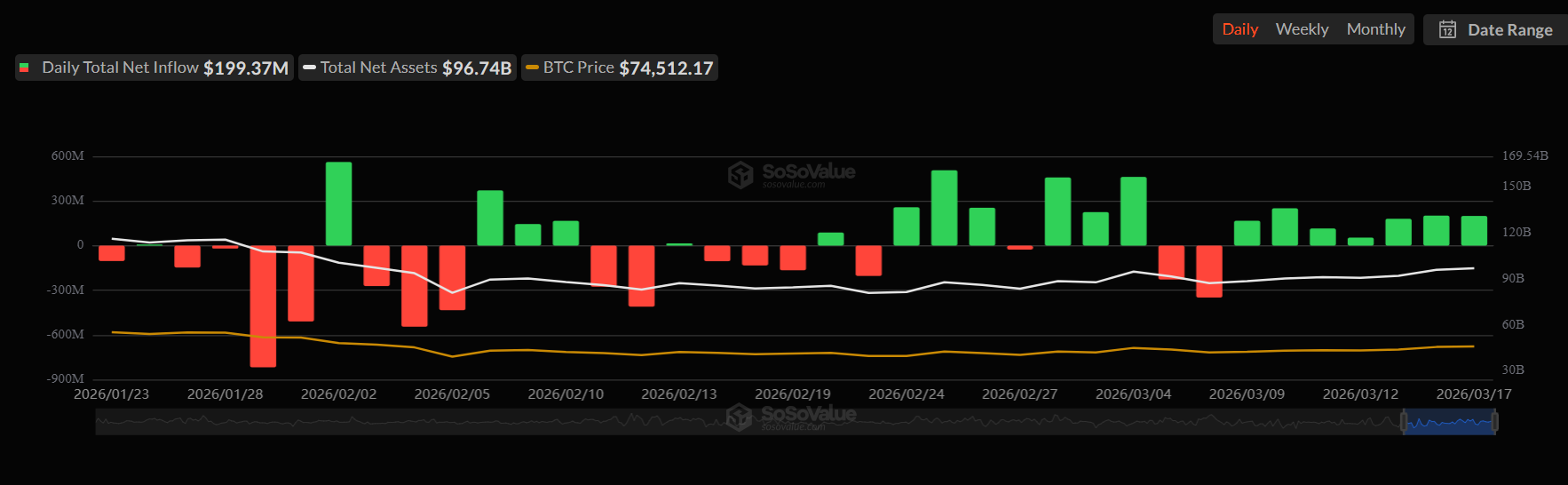
This consistent inflow trend is significant. For much of February and early March, ETF activity was erratic, with sharp inflows often offset by equally strong redemptions. The current streak represents the longest sustained period of net inflows in weeks, pointing to growing conviction among institutional investors.
The timing is also critical. Bitcoin is approaching the $75,000 resistance level—a psychological and technical barrier that has repeatedly capped upside attempts. Institutional accumulation at this range suggests large players are positioning ahead of a potential breakout rather than waiting for confirmation.
Beyond ETFs, corporate accumulation is reinforcing the narrative. Strategy, led by Michael Saylor, recently executed its largest Bitcoin purchase of 2026, acquiring over 22,000 BTC in a $1.57 billion deal. The company’s stock responded positively, rising alongside Bitcoin and signaling continued alignment between corporate treasury strategies and crypto market performance.
Short-Term Holders Are Selling Into Strength
While institutional flows paint a bullish picture, on-chain metrics tell a more cautious story about retail behavior.
Data from CryptoQuant shows that short-term holders—wallets holding Bitcoin for less than 155 days—are increasingly sending coins to exchanges in profit. More than 48,000 BTC were moved to exchanges in a single day as Bitcoin tested the $75,000 level, marking a yearly high in profit-taking activity.
This behavior indicates a lack of confidence in a sustained breakout. Rather than accumulating, many retail participants are treating rallies as opportunities to lock in gains and reduce risk exposure.
The trend reflects broader market psychology. After weeks of sideways price action and macro-driven volatility, short-term investors appear unwilling to hold through uncertainty. Each upward move is met with selling pressure, creating friction that slows Bitcoin’s ascent.
This divergence between institutional accumulation and retail distribution highlights a market split into two distinct camps:
- Long-term, well-capitalized investors steadily building positions
- Short-term traders actively de-risking into price strength
Macro and Regulatory Tailwinds Add Support
Bitcoin’s recent price action is also being shaped by macro and regulatory developments that are subtly improving market sentiment.
Geopolitical signals have played a role. Comments from U.S. President Donald Trump regarding renewed communication with Iran injected optimism into global markets, contributing to Bitcoin’s push toward $74,000. While indirect, such developments often influence risk assets by easing uncertainty.
More importantly, regulatory clarity in the United States has strengthened Bitcoin’s institutional appeal. A joint framework released by the SEC and CFTC formally classified Bitcoin as a digital commodity rather than a security.
This distinction removes a long-standing source of ambiguity and reinforces Bitcoin’s regulatory positioning compared to other crypto assets. For institutional investors, clarity reduces compliance risk and supports broader adoption through regulated financial products like ETFs.
The current Bitcoin market is defined by a clear contradiction: strong institutional inflows coexisting with persistent retail selling.
On one hand, ETF flows and corporate purchases indicate that long-term capital sees value at current levels. These participants are less sensitive to short-term volatility and more focused on strategic positioning.
On the other hand, retail investors and short-term holders are behaving defensively. Their actions suggest skepticism about Bitcoin’s ability to break decisively above resistance in the near term.
This dynamic creates a supply-demand tug-of-war. Institutional buying provides a steady floor, while retail selling caps immediate upside. The result is a grinding price structure where progress is incremental rather than explosive.
Bitcoin’s ability to break above $75,000 will likely depend on whether institutional demand can absorb ongoing selling pressure from short-term holders.
If ETF inflows remain consistent and macro conditions stay supportive, the balance could tip in favor of buyers. A decisive breakout above resistance would likely trigger renewed momentum and potentially force sidelined capital back into the market.
However, if retail selling intensifies or inflows begin to slow, Bitcoin could remain range-bound. In that scenario, the market may continue to consolidate as it searches for a stronger catalyst.
Bitcoin’s climb toward $75,000 reflects a market regaining institutional confidence, but not without resistance. The steady inflow of capital through ETFs and corporate accumulation points to a bullish long-term outlook. At the same time, short-term holders are actively selling into strength, revealing underlying caution among retail participants.
Also Read: Bitcoin’s 21M Cap Explained: Why the Real Supply Is Much Lower
This split narrative underscores the complexity of the current cycle. Bitcoin is no longer driven by a single cohort of investors but by competing forces with different time horizons and risk appetites.
Whether the next move is a breakout or another consolidation phase will depend on which side gains the upper hand. For now, Bitcoin remains caught between conviction and caution—a market poised, but not yet committed.
Disclaimer: The information in this article is for general purposes only and does not constitute financial advice. The author’s views are personal and may not reflect the views of Chain Affairs. Before making any investment decisions, you should always conduct your own research. Chain Affairs is not responsible for any financial losses.

I’m a crypto enthusiast with a background in finance. I’m fascinated by the potential of crypto to disrupt traditional financial systems. I’m always on the lookout for new and innovative projects in the space. I believe that crypto has the potential to create a more equitable and inclusive financial system.