
|
Getting your Trinity Audio player ready...
|
- Hyperliquid shows a rare $3.64B long-short equilibrium, signaling extreme tension.
- Shorts are currently under pressure, increasing the risk of a squeeze.
- ETH $2,000 level remains the critical trigger for the next major move.
A rare and fragile equilibrium is forming on Hyperliquid, where $3.64 billion in leveraged positions has split almost perfectly between bulls and bears. The near 1:1 long-short ratio, revealed by CoinGlass, signals a market stuck in tension—one that could snap violently with even a modest price move.
At the center of this standoff is Ethereum, alongside a growing mix of crypto and real-world asset (RWA) derivatives. With leverage levels often exceeding 20x, the current setup resembles a coiled spring: stable on the surface, but primed for a rapid and potentially cascading liquidation event.
Hyperliquid Open Interest Hits Critical Mass
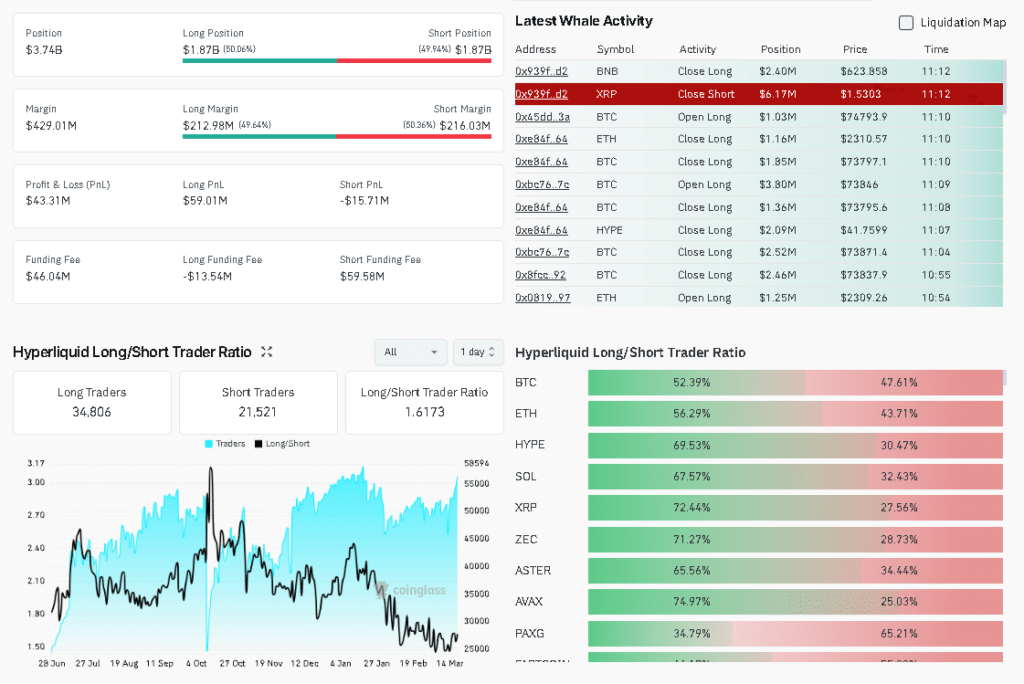
Hyperliquid’s total open interest has climbed to approximately $3.644 billion, placing it in direct competition with major centralized exchanges. But unlike traditional markets, the composition of this exposure reveals a deeper structural imbalance.
Long positions account for roughly $1.821 billion, while short positions stand at $1.823 billion. This near-perfect parity suggests that large traders—commonly referred to as crypto whales—are not committing to a clear directional bias. Instead, they are heavily positioned on both sides, waiting for a decisive breakout.
Despite the balance in nominal value, profit distribution tells a different story. Long traders are currently sitting on an estimated $57 million in unrealized gains, supported by gradual upward momentum in major assets. Short sellers, on the other hand, are facing losses of over $11 million.
This asymmetry creates immediate pressure on bearish positions. If prices continue to rise even slightly, short sellers may be forced to close positions, triggering a short squeeze. Conversely, a sharp downturn would erase long profits quickly, flipping bullish positions into forced sellers.
Why This Deadlock Could Trigger a Liquidation Cascade
The mechanics of leveraged trading on Hyperliquid amplify the risks. With leverage often exceeding 20x, even a 2–3% move in underlying assets can trigger liquidations.
In the current environment, the short side appears more vulnerable. Already under pressure, a bullish catalyst—such as a macroeconomic shift or crypto inflows—could force rapid short covering. This would create a feedback loop where rising prices trigger more liquidations, accelerating upward momentum.
However, the downside scenario is equally dangerous.
If the market reverses, the $57 million in unrealized gains held by long traders could evaporate quickly. In high-leverage DeFi environments, liquidation mechanisms are automated through smart contracts, meaning positions can unwind almost instantly without human intervention.
The result is a binary setup:
- A bullish breakout could ignite a short squeeze.
- A bearish reversal could trigger mass long liquidations.
In both cases, volatility is not just likely—it is structurally embedded in the system.
Whale Positioning Expands Beyond Crypto
One of the defining trends behind Hyperliquid’s surge in open interest is its expansion into real-world assets. The platform now supports derivatives tied to commodities and other traditional financial instruments, attracting a new class of sophisticated traders.
This evolution has broadened whale activity beyond pure crypto speculation. Traders are increasingly using the platform to hedge macro risks, including geopolitical tensions and commodity price swings.
At the same time, the native HYPE token ecosystem is seeing accumulation from notable market participants. Large wallets are signaling long-term confidence, even as short-term leverage risks intensify.
A standout example is a wallet holding a 20x leveraged long position on Ethereum with an entry price just above $2,000. This position alone carries over $15 million in unrealized profit, illustrating the scale of risk concentrated in individual trades.
Such positions often act as magnets for price action. Markets tend to gravitate toward liquidation levels, creating self-reinforcing cycles where large positions influence short-term volatility.
Key Levels That Could Decide the Market
With leverage so tightly balanced, price levels become critical triggers for cascading moves.
On the upside, Ethereum breaking above the $2,100 level could force a large portion of the $1.823 billion short book into liquidation. This would likely trigger a rapid influx of buy orders, pushing prices higher in a classic squeeze dynamic.
On the downside, the $1,990 support level is emerging as a key threshold. A breakdown below this point would put major leveraged long positions at risk, potentially triggering a wave of forced selling.
If that scenario unfolds, analysts expect a deeper flush toward the $1,850 range as leveraged positions unwind.
In both directions, the first meaningful move is likely to dictate short-term market structure. The current equilibrium leaves little room for gradual price discovery—any breakout is expected to be sharp and aggressive.
Volatility Is the Only Certainty
For now, the market remains locked in a tense stalemate. The near-equal distribution of long and short positions reflects uncertainty among large traders, rather than conviction.
However, this balance is inherently unstable.
The combination of high leverage, concentrated whale positions, and expanding RWA exposure creates a system where small price changes can trigger outsized reactions. External catalysts—whether macroeconomic data, crypto inflows, or commodity volatility—could provide the spark.
Also Read: $1.43B in Hyperliquid Trading! Oil Surges Past Crypto – Here’s Why
Until then, the $2,000 level on Ethereum remains a critical pivot point.
In this environment, traders are not just betting on direction—they are navigating a market structure where the cost of being wrong can escalate rapidly. The Hyperliquid ecosystem, once seen as a high-growth DeFi venue, is now a live test of how decentralized leverage behaves under extreme tension.
Disclaimer: The information in this article is for general purposes only and does not constitute financial advice. The author’s views are personal and may not reflect the views of Chain Affairs. Before making any investment decisions, you should always conduct your own research. Chain Affairs is not responsible for any financial losses.

I’m your translator between the financial Old World and the new frontier of crypto. After a career demystifying economics and markets, I enjoy elucidating crypto – from investment risks to earth-shaking potential. Let’s explore!