
|
Getting your Trinity Audio player ready...
|
- Stablecoin transaction volume reached a record $1.8 trillion in February.
- USDC accounted for 70% of transfers, far surpassing Tether’s activity.
- Rising stablecoin balances on exchanges suggest renewed crypto market buying power.
Stablecoins are playing an increasingly important role in crypto markets, and February delivered a major milestone. Monthly stablecoin transaction volume surged to a record $1.8 trillion, highlighting the growing reliance on dollar-pegged digital assets for trading, payments, and liquidity across the crypto ecosystem.
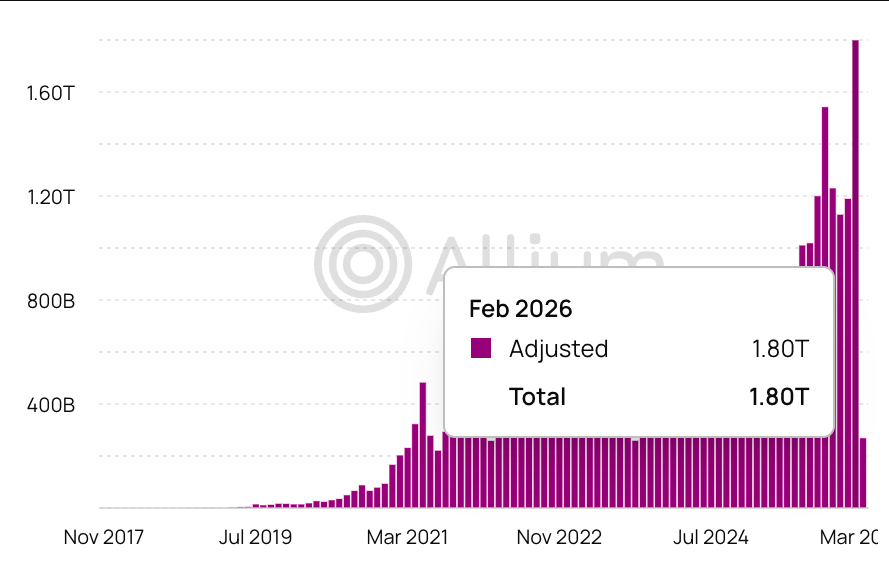
Even more surprising to analysts was the scale of activity surrounding USD Coin (USDC). The stablecoin accounted for around 70% of all transfer volume, significantly outpacing Tether (USDT) despite having a much smaller market capitalization.
The shift signals a possible change in how traders and institutions are using stablecoins to move capital across the market.
USDC Surges Past Tether in Transfer Volume
According to blockchain data platform Allium, USDC recorded $1.26 trillion in transaction volume in February, more than double the $514 billion processed by USDT.
This development is notable because Tether still dominates the market in terms of supply. USDT’s market capitalization sits at roughly $184 billion, compared with about $77 billion for USDC.
Despite that gap, USDC has been consistently processing more transfer activity in recent months. Analysts say this could reflect growing adoption among institutions, payment providers, and trading platforms that favor USDC’s transparency and regulatory positioning.
The trend has also been supported by fresh issuance. Blockchain intelligence firm Arkham reported that over $3 billion in new USDC was minted in early March, while USDT’s circulating supply remained relatively stable.
Also Read: AVAX Whales Are Buying the Dip — Is Avalanche Preparing for a Major Rally?
Meanwhile, the company behind USDC, Circle Internet Group, recently reported strong financial results, driven by expanding payments infrastructure and rising usage of the stablecoin.
Rising Stablecoin Supply Signals Returning Market Liquidity
Beyond the headline transaction numbers, stablecoin flows are also offering clues about broader crypto market conditions.
The Stablecoin Supply Ratio (SSR) — which compares the market value of Bitcoin to the total value of stablecoins — has begun to recover after a sharp drop earlier in February. Analysts say this suggests that liquidity and potential buying power are returning to the market.
Data from CryptoQuant shows that stablecoin balances on crypto exchanges climbed to a three-week high of $66.5 billion. On March 5 alone, more than $5 billion in stablecoins flowed into exchanges, a sharp increase from roughly $1.14 billion recorded just days earlier.
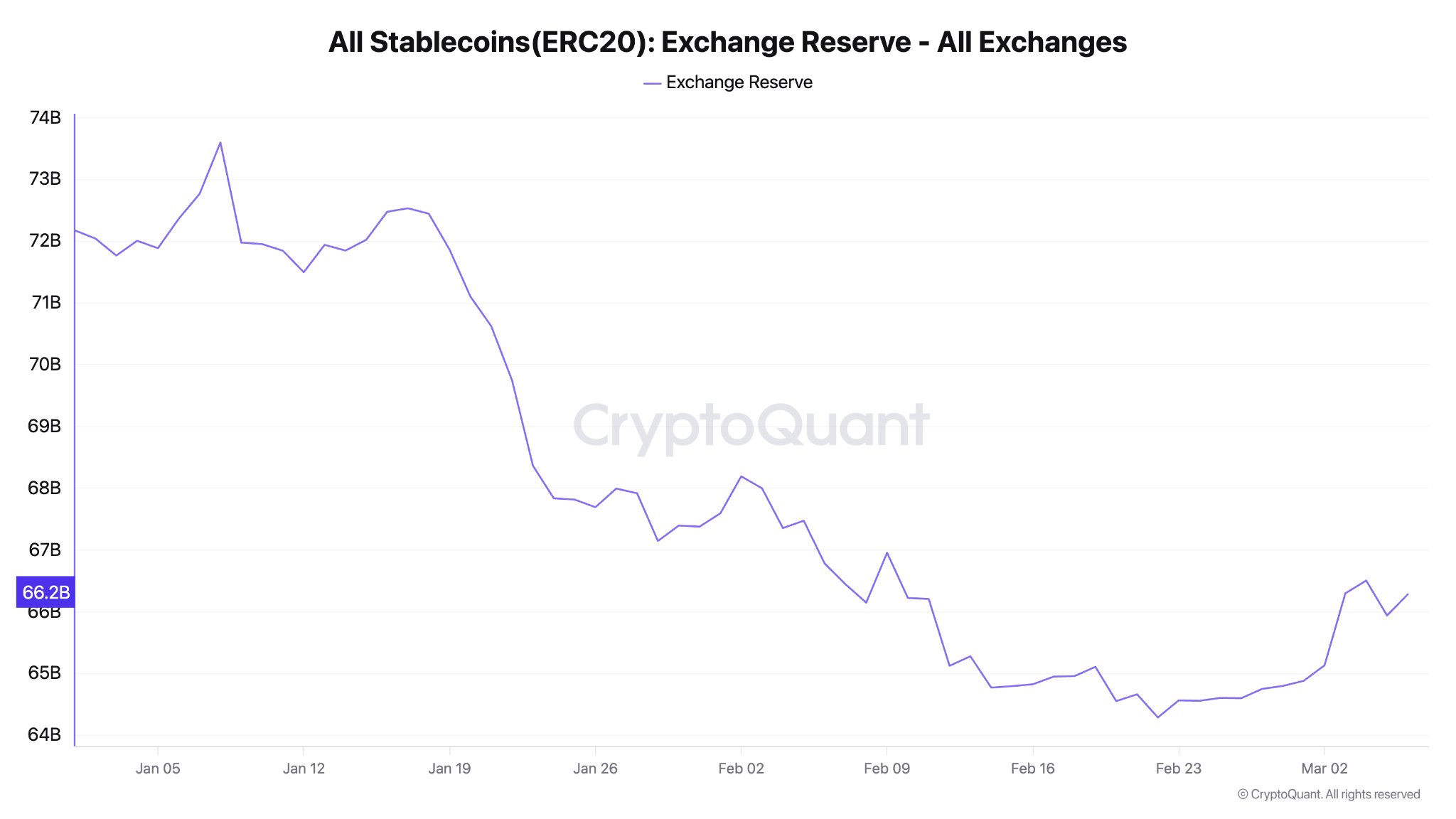
Historically, rising stablecoin reserves on exchanges often precede periods of stronger crypto market activity because they represent capital waiting to be deployed into assets like Bitcoin and altcoins.
What This Means for the Crypto Market
February’s record transaction volume underscores how critical stablecoins have become to the digital asset economy. They serve as a bridge between traditional finance and crypto markets while providing traders with fast and stable liquidity.
USDC’s unexpected dominance in transfer activity could also signal shifting preferences among institutions and large traders.
If stablecoin inflows to exchanges continue to rise, analysts believe the market may be building the liquidity foundation needed for the next phase of crypto price growth.
Disclaimer: The information in this article is for general purposes only and does not constitute financial advice. The author’s views are personal and may not reflect the views of Chain Affairs. Before making any investment decisions, you should always conduct your own research. Chain Affairs is not responsible for any financial losses.

I’m a crypto enthusiast with a background in finance. I’m fascinated by the potential of crypto to disrupt traditional financial systems. I’m always on the lookout for new and innovative projects in the space. I believe that crypto has the potential to create a more equitable and inclusive financial system.