
|
Getting your Trinity Audio player ready...
|
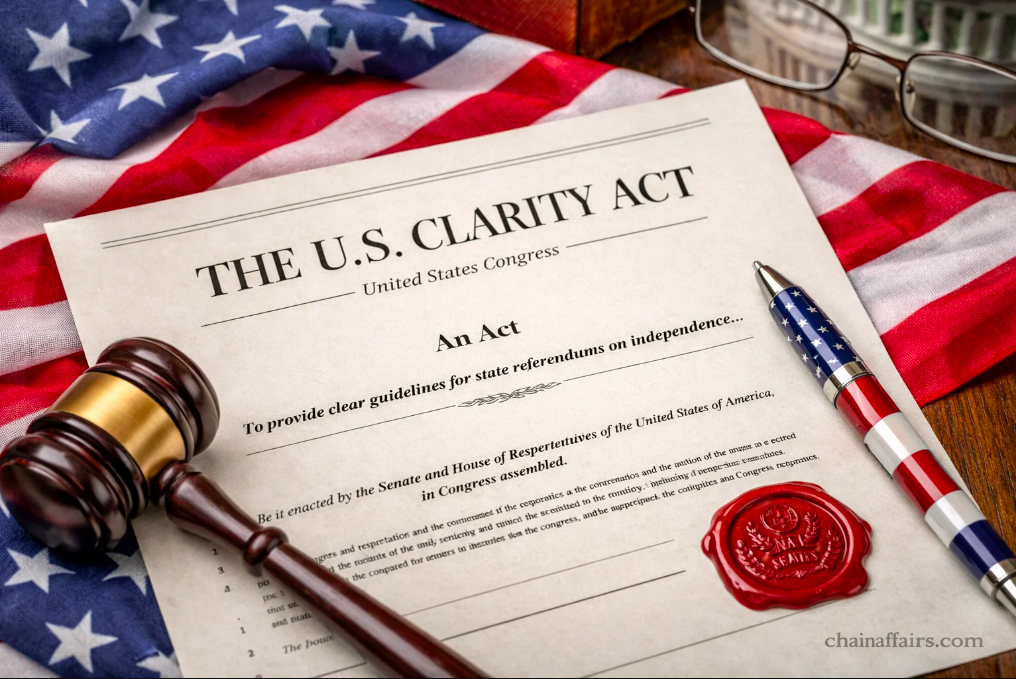
The U.S. Clarity Act is a proposed federal law designed to bring long-awaited regulatory certainty to the American cryptocurrency market. For more than a decade, digital assets in the U.S. have existed in a gray zone, governed largely by enforcement actions rather than clear legislation. The Clarity Act aims to replace that uncertainty with defined rules for how crypto assets are classified, regulated, and supervised.
At a time when capital, talent, and innovation are increasingly moving offshore, supporters see the bill as a critical step toward restoring U.S. competitiveness in the global digital asset economy.
The Regulatory Problem the Clarity Act Tries to Solve
The central issue facing the U.S. crypto market is fragmented oversight. Currently, the Securities and Exchange Commission (SEC) and the Commodity Futures Trading Commission (CFTC) both assert authority over parts of the industry, often without clear boundaries. This overlap has led to inconsistent guidance, legal disputes, and high-profile enforcement cases that have left companies guessing about compliance.
Without a unified framework, crypto firms have struggled to determine whether their tokens are securities, commodities, or something else entirely. This uncertainty has discouraged institutional participation, delayed product launches, and driven some firms to relocate outside the United States.
The Clarity Act is intended to address these problems by clearly defining regulatory responsibilities and asset classifications from the outset.
How the Clarity Act Defines Digital Assets
One of the bill’s most significant contributions is its approach to asset classification. Rather than applying a one-size-fits-all rule, the Clarity Act evaluates digital assets based on how they function and how decentralized their networks are.
Under the proposal, a token may initially be treated as a security if it is sold as part of a capital-raising effort tied to a centralized development team. Over time, however, that classification can change. If a network becomes sufficiently decentralized — meaning no single party controls its operation or economic value — the asset may transition into a commodity regulated primarily by the CFTC.
This concept, often described as a “pathway to decentralization,” is designed to give projects a clearer compliance roadmap instead of exposing them to indefinite regulatory risk.
Implications for the SEC and CFTC
The Clarity Act seeks to formally define the roles of the SEC and the CFTC, an issue that has long been contested. The SEC would retain authority over digital assets that function as securities, particularly during early-stage token offerings. The CFTC, meanwhile, would oversee decentralized commodities and related trading activity.
For regulators, this division could reduce jurisdictional disputes. For market participants, it could mean clearer licensing, reporting, and compliance standards — especially for exchanges and custodians that currently operate under overlapping or unclear requirements.
Impact on Crypto Exchanges and Token Issuers
Crypto exchanges stand to be among the biggest beneficiaries of the Clarity Act. Clear rules around registration, custody, disclosure, and market structure would allow platforms to operate with greater legal certainty. This is especially important for U.S.-based exchanges that have faced enforcement actions despite limited regulatory guidance.
Token issuers would also gain clarity around disclosure obligations and investor protections. Instead of relying on informal guidance or legal interpretation, projects could follow defined standards when launching and decentralizing their networks.
This could reduce legal risk while improving transparency for investors.
Why Institutional Investors Are Watching Closely
Institutional investors have largely stayed on the sidelines of U.S. crypto markets due to regulatory uncertainty. Pension funds, asset managers, and insurers require clear legal frameworks before committing capital at scale.
By clarifying asset classifications and regulatory oversight, the Clarity Act could unlock broader institutional participation. Analysts note that assets like Ethereum are particularly sensitive to the bill’s outcome, given their role in discussions around decentralization and network maturity.
Clearer rules could also accelerate the growth of crypto ETFs and ETPs, expanding access for traditional investors.
Also Read: The GENIUS Act Explained: A New Era for U.S. Stablecoin Regulation
Political Hurdles and Delays
Despite strong industry support, the Clarity Act has faced delays. Lawmakers must balance competing priorities, partisan divisions, and broader debates around financial regulation and consumer protection. While officials have signaled progress in the coming year, each delay prolongs uncertainty.
These setbacks have already affected market sentiment, contributing to volatility in crypto investment flows and cautious positioning among U.S.-based institutions.
What the Clarity Act Could Mean Long Term
If passed, the U.S. Clarity Act could fundamentally reshape how crypto is regulated in America. It would shift oversight from reactive enforcement to proactive legislation, providing a stable foundation for innovation and growth.
While the bill will not eliminate all regulatory risk, it represents a major step toward aligning the U.S. with other jurisdictions that have already adopted clearer crypto frameworks.
Until then, the Clarity Act remains both a source of frustration and a symbol of potential progress — one that markets will continue to watch closely.
Quick Reference Table
| Feature | Requirement under Clarity Act |
|---|---|
| Primary Goal | Consumer protection and USD stability in digital form |
| Issuer Types | Banks (Federal) or Non-Banks (State-approved) |
| Collateral | 100% HQLA (Cash & <90-day U.S. Treasuries) |
| Algorithmic Tokens | Multi-year Moratorium on new “endogenous” tokens |
| Redemptions | 1:1 parity required; must be processed “promptly” |
| Audit Frequency | Monthly public attestation; Annual certified audit |
| Oversight | Federal Reserve, OCC, and State Regulators |
| Consumer Protection | Bankruptcy-remote reserves; senior claim for holders |
| Interoperability | Fed-mandated standards to prevent walled gardens |
Disclaimer: The information in this article is for general purposes only and does not constitute financial advice. The author’s views are personal and may not reflect the views of Chain Affairs. Before making any investment decisions, you should always conduct your own research. Chain Affairs is not responsible for any financial losses.

I’m the cryptocurrency guy who loves breaking down blockchain complexity into bite-sized nuggets anyone can digest. After spending 5+ years analyzing this space, I’ve got a knack for disentangling crypto conundrums and financial markets.


