
|
Getting your Trinity Audio player ready...
|
- Hardware-Level Trust: Data is verified directly by sensors, eliminating manual fraud and tampering.
- Real-Time Accountability: Credits update dynamically based on live performance instead of static claims.
- Decentralized Speed: Global monitoring scales faster and cheaper via individual hardware owners.
For decades, the corporate sustainability report has been a masterpiece of creative writing rather than a rigorous scientific document. Large conglomerates have spent billions on “carbon offsets” that didn’t exist, “sustainable” supply chains that were invisible to the naked eye, and “net-zero” pledges that relied on data sets as flimsy as the paper they were printed on.
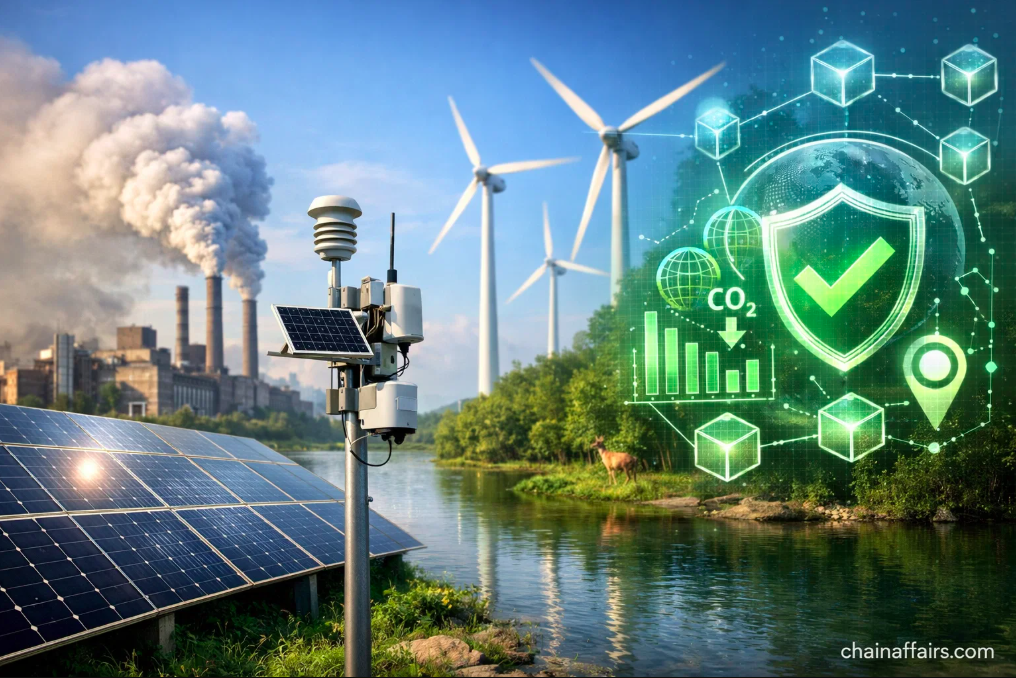
But in 2026, the era of “trust us” is being replaced by the era of “verify it.” The catalyst isn’t a new government regulation or a change in corporate heart—it is DePIN (Decentralized Physical Infrastructure Networks). By deploying global meshes of hardware sensors connected directly to the blockchain, we are finally seeing the “physical world” uploaded to the “digital ledger” in real-time, creating an immutable truth-machine that corporate PR departments can no longer manipulate.
The Illusion of Sustainability: Why We Failed
To understand why DePIN is a revolutionary force, one must first understand the catastrophic failure of the traditional Environmental, Social, and Governance (ESG) industry. Between 2015 and 2024, the carbon credit market was rocked by scandals. Investigative reports found that over 90% of rain forest offsets used by major corporations were “worthless,” representing “phantom credits” for trees that were never under threat or, in some cases, didn’t even exist.
The problem was fundamental: The Oracle Problem. In blockchain terms, an “oracle” is the bridge between the real world and the ledger. Historically, the “oracles” for corporate sustainability were human auditors. These auditors were often paid by the companies they were investigating, visited sites only once a year, and relied on self-reported data. This created a massive lag in information and a high susceptibility to corruption. Greenwashing wasn’t just a marketing tactic; it was a systemic byproduct of poor data infrastructure.
Enter DePIN: The Hardware Revolution
DePIN flips the script by removing the human auditor from the center of the equation. Instead of a consultant with a clipboard, the auditor is a solar-powered, tamper-proof sensor.
1. Proof of Physical Work (PoPW)
DePIN projects like Helium (connectivity), Hivemapper (mapping), and emerging environmental networks like PlanetWatch or WeatherXM utilize a mechanism known as “Proof of Physical Work.” In this model, individuals and small businesses buy and install hardware—sensors that measure air quality, methane leaks, soil moisture, or carbon sequestration.
In exchange for providing this data, the hardware owners earn tokens. But here is the critical part: the data is signed with a unique cryptographic key embedded in the hardware’s chip. If the sensor is moved, tampered with, or fed fake data, the consensus mechanism of the network rejects it.
2. The Methane “Smoke Alarm”
Consider the oil and gas industry. For years, “fugitive emissions”—unintentional leaks of methane—were grossly underestimated. In 2026, decentralized networks of methane sensors are being deployed across the Permian Basin and the North Sea. These sensors aren’t owned by the oil companies; they are owned by local landholders and independent contractors.
When a leak occurs, the sensor detects the spike in parts-per-billion (PPB) and immediately writes that data to a public blockchain. This creates a “time-stamped” event. The oil company cannot “delete” this record during an annual audit. The data is public, permanent, and provable.
The Technological Pillars of Truth
How does a DePIN sensor ensure its data is actually “factual”? It relies on three technological breakthroughs:
Zero-Knowledge Proofs (ZKPs)
One of the biggest hurdles for corporate transparency was “trade secrets.” Companies argued they couldn’t release raw environmental data because it might reveal proprietary production volumes.
With Zero-Knowledge Proofs, a company can prove their emissions remained below a certain threshold without revealing the sensitive raw data that produced those figures. The ZKP provides a mathematical “certificate of validity” that the public can trust without the company losing its competitive edge.
IoT + Edge Computing
Modern DePIN sensors perform “edge computing.” Instead of sending massive amounts of raw data to a central server (where it could be intercepted or altered), the sensor processes the data locally and only sends the cryptographic hash of the result to the blockchain. This makes the network scalable and the data significantly more secure.
Decentralized Identifiers (DIDs) for Machines
Every sensor in a DePIN network has its own Digital Identity. This means we can track the “reputation” of a sensor. If a sensor consistently provides data that contradicts its neighbors, its reputation score drops, and its data is eventually ignored by the network. This “crowdsourced verification” creates a self-healing map of reality.
The Death of the “Paper” Carbon Credit
The most profound impact of DePIN is the birth of dMRV (digital Measurement, Reporting, and Verification).
In the old world, a carbon credit was a PDF document. In the DePIN world, a carbon credit is a Dynamic NFT (dNFT).
Imagine a reforestation project in the Amazon. Instead of a one-time certificate, the project issues a dNFT. This NFT is linked to a network of soil sensors and satellite feeds. If the sensors detect a fire or a drop in soil health, the metadata of the NFT updates automatically. If the trees are cut down, the credit “dies” on-chain, and the company that bought it can no longer claim it toward their net-zero goals.
This creates Real-Time Accountability. Investors no longer have to wait for the annual report to see if a company is meeting its goals; they can check the dashboard in real-time.
Case Study: The “Clean” Energy Paradox
The transition to renewable energy has been plagued by the “Double Counting” problem—where both the producer of solar power and the user of that power claim the same “green” benefit.
By using DePIN-enabled smart meters, the path of a single kilowatt-hour can be traced from the solar panel to the EV charger. When the power is consumed, the “Green Energy Certificate” is “burned” on-chain. It cannot be used again. This level of granularity is essential for the 24/7 Carbon-Free Energy (CFE) goals currently being pursued by tech giants like Google and Microsoft.
The Economic Shift: From Cost to Revenue
DePIN doesn’t just punish polluters; it rewards the “Data Providers.” We are seeing the rise of a new asset class: Environmental Data.
Farmers who previously struggled to monetize their land are now installing DePIN sensors to track soil carbon sequestration. They aren’t just selling wheat; they are selling “Verified Carbon Data.” Because the data is verified by a decentralized network rather than a single expensive auditor, the farmer keeps 90% of the value, rather than losing 50% to “consultancy fees.”
Also Read: The Silicon-Satoshi Convergence: A Manifesto for Sovereign Intelligence
Challenges and the Path Ahead
While the promise is immense, DePIN faces hurdles:
- Hardware Spoofing: Sophisticated actors may try to simulate environmental conditions to “earn” tokens. This requires constant evolution in “Proof of Location” and “Proof of Sensation” algorithms.
- Regulatory Lag: Government bodies like the SEC and the European Commission are still catching up to the idea of “on-chain evidence” being legally binding.
- Initial Capital: Deploying physical hardware is more expensive than launching a software app. However, the token-incentive model has proven that communities can bootstrap infrastructure faster than many centralized corporations.
Conclusion: The Era of Radical Transparency
Corporate greenwashing thrived in the shadows of “information asymmetry.” Corporations knew their true impact, but the public only knew what the marketing team chose to share.
DePIN turns the lights on. It democratizes the tools of observation. When the “smoke alarm” is owned by the community and the “ledger” is owned by no one, the truth becomes an inescapable utility.
As we move toward the end of the decade, the question for a CEO will no longer be “What does your sustainability report say?” but rather “Is your data Verified by DePIN?” The companies that cannot answer “yes” will find themselves locked out of capital markets, ignored by conscious consumers, and exposed by the very sensors that now surround us.
The physical world has finally found its voice—and it is telling the truth.
Key Terms to Know
- DePIN: Decentralized Physical Infrastructure Networks.
- Oracle: A service that connects a blockchain with the outside world.
- dMRV: digital Measurement, Reporting, and Verification.
- Greenwashing: The practice of making misleading claims about the environmental benefits of a product or practice.
- Tokenomics: The economic system of a cryptocurrency, often used here to incentivize sensor deployment.
This report was compiled using data from the 2026 Environmental Ledger and interviews with leading DePIN architects.
Disclaimer: The information in this article is for general purposes only and does not constitute financial advice. The author’s views are personal and may not reflect the views of Chain Affairs. Before making any investment decisions, you should always conduct your own research. Chain Affairs is not responsible for any financial losses.

I’m a crypto enthusiast with a background in finance. I’m fascinated by the potential of crypto to disrupt traditional financial systems. I’m always on the lookout for new and innovative projects in the space. I believe that crypto has the potential to create a more equitable and inclusive financial system.