
|
Getting your Trinity Audio player ready...
|
- Trump claims the U.S. quickly neutralized major Iranian military capabilities but says operations will continue.
- Iran retaliated with attacks across the Middle East, escalating the conflict.
- Oil prices surged as geopolitical tensions threaten global energy supply.
U.S. President Donald Trump has declared that the United States has effectively won the ongoing conflict with Iran—but warned that military operations will continue until the mission is fully complete. The remarks come as fighting intensifies across the Middle East and global oil markets react sharply to rising geopolitical risk.
Trump’s comments suggest that while the U.S. believes it has achieved a decisive military advantage, the broader conflict is far from over. The situation has already triggered market volatility, particularly in oil prices and risk assets.
Trump Claims Rapid Military Victory
Speaking about the early stages of the conflict, Trump asserted that U.S. forces neutralized a significant portion of Iran’s military capabilities within hours of the initial assault.
According to the president, American operations destroyed large sections of Iran’s naval and air assets, along with key radar and air-defense infrastructure. He characterized the first phase of the operation as decisive, stating that the outcome was effectively determined within the first hour.
Despite the claim of victory, Trump emphasized that the United States would not withdraw prematurely. Instead, he indicated that American forces will remain engaged until the objectives of the operation are fully achieved.
The statement follows warnings from the U.S. Department of Defense and Defense Secretary Pete Hegseth that military actions against Iran could intensify in the coming days.
Iran Responds With Counterattacks
Tehran has responded forcefully to the U.S. air campaign. Iranian forces reportedly launched retaliatory strikes targeting Israel and several strategic locations across the Middle East.
In one incident, explosive-laden boats reportedly struck two fuel tankers in Iraqi waters, setting them ablaze and resulting in at least one fatality among the crew. The attacks signal that Iran is prepared to escalate rather than de-escalate the confrontation.
Market analysts believe the retaliation may also be linked to plans by the International Energy Agency to release roughly 400 million barrels of oil from strategic reserves in an attempt to stabilize energy markets.
According to market strategist Tony Sycamore, Iran’s actions appear to be a direct response to the coordinated oil release aimed at cooling rapidly rising prices.
Oil Markets Swing as Conflict Intensifies
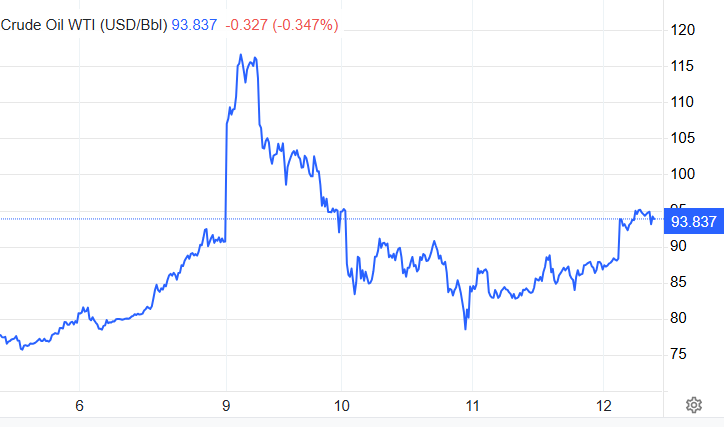
The escalating crisis has sent shockwaves through global energy markets. Oil prices surged earlier in the week, briefly approaching $120 per barrel before pulling back to around $90.
However, renewed tensions pushed crude higher again on Wednesday. Prices climbed nearly 5% during the session and currently hover near $94 per barrel—an increase of roughly 8% in a single day.
Energy markets remain highly sensitive to developments in the Middle East, particularly any threat to supply routes or production infrastructure. Iranian military officials have warned that continued instability could send oil prices dramatically higher, potentially reaching extreme levels if regional security deteriorates further.
Also Read: Trump Hints at Iran Peace Talks as War Escalates and Oil Prices Swing
While Trump’s declaration of victory signals confidence in the U.S. military campaign, the broader conflict with Iran is clearly ongoing. With retaliatory attacks unfolding and oil markets reacting sharply, geopolitical uncertainty continues to ripple across global financial systems.
For now, investors and policymakers alike are closely watching developments in the Middle East, where the next move could shape energy prices, market sentiment, and international security in the weeks ahead.
Disclaimer: The information in this article is for general purposes only and does not constitute financial advice. The author’s views are personal and may not reflect the views of Chain Affairs. Before making any investment decisions, you should always conduct your own research. Chain Affairs is not responsible for any financial losses.

I’m your translator between the financial Old World and the new frontier of crypto. After a career demystifying economics and markets, I enjoy elucidating crypto – from investment risks to earth-shaking potential. Let’s explore!