
|
Getting your Trinity Audio player ready...
|
The anticipation surrounding the Pi Network mainnet launch has given way to mounting concerns as May 2025 draws near. Once hailed as a revolutionary mobile mining project, Pi Network now finds its native token, Pi Coin, at a critical juncture. Following an initial surge to $3 after its mainnet debut, the cryptocurrency has experienced a significant downturn. As of late April 2025, Pi Coin has depreciated to approximately $0.6077, marking a 15% loss in the past month alone. This conspicuous decline stands out against the broader cryptocurrency market, where major tokens like Bitcoin are currently gaining momentum, leaving early Pi investors increasingly frustrated.
Fading Momentum and Lingering Challenges
According to Bitget Wallet COO Alvin Kan, the initial excitement surrounding Pi Network stemmed from its novel mobile mining concept and community referral system. However, this initial momentum has waned. The project now grapples with fundamental challenges that are hindering its growth and price stability.

Limited listings on major cryptocurrency exchanges restrict accessibility for potential investors, while a lack of tangible real-world utility and poor liquidity further dampen demand. These factors collectively make it difficult for Pi Network to attract new buyers and retain existing holders, contributing to the ongoing price erosion.
Technical Indicators Signal Further Downside Risk
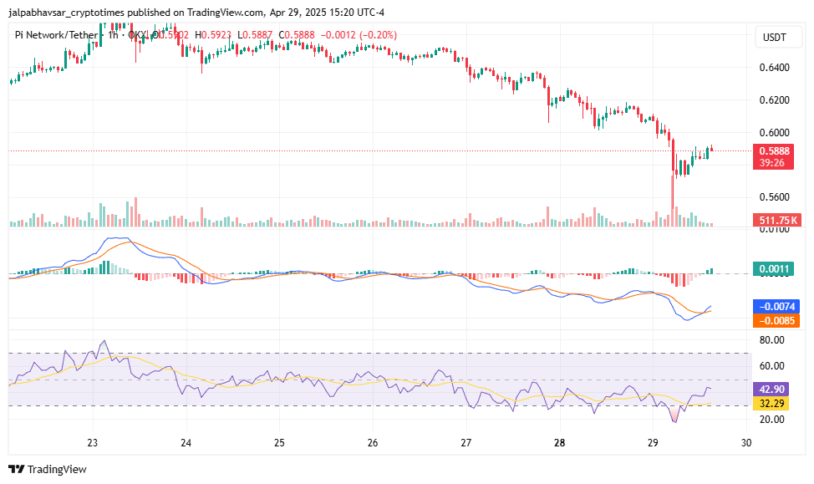
Technical analysis paints a concerning picture for Pi Coin’s immediate future. While the Chaikin Money Flow (CMF) indicates that some capital is still entering the Pi ecosystem, the overall flow remains negative, signifying stronger selling pressure than buying interest. This dynamic suggests that any short-lived price gains are likely to be swiftly negated by subsequent sell-offs. Furthermore, Pi’s Relative Strength Index (RSI) is nearing oversold territory at 38, and the Moving Average Convergence Divergence (MACD) is on the verge of turning negative.
These indicators collectively point towards a potential continuation of the downward trend. Currently trading within a narrow range of $0.59 to $0.67, Pi Coin is now testing the lower boundary, increasing the risk of a further decline towards $0.5192 or even its all-time low of $0.40. Adding to the pressure, significant token unlocks are scheduled.
In April alone, 21.4 million PI tokens (valued at over $12 million) were released into circulation. Over the next year, monthly unlocks are projected to average a substantial 131 million tokens. This influx of new supply will likely exert further downward pressure on the price unless a significant surge in demand materializes. Without a token burn mechanism or substantial ecosystem developments that drive utility, the prevailing selling pressure is expected to persist.
Also Read: Can You Really Spend Pi Coin in 2025? Here’s What You Can (and Can’t) Buy
Path to Recovery Hinges on Utility and Adoption
Despite the current bearish sentiment, Pi Network still has a potential pathway to recovery. A decisive break above the $0.8727 resistance level, establishing it as a new support, would signal a potential trend reversal. However, achieving this crucial milestone necessitates a fundamental shift in the project’s focus. To demonstrate long-term value and attract sustainable demand, Pi Network must prioritize the development and implementation of practical use cases and secure broader market access through more exchange listings.
A utility-first approach, coupled with meaningful integrations within both the retail and decentralized finance (DeFi) sectors, appears to be the most viable strategy for Pi Network to regain investor confidence and reverse its current price trajectory.
Disclaimer: The information in this article is for general purposes only and does not constitute financial advice. The author’s views are personal and may not reflect the views of Chain Affairs. Before making any investment decisions, you should always conduct your own research. Chain Affairs is not responsible for any financial losses.

I’m your translator between the financial Old World and the new frontier of crypto. After a career demystifying economics and markets, I enjoy elucidating crypto – from investment risks to earth-shaking potential. Let’s explore!