|
Getting your Trinity Audio player ready...
|
- Iran’s Bitcoin mining power fell 77% due to infrastructure damage from military conflict.
- The global Bitcoin network remained stable near 1,000 EH/s despite the disruption.
- Broader hashrate decline is driven more by falling Bitcoin prices than geopolitics.
Iran’s share of global Bitcoin mining power has sharply declined, highlighting how geopolitical tensions can disrupt localized crypto infrastructure—without shaking the broader network. New data shows the country’s hashrate dropped from about 9 exahashes per second (EH/s) to just 2 EH/s over the past quarter, as military strikes damaged critical power systems and forced hundreds of thousands of machines offline.
Despite the steep regional contraction, the global Bitcoin network has remained resilient, underscoring the strength of its decentralized design.
Infrastructure Damage Triggers Mining Shutdown
The hashrate collapse follows months of escalating conflict involving Iran, the United States, and Israel. Airstrikes targeting infrastructure disrupted electricity supply to industrial mining farms, many of which rely on stable, subsidized power.
Since legalizing Bitcoin mining in 2019, Iran had built a competitive mining sector by leveraging cheap energy—particularly hydroelectric power. This model allowed operators to generate revenue while bypassing traditional financial systems affected by sanctions.
However, that advantage quickly disappeared once grid reliability became uncertain. Estimates suggest roughly 427,000 mining rigs went offline during the disruption, wiping out around 7 EH/s of capacity.
Global Network Holds Steady Despite Shock
While Iran’s decline is significant locally, its global impact has been minimal. The total Bitcoin network hashrate has hovered near 1,000 EH/s, meaning the lost capacity represents less than 1% of global mining power.
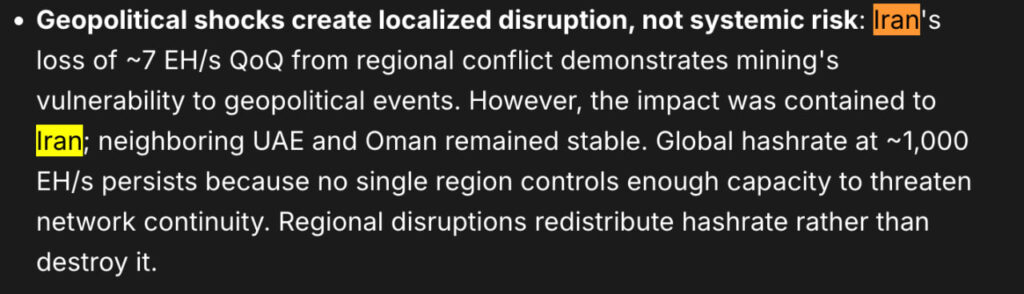
This stability reflects a core feature of Bitcoin’s design: geographic distribution. When one region drops offline, mining activity shifts elsewhere rather than collapsing entirely.
Neighboring countries like the United Arab Emirates and Oman have not experienced disruptions, suggesting the impact has remained contained within Iran.
Price চাপ, Not Conflict, Drives Broader Decline
Although Iran’s situation grabbed attention, analysts point to market conditions as the bigger factor behind global mining slowdown. Bitcoin’s price has fallen more than 45% from its all-time high, squeezing miner profitability.
As a result, older and less efficient machines—accounting for an estimated 252 EH/s globally—have been shut down. This has contributed to a broader 5.8% decline in the network’s average hashrate over the quarter.
Bitcoin’s built-in difficulty adjustment mechanism, which recalibrates every two weeks, ensures block production remains steady regardless of these fluctuations. The system can absorb shocks like Iran’s decline with little disruption to transaction processing.
Iran’s mining collapse marks the sharpest regional decline since China’s 2021 crackdown, but the scale is far smaller. Unlike that event, which temporarily removed over half the network’s hashrate, this episode has not triggered widespread instability.
Also Read: Iran Bypasses Dollar With Crypto Toll System—What It Means
Instead, it reinforces a key takeaway: Bitcoin’s security doesn’t depend on any single country. Even significant regional disruptions are quickly balanced by the network’s global distribution.
As a fragile ceasefire emerges, attention now turns to whether Iran can restore its infrastructure—and whether its mining sector can recover in an increasingly competitive and price-sensitive environment.
Disclaimer: The information in this article is for general purposes only and does not constitute financial advice. The author’s views are personal and may not reflect the views of Chain Affairs. Before making any investment decisions, you should always conduct your own research. Chain Affairs is not responsible for any financial losses.

I’m your translator between the financial Old World and the new frontier of crypto. After a career demystifying economics and markets, I enjoy elucidating crypto – from investment risks to earth-shaking potential. Let’s explore!