
|
Getting your Trinity Audio player ready...
|
- Iran’s domestic crypto trading volume collapsed by nearly 80% due to internet blackouts and central bank restrictions on the USDT–toman pair.
- Massive, rapid outflows from major Iranian exchanges like Nobitex surged by 700%, signaling that citizens are moving assets to safety.
- Despite initial fears, Bitcoin and the broader crypto market have bounced back, largely driven by retail sentiment and “buy the dip” positioning.
The crypto sector has always touted its resilience against centralized control, but recent events in the Middle East have put that theory to a stern test. Following the U.S.–Israeli airstrikes on Iran—which claimed the life of its supreme leader—financial markets have experienced intense volatility. While global digital assets have begun a sharp recovery, the situation inside Iran tells a starkly different story of paralysis and capital flight.
A Domestic Market in Lockdown
Within Iran’s borders, the cryptocurrency ecosystem has effectively been forced into a defensive posture. Data from blockchain research firm TRM Labs highlights a drastic contraction: trading volume across local exchanges plummeted by nearly 80% in the immediate aftermath of the strikes, spanning February 27 through March 1.
The primary catalyst for this freeze wasn’t just panic, but total infrastructure failure. Following the military action, widespread internet blackouts rendered platforms inaccessible for the average user. In a bid to manage extreme volatility, Iran’s central bank reportedly ordered platforms to halt trading on the USDT–toman pair—a critical lifeline connecting digital assets to the local fiat currency.
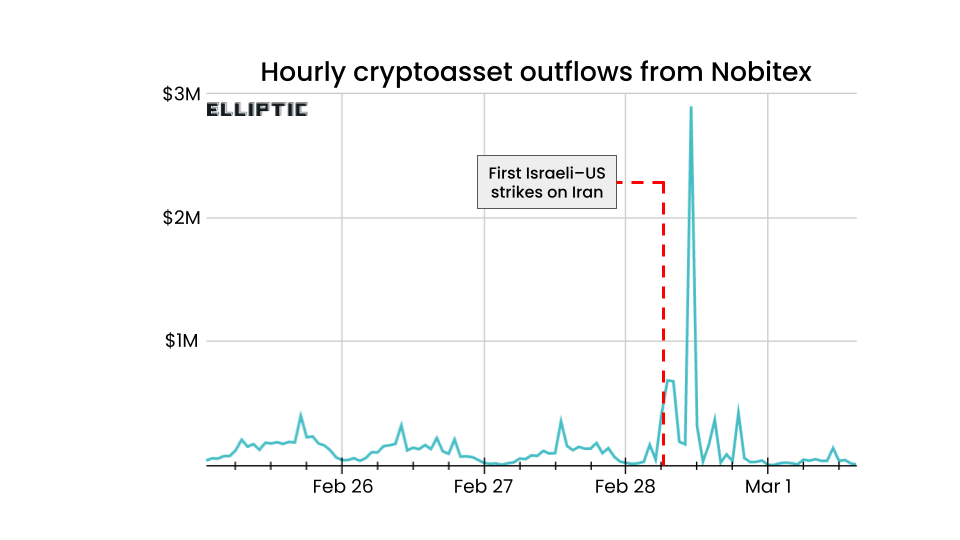
While exchanges remain operational, they are now running in a “risk-managed” state. Users have faced tighter controls and delayed withdrawals, a common reaction when infrastructure is under duress. Meanwhile, analytics from Elliptic suggest a massive shift in capital, with a 700% spike in outflows from Nobitex, Iran’s largest exchange, as citizens scrambled to move assets beyond national borders.
The Global Rebound: Sentiment or Strength?
Outside of Iran, the narrative has been defined by rapid recovery. Bitcoin, which initially dipped toward the $63,000 level as news of the conflict broke, has since surged back toward $70,000. Total crypto market capitalization has regained ground, climbing back above $2.38 trillion.
Also Read: Bitcoin Crashes Below $68K as Trump Signals Longer Iran War — Is More Pain Ahead?
Market analysts point to a “buy the rumor, sell the news” dynamic. Investors who offloaded risk-on assets ahead of the escalation are now re-entering the market, betting that the worst of the economic damage has been contained. On-chain data from Santiment suggests that this rally is heavily sentiment-driven—retail investors, sensing a floor, sparked a massive buying wave that pushed prices higher within hours.
The Road Ahead
Whether this current recovery signals a true breakout or remains a fragile “dead-cat bounce” depends on the shifting geopolitical landscape. While institutional players like Michael Saylor’s Strategy and BitMine continue to accumulate, the market remains hypersensitive. As long as tensions remain high, crypto prices will likely remain chained to the latest headlines, fluctuating with every update on ceasefires and diplomatic posturing.
Disclaimer: The information in this article is for general purposes only and does not constitute financial advice. The author’s views are personal and may not reflect the views of Chain Affairs. Before making any investment decisions, you should always conduct your own research. Chain Affairs is not responsible for any financial losses.

I’m a crypto enthusiast with a background in finance. I’m fascinated by the potential of crypto to disrupt traditional financial systems. I’m always on the lookout for new and innovative projects in the space. I believe that crypto has the potential to create a more equitable and inclusive financial system.