
|
Getting your Trinity Audio player ready...
|
- Iran’s crypto trading volume fell 80% amid military strikes and internet restrictions.
- TRM Labs says the decline reflects access limits, not systemic failure.
- Conflicting data from Elliptic raises questions about potential capital flight.
Crypto trading activity in Iran has collapsed by roughly 80% following recent U.S. and Israeli military strikes, according to a new report from TRM Labs. The sharp contraction, recorded between February 27 and March 1, coincided with widespread internet disruptions that limited users’ ability to access exchanges.
Despite the dramatic drop in transaction volume, analysts say the country’s crypto infrastructure has not suffered a systemic breakdown. Instead, the data suggests a temporary freeze driven by connectivity blackouts and precautionary measures taken by local platforms.
Internet Blackouts Trigger Sudden Trading Freeze
TRM Labs linked the 80% decline directly to severe connectivity issues that began shortly after military operations intensified on February 28. With access to online platforms restricted, traders were effectively locked out of the market.
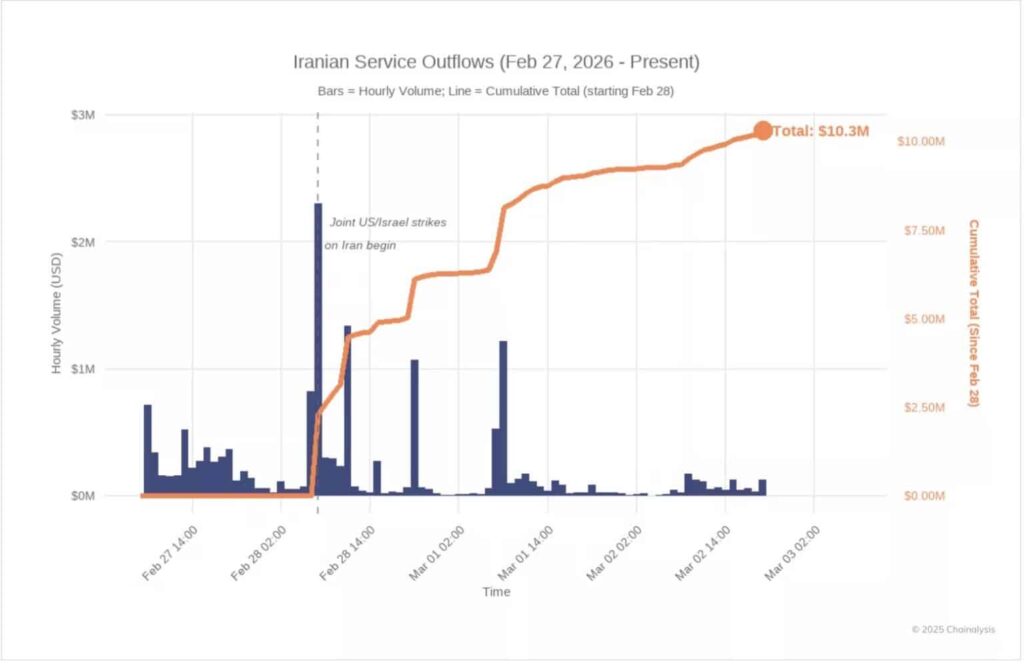
The report characterizes the situation as “risk containment mode,” rather than a collapse of blockchain networks or exchange insolvency. In practical terms, users could not execute trades—not because liquidity vanished entirely, but because internet access was disrupted.
This pattern is common in conflict zones, where infrastructure limitations can temporarily choke digital asset activity without damaging the underlying networks.
Conflicting Signals on Capital Flight
Interpretations of capital movement during the crisis differ. Blockchain analytics firm Elliptic reported a 700% surge in outflows from Nobitex, Iran’s largest exchange, raising questions about possible capital flight.
However, TRM Labs offered a more measured assessment. It found that Nobitex processed roughly $3 million in combined inflows and outflows during the period—figures it described as not unusual within normal operating ranges.
The firm cautioned against interpreting the data as evidence of a mass exodus, arguing that access restrictions likely distorted transaction patterns.
Central Bank Steps In to Contain Risk
Iran’s central bank reportedly instructed major exchanges, including Nobitex, Wallex, and Tabdeal, to suspend trading of the USDT-toman pair—the primary bridge between crypto and local currency.
When trading resumed, order books were thinner and price discrepancies widened, reflecting impaired liquidity. Still, exchanges remained operational. Platforms implemented batched withdrawals and issued risk advisories to users, signaling an effort to preserve stability rather than manage insolvency.
Also Read: Iran Strikes Send Crypto Into Chaos: What You Need to Know
For now, analysts say it is too early to determine whether lasting damage has been done. Much will depend on the restoration of full internet connectivity and the normalization of trading flows.
The divergence between Elliptic and TRM Labs highlights the difficulty of analyzing crypto markets in sanctioned and conflict-affected regions. Yet the core takeaway remains clear: Iran’s crypto slowdown appears driven by access limitations and defensive controls—not by a structural failure of its digital asset ecosystem.
Disclaimer: The information in this article is for general purposes only and does not constitute financial advice. The author’s views are personal and may not reflect the views of Chain Affairs. Before making any investment decisions, you should always conduct your own research. Chain Affairs is not responsible for any financial losses.

I’m your translator between the financial Old World and the new frontier of crypto. After a career demystifying economics and markets, I enjoy elucidating crypto – from investment risks to earth-shaking potential. Let’s explore!