
|
Getting your Trinity Audio player ready...
|
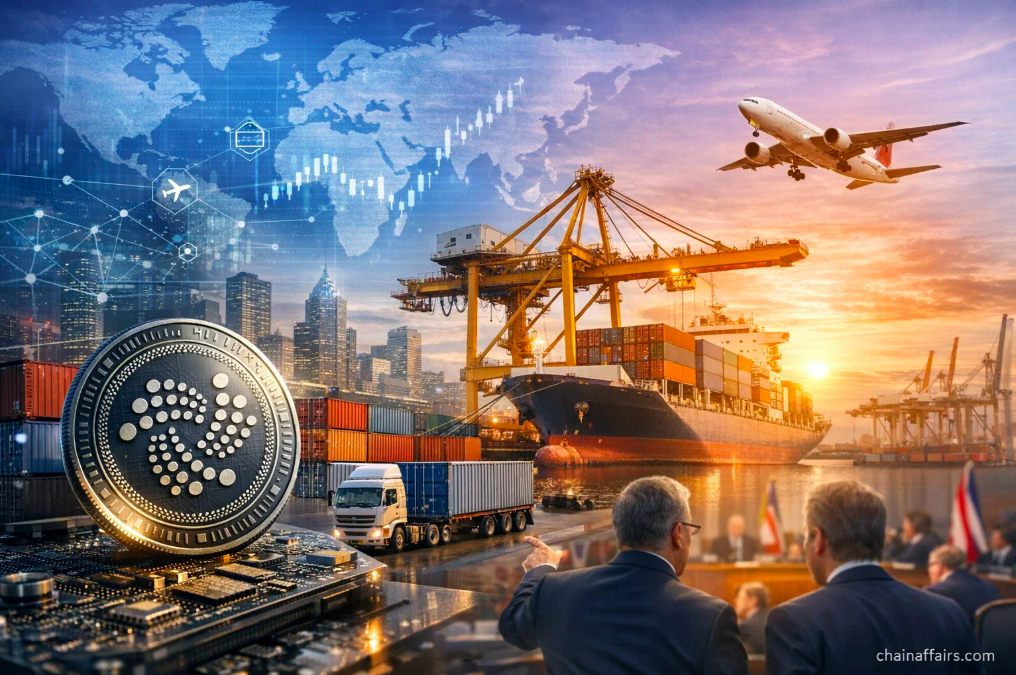
IOTA is no longer pitching a vision. It’s shipping infrastructure — and the institutions it has spent years courting are starting to sign on.
The IOTA Foundation has laid out a detailed roadmap to bring the global trade economy onto public blockchain infrastructure, anchored by tokenized assets, digital identity, and verifiable data. Co-founder Dominik Schiener has been explicit about the framing: this is not a crypto speculation play. It is an infrastructure build targeting the systems that move physical goods across borders — systems that, despite handling tens of trillions of dollars annually, still depend heavily on paper, manual checks, and disconnected databases.
To signal the shift, IOTA recently overhauled iota.org, reorganizing its activity into five enterprise focus areas: real-world asset tokenization, trade and supply chains, digital identity, product lifecycle integrity, and decentralized finance. The update is less a rebrand than a public inventory of what the network is actually building.
TWIN and ADAPT: From Pilots to Infrastructure
The Trade Worldwide Information Network — TWIN — is already live. In Kenya, it began with flower exports and is expanding to cover all commodities in 2026. In the United Kingdom, over 2,000 poultry consignments traveling between Poland and Britain have been logged on the IOTA mainnet, cutting through customs and regulatory paperwork in the process. Each shipment generates around 26 on-chain transactions; digitizing just 1% of global trade would produce over 650 million mainnet transactions annually.
The more structurally significant deployment is ADAPT, built alongside the AfCFTA Secretariat, the Tony Blair Institute, and the World Economic Forum. The initiative targets trade digitization for 1.5 billion people across Africa by 2035, with border clearance times expected to fall from 14 days to hours and cross-border payment fees potentially dropping by more than half.
A Growing Ecosystem With Real Deployments
Beyond TWIN and ADAPT, IOTA’s enterprise ecosystem is gaining depth. Salus tokenizes critical mineral shipments by issuing key trade documents as NFTs on the IOTA ledger, with smart contracts automating title transfer, collateral handling, and payment execution. Orobo handles digital product passports. ObjectID covers verification for physical goods. On the identity side, Impierce and Turing Space provide credential issuance and verification using W3C-aligned standards for reusable, privacy-preserving authentication.
CMO Karen O’Brien put the strategic logic plainly: crypto wins not through speculation, but by solving real economic problems. IOTA’s bet is that trade, identity, and tokenized assets represent that problem set — and that governments, not retail investors, are the right customers.
The ASEAN Frontier
Southeast Asia is the next growth target. Negotiations with several ASEAN nations are entering advanced stages, with some countries already preparing formal agreements. The region’s 650 million inhabitants and increasingly developed tokenization legislation make it a logical fit for on-chain trade infrastructure. Momentum is building, even if progress across individual markets remains uneven.
Also Read: IOTA’s “Digital Highway” Is Quietly Rebuilding How the World Moves Goods Across Borders
At the network level, IOTA’s 2025 transition to a Move-based Layer 1 introduced deflationary tokenomics — burning transaction fees and requiring token deposits for digital asset storage — alongside an 11% APY staking reward designed to reinforce long-term utility as enterprise adoption scales.
The infrastructure is live. The question now is how fast the institutions can move.
Disclaimer: The information in this article is for general purposes only and does not constitute financial advice. The author’s views are personal and may not reflect the views of Chain Affairs. Before making any investment decisions, you should always conduct your own research. Chain Affairs is not responsible for any financial losses.

I’m your translator between the financial Old World and the new frontier of crypto. After a career demystifying economics and markets, I enjoy elucidating crypto – from investment risks to earth-shaking potential. Let’s explore!
